Rental Owner Onboarding: What Happens After You Hire a Manager
November 9, 2026
Rental owner onboarding is the stretch between saying yes to a property manager and the day your home is rented, or your existing tenants are fully handed over, under that manager’s care. It covers the agreement, your documents, a property walkthrough, a rent and market review, the setup of money and records, and a clear map of who decides what. Done well, it takes a few focused conversations from you and then gets out of your way.
This guide walks through each stage in order, explains what to have ready, and shows where owners most often lose time. It is written for investors adding a property, homeowners renting out a house for the first time, and anyone comparing how managers start a relationship.
TL;DR
- Onboarding runs in a fixed order: discovery conversation, agreement, document and key handover, walkthrough and rent analysis, financial and tenant setup, then launch.
- Most delays come from missing paperwork, unclear repair approval limits and an unfinished property, not from the manager.
- Before you sign, settle three numbers: the repair approval ceiling, the reserve balance and the reporting schedule.
- Pre-1978 homes carry federal lead paint disclosure duties, so ask your manager how they handle them.
- A completed intake form on day one is the single best way to shorten the process.
Table of Contents
- What owner onboarding actually covers
- Step 1: The discovery conversation
- Step 2: The management agreement
- Step 3: Documents and information to prepare
- Step 4: The property walkthrough
- Step 5: Rent analysis and leasing plan
- Step 6: Setting up money, records and maintenance
- How long onboarding takes and what slows it
- Switching from a previous manager
- Our perspective
- Work with a team that handles the handoff
- A short owner checklist
- FAQ
- Sources
What owner onboarding actually covers
Hiring a manager does not make you a passive bystander. Fannie Mae’s guide for new landlords notes that a manager’s duties may include marketing units, selecting tenants, maintaining the building, budgeting, tenant relations and collecting rent, and that the owner remains responsible for hiring and supervising the manager. Onboarding is where that supervision is set up: you define what the manager does, what they may spend, and what you see every month.
Think of it as five jobs happening in parallel:
- Legal setup: the management agreement, tax forms, insurance details.
- Property knowledge: keys, access, systems, warranties, known quirks.
- Market positioning: the rent, the condition standard, the leasing plan.
- Money and records: accounts, owner statements, reserves, vendor payments.
- Tenant handoff: existing leases and deposits, or a marketing plan for a vacant unit.
A vacant home skips the last handoff and goes straight into leasing. A rented home skips marketing but needs more records. Either way, the five jobs are the same.
Step 1: The discovery conversation
The first call is about your goals, not the paperwork. A good manager asks what you want from the property: steady monthly cash flow, appreciation, a hands-off hold while you live elsewhere, or a build-to-rent position inside a larger portfolio. Your answer shapes everything from the rent strategy to how quickly you want repairs approved.
Come ready to answer:
- Is the property vacant, owner-occupied or already leased?
- Is there a mortgage, an HOA or a ground lease with rules about renting?
- What is your target rent, and what is the minimum that covers your costs?
- How much do you want to be consulted on repairs and tenant decisions?
- Are you planning improvements before leasing?
If you are weighing whether you need a full manager or only leasing help, our overview of what a property manager will do for you lays out the day-to-day scope.
Step 2: The management agreement
The agreement is the most important document in onboarding because it fixes the boundary between your role and the manager’s. Read it slowly. The items below deserve a line-by-line check.
Authority and spending limits
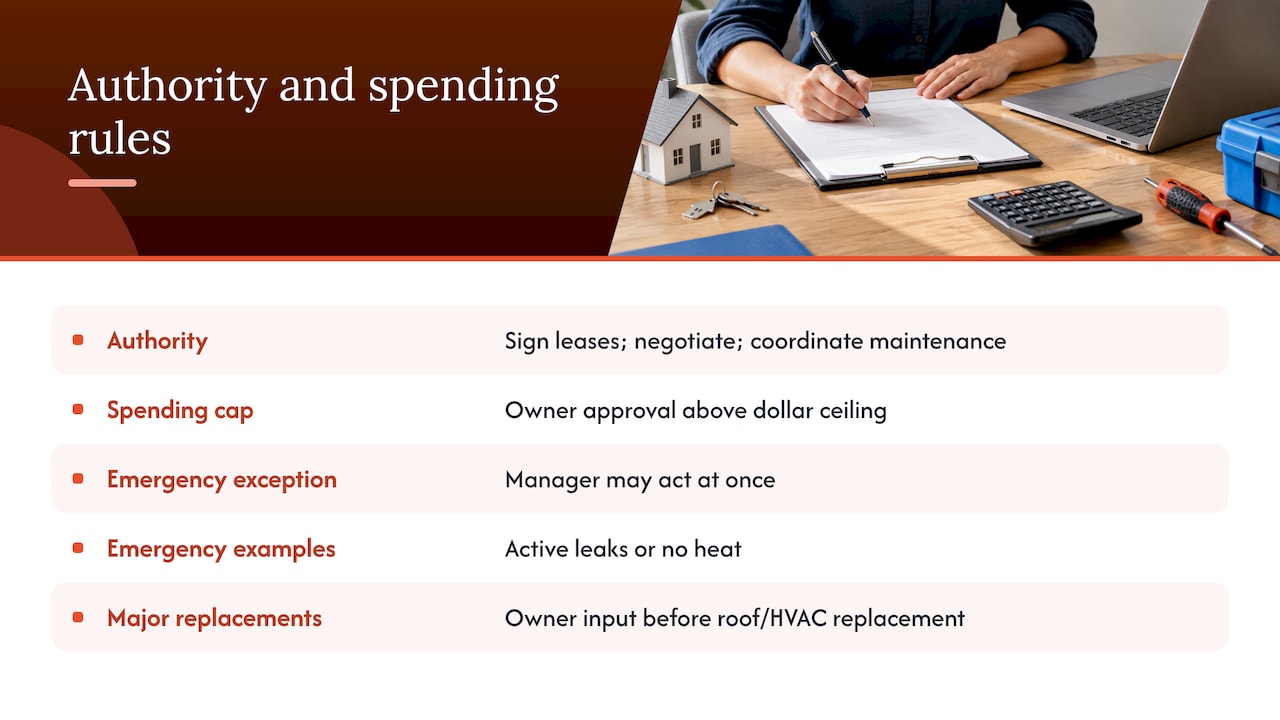
The agreement should state whether the manager may sign leases, negotiate rental terms and coordinate maintenance on your behalf. It should also set a dollar ceiling above which the manager must ask you before spending. There is no universal number: a small single-family rental and a 40-unit building need different limits. Pick a figure that lets a broken water heater get fixed the same day without a phone tag, and that gives you a say before a roof or HVAC replacement. Emergencies, such as active leaks or no heat, are usually carved out so the manager can act at once. Make sure the agreement says so.
Fees
Management arrangements generally combine a monthly management fee with other charges such as a leasing fee and maintenance coordination fees. Ask for every fee in a single schedule so you can model your net return. Our fees depend on the property type and market, so we quote them for your specific home or portfolio rather than publishing one number.
Reporting and accounting
Confirm that you will receive monthly owner statements showing income, expenses and any reserve balance, and agree on how you access them. Look for specific duties listed in the agreement, so both sides know where the manager’s job ends and yours begins. Vague language such as “general management” is where disputes start.
Term and exit
Check the length of the agreement, how either side can end it, any termination fee, and what happens to tenant deposits and records when it ends. A manager confident in the service will not hide these terms.
Because rules for licensing, trust accounts and contract contents vary by state, treat any checklist as a starting point. For legal questions about your contract in your state, ask a real estate attorney licensed there.
Step 3: Documents and information to prepare
The fastest onboardings are the ones where the owner arrives with a folder. Gather these before or right after signing.
| Category | What to have ready |
|---|---|
| Ownership | Deed or proof of ownership, entity documents if you hold title through an LLC, your tax ID and a completed W-9 |
| Insurance | Landlord or dwelling-fire policy declarations page, with your manager listed as needed |
| Property history | Year built, age of roof, HVAC and water heater, recent repairs, known issues |
| Access | All keys, garage openers, gate codes, lockbox details, smart-lock logins |
| Warranties and manuals | Appliance and system warranties, home warranty plan if any |
| Rules | HOA documents, rental restrictions, parking and pet rules, city rental registration or permit requirements |
| Existing leases | Signed leases, addenda, deposit amounts and where they are held, tenant contact details, payment history |
| Banking | Account details for owner payouts |
| Preferences | Pet policy, smoking policy, preferred vendors, who may enter the property |
We publish a property intake form that captures most of this in one pass. Filling it out before the walkthrough means the visit can focus on the home itself instead of collecting basics.
Pets and special policies
Decide your pet policy early, because it changes your tenant pool and the screening criteria used at placement. Our post on property management and pets walks through the trade-offs so you can set the rule before listing day.
Federal disclosure for older homes
If your home was built before 1978, the EPA’s lead-based paint rule applies. The Lead-based Paint Disclosure Rule requires landlords and property managers to give specific information about known lead-based paint and hazards before a renter signs a lease, with a few exemptions such as housing certified lead-paint free. Tell your manager what you know about the home’s paint history and any past testing so the right disclosure goes into the lease packet.
Step 4: The property walkthrough
The walkthrough is where a manager turns your paperwork into a plan. Expect a detailed, room-by-room visit that is documented with dated photos and notes. That record later protects you when a security deposit is discussed.
What gets checked:
- Condition of finishes: flooring, paint, walls, fixtures, windows and screens.
- Major systems: HVAC age and filter condition, water heater, plumbing under sinks, electrical panel, smoke and carbon monoxide detectors.
- Exterior: roof and gutters, drainage, fencing, landscaping, irrigation, driveways, any pool or outdoor structures.
- Safety items: handrails, stairs, locks, lighting and egress. If children will live in the home, stairs are a common concern; some tenants look into stair childproofing options for renters, and it helps to decide up front what modifications your lease allows.
- Make-ready list: what needs to be repaired, cleaned or replaced before photos are taken.
The outcome should be a written list divided into three groups: must fix before leasing, worth doing for better rent, and can wait. If the work is larger than touch-up, a renovation oversight service can scope bids and supervise contractors so you are not managing a crew from afar. We cover that under project management.
Step 5: Rent analysis and leasing plan
A rental market assessment compares your home to similar properties nearby that are active or recently leased, adjusting for size, condition, amenities and location. It should give you a recommended rent and a realistic range, plus an expected time to lease at each price point.
Ask to see how the number was built. A good analysis shows the comparable homes, not just the conclusion. Then agree on:
- The listing price and the date you will review it if there are no applications.
- Screening criteria: income multiple, rental history, credit and background standards, applied consistently to every applicant.
- Lease term and target move-in window. Many owners aim for a lease that expires in a stronger leasing season in their market.
- Marketing channels and photography.
Fair housing law applies to every step of tenant selection, so consistent written criteria protect both you and the manager.
Step 6: Setting up money, records and maintenance
This stage is the quiet backbone of the arrangement, and it is where a manager’s systems matter most.
Payments and reserves
You will typically agree on a reserve balance the manager holds for routine repairs, so small costs do not need a fresh transfer each time. You also set the payout schedule and confirm the payout bank details. Tenant security deposits are handled according to your state’s rules, so ask where they will be held and who is responsible for the return and accounting.
Owner portal and statements
Most owners prefer to see activity without calling. Make sure you receive portal access, know where to find statements, and understand how repair invoices and tax documents are delivered. At Auben, owners get access through our owner portal.
Maintenance setup
Agree on how requests come in, who triages them, and how vendors are chosen. Ask whether the manager has in-house maintenance, how outside vendors are selected, and whether you can request bids above your approval ceiling. Our approach uses in-house maintenance with transparent vendor selection, so you can see what was done and why.
Tenant records
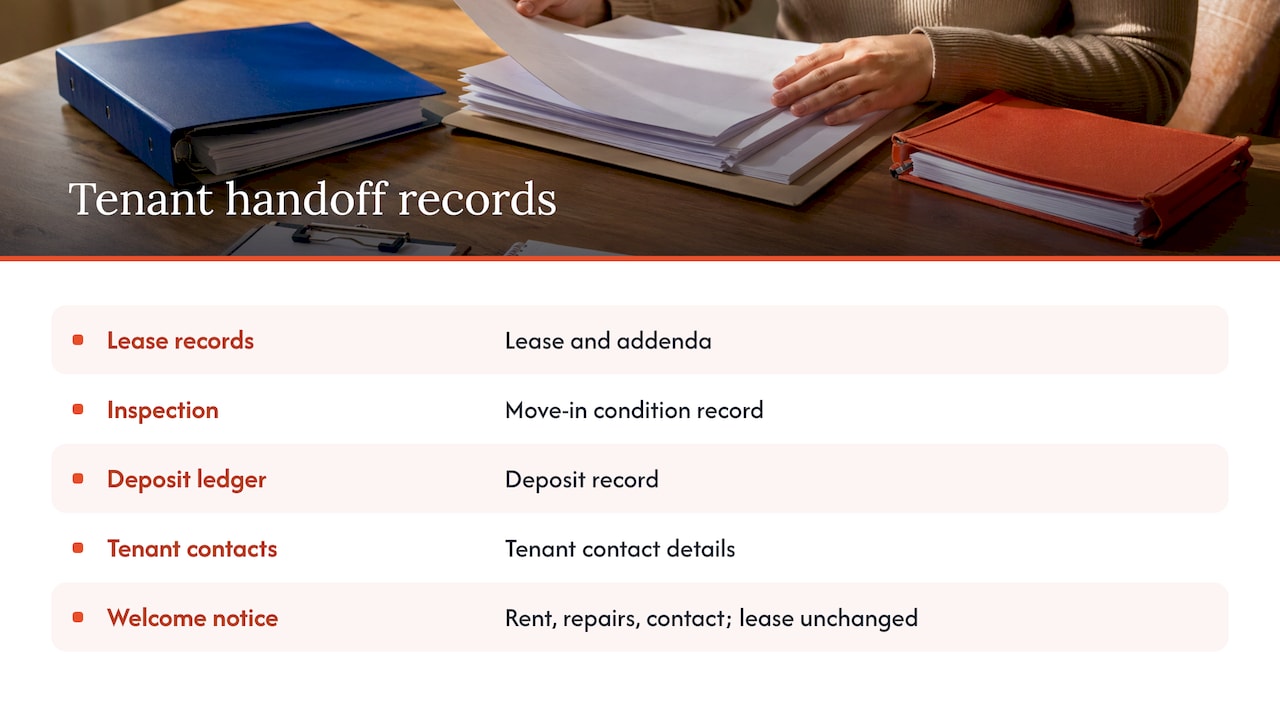
For an occupied property, the manager collects the lease, addenda, move-in inspection, deposit ledger and contact details, then introduces themselves to the tenants with a welcome notice that explains where to pay rent and how to submit a maintenance request. The tenants should hear a single, clear message about the change: new payment instructions, a new contact and an unchanged lease.
How long onboarding takes and what slows it
There is no standard clock. Timing depends on whether the home is vacant, how much repair work is needed, and how fast documents arrive. The common sources of delay are the same everywhere:
- Missing documents: a lost lease copy, an absent W-9 or unavailable HOA rules.
- Unresolved access: keys with a previous manager or a tenant who is not told about the change.
- Make-ready work: repairs that take longer than the leasing plan assumed.
- Open approvals: no agreed spending ceiling, so every small repair waits for an email reply.
- Slow decisions on rent: holding out for a number the market comparables do not support.
Owners who control these five things control most of the timeline. A well-run manager will give you a written checklist with owners and dates, so you can see what is waiting on whom.
Switching from a previous manager
If you are moving a rented property from another manager, add a transition plan. Give written notice according to your current agreement, request the full file (leases, ledgers, deposits, inspection reports, vendor contacts and keys), and confirm the date deposits are transferred. Have the new manager send tenants the new payment instructions before the first rent date so no payment goes to the wrong place.
Our perspective
Owners tell us the same thing after the first month: the agreement was the easy part, and the first 30 days were what shaped the relationship. We design onboarding so that you know who is responsible for what before the first repair request arrives.
At Auben, we combine local market expertise with investor-focused strategies. A pod-based team structure means a focused group handles your property, rather than a queue of unrelated staff. In-house maintenance and transparent vendor selection mean that repair decisions are visible to you. Proactive resident retention keeps good tenants longer, which protects your returns.
With more than 15 years of experience and 2,700 properties served across 10 regional markets, we have seen what makes a handoff smooth: complete information, a clear approval limit and honest rent expectations. Give us those three things and our technology and team handle the rest.
MediaBeast
Work with a team that handles the handoff
If you own single-family, multi-family or build-to-rent property in Charleston, Columbia, Fort Worth, Dallas-Fort Worth, Kansas City, Overland Park, Houston or Jacksonville, we can take the onboarding steps above off your plate: agreement, walkthrough, leasing plan and ongoing reporting. Start with our property management page, or see how asset management fits if you hold several properties.

If you are still deciding what to ask a manager, our common questions owners have and the post on key factors investors need to track are good places to build your list.
A short owner checklist
- Read the whole agreement and confirm the repair approval ceiling, fee schedule and exit terms.
- Send ownership, insurance, tax and banking documents.
- Hand over every key, code and warranty.
- Complete the intake form and share known problems honestly.
- Attend or approve the walkthrough list and decide what to fix before leasing.
- Review the rent analysis and agree on the screening criteria.
- Confirm portal access, reporting dates and payout schedule.
- For occupied homes, make sure tenants receive a clear notice about the change.
FAQ
Does onboarding mean I am hired?
Not exactly. Onboarding usually begins after you sign a management agreement, but you are the one who hires and supervises the manager. The discovery call and property review before that are about fit, and you decide whether to sign.
What documents does a manager need from me?
Expect to provide proof of ownership, a W-9, insurance information, keys and access codes, warranties, HOA rules and, for occupied homes, current leases and deposit details. A completed intake form covers most of the property details.
What should I approve during setup?
Approve the management fee schedule, the maximum repair amount the manager can spend without asking you, your reserve balance, your pet and screening policies, and the rent and make-ready plan. Also confirm how and when you receive statements.
Do I need to be at the property walkthrough?
You do not have to be, but your input helps. If you cannot attend, share known issues and past repairs in writing, and review the photos and the make-ready list afterward before approving work.
Do lead paint rules apply to my rental?
They apply to most private housing built before 1978. The EPA requires landlords and managers to provide specific lead hazard information before a lease is signed, so tell your manager the year built and any testing you know about.