Owner Statements in Property Management: How to Read One
October 25, 2026
An owner statement is the financial report your property manager sends you, usually monthly or quarterly, summarizing what the property earned and spent during a set period. It covers income, expenses, fees and what is left to pay out to you. If you own a rental and hand it to a manager, this one document is how you know whether the arrangement is working.
Most owners glance at the bottom number and file the PDF. That is a mistake. The statement is where a wrong fee, a duplicate invoice or an overstated reserve shows up first, and it is also the paper trail your tax preparer needs in April. This guide walks through every section, shows the math, and gives you a repeatable way to check a statement in about fifteen minutes.
TL;DR
- An owner statement summarizes cash collected, expenses paid, management fees, reserves and the net amount distributed to you for one period.
- Income counts only when the money is actually received. Unpaid rent normally does not appear as income.
- Check three things every month: the opening balance matches last month’s closing balance, every fee matches your management agreement, and every large expense has an invoice behind it.
- Keep the statements. The IRS expects you to keep records of rental income and expenses, and statements are the cleanest summary of both.
- If a charge is unfamiliar, ask for the invoice or work order in writing and compare it with what your agreement authorizes.
Table of Contents
- What an owner statement actually is
- What a good statement includes
- How the math works
- Cash, not what is owed
- Reading it against your tax return
- A fifteen-minute monthly check
- What to do when a charge looks wrong
- Our perspective
- Common mistakes owners make with statements
- How we handle owner reporting
- FAQ
- Sources
What an owner statement actually is
Think of it as a bank statement for your rental, written by the person who runs it. Your manager collects rent from the resident, pays the bills the property generates, takes the agreed fee, holds back any required reserve, and sends you the rest. The owner statement is the summary of that sequence.
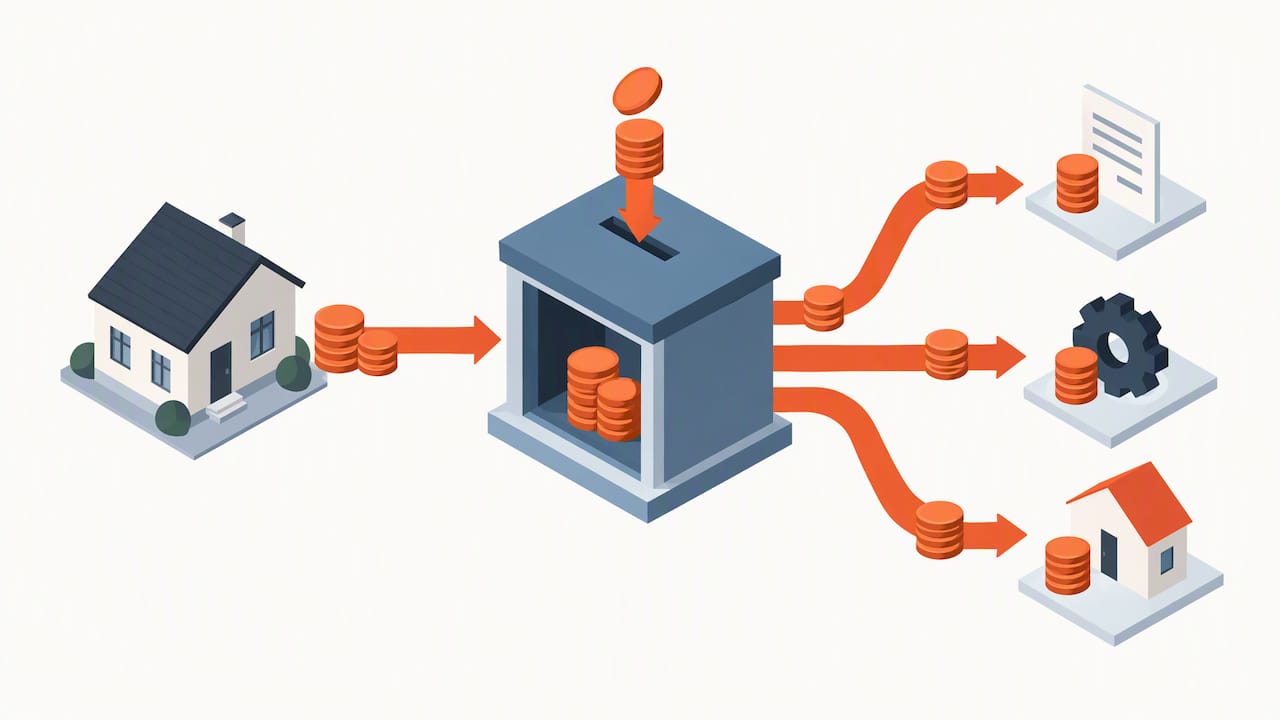
People use several names for the same thing: owner statement, owner report, landlord statement, property statement. In some contexts, “landlord statement” also means something different, such as a letter a landlord gives a tenant to confirm rent paid or a lease balance. Here we mean the report a manager gives an owner. If a manager sends a document with another name but it shows period income, expenses and your payout, it does the same job.
It is also usually one piece of a larger package. A statement is often accompanied by a transaction ledger, work order summaries, a rent roll and explanations for unusual activity. The statement tells you the totals. The supporting pages tell you why.
What a good statement includes
Formats vary, but a statement you can actually audit has the same building blocks. A standard sample statement opens with the statement period and date, the owner’s identification, the property addresses and a summary for each property. From there, look for the following.
Cash summary
This is the top block, and it answers one question: how much cash moved? It should show a beginning cash balance, additions (rental income, owner contributions, other additions), subtractions (expenses, owner draws, other subtractions) and an ending cash balance.
Income detail
Essential line items include rental income itemized by source, operating expenses such as maintenance, utilities and management fees, and net income or distributions. “Itemized by source” matters. Rent, late fees, pet fees, application fees and utility reimbursements should each appear on their own line, so you can tell a strong month from a month padded with one-time charges.
Expense detail
Each expense needs a date, a payee, a category and an amount. “Maintenance: $480” is a total, not an explanation. You want to see the vendor, what was done and which unit or property it applied to. This is where in-house maintenance teams and outside vendors both need to be transparent. We say more about that in the perspective section below.
Management fees and leasing fees
Fees should appear as separate lines, not buried inside “other.” A management fee is typically calculated on collected rent. A leasing fee is charged when a new resident is placed. Our own breakdown of how leasing fees and management fees differ shows why the two can add up to very different annual costs, and what owners should know about property management fees covers the usual fee structures.
Reserve and distribution
Most agreements ask the owner to leave a small reserve with the manager so routine repairs can be paid without waiting for a wire. The reserve is cash held for you, not money spent. The statement should show the reserve balance and the final distribution amount.
How the math works
The formulas are simple, and knowing them lets you check any statement yourself. Net income is total income minus total expenses and the management fee. The distribution is the prior balance plus net income, minus the reserve requirement.
Here is a worked example with made-up numbers for one single-family rental:
| Line | Amount |
|---|---|
| Rent collected | $2,100.00 |
| Late fee collected | $75.00 |
| Total income | $2,175.00 |
| Plumbing repair (invoice attached) | $215.00 |
| HVAC filter replacement | $28.00 |
| Total expenses | $243.00 |
| Management fee (8% of $2,175, illustrative rate) | $174.00 |
| Net income | $1,758.00 |
| Prior balance carried forward | $0.00 |
| Reserve requirement to be held | $0.00 (already funded) |
| Distribution to owner | $1,758.00 |
The 8% rate is only there to make the arithmetic visible. Your rate comes from your own agreement, and so does the base it applies to. If your agreement says the fee applies to rent only, and your statement applies it to rent plus late fees, that is a question worth asking.
Notice what is not in the table: the mortgage payment, property tax and insurance. Unless your manager pays those from the property account, they sit outside the statement, which means the net distribution is not your profit. It is the cash the property generated before your own carrying costs.
Cash, not what is owed
A common surprise for new owners: income on a statement refers to cash actually collected, so unpaid rent and outstanding receivables are typically not counted until the money arrives. If your resident pays late on the 12th, the rent appears on the statement for the period in which it was received, and you may see a quiet first month followed by a double month.
This also explains an odd situation for people who inherit a rental. A first statement may show only partial income because the transfer of the lease and deposits took weeks. If that is you, this walkthrough on renting out an inherited property covers the ownership side, and the statement then simply reflects whatever was collected after you took control.
The practical effect: when income looks low, check the resident ledger before assuming the manager made a mistake. Then look at delinquency and what the manager is doing about it.
Reading it against your tax return
Your statement and your Schedule E are cousins, not twins. A CPA-written explanation distinguishes gross rent and other income from management fees and repairs, treats reserve contributions as cash held rather than an expense, and treats owner distributions as transfers rather than income or expenses. That last point trips people up: the check that lands in your bank account is not your taxable income. The gross figures are.
The same CPA’s practical advice is to record gross activity rather than only the net bank draw, because netting income, fees, repairs and reserves hides both the economics and the tax treatment. We agree. Book the rent, the fee and each repair separately.
For federal purposes, the IRS says you should keep records of rental income and expenses and that ordinary and necessary expenses can include items such as mortgage interest, property tax, operating expenses, depreciation, repairs, advertising, maintenance, utilities and insurance. It also notes that improvements are generally recovered through depreciation rather than deducted as repairs. That has a direct consequence for your statement: if your manager lists a full roof replacement or a new water heater under “repairs,” tell your tax preparer, who may need to treat it as an improvement. The IRS explains in Publication 583 that good records help you monitor activity, identify the source of receipts, track deductible expenses and support your return.
This is general information, not tax advice. Your CPA decides how each line is treated for your situation.
A fifteen-minute monthly check
You do not need accounting training. Run the same short routine every month.
- Tie out the balance. Use the prior period’s ending balance as this period’s beginning balance. If they differ, stop and ask why.
- Match income to the lease. Does rent collected equal the lease amount times the number of paid units? Are late fees consistent with the lease terms?
- Match fees to your agreement. Fees should align exactly with the terms in your signed property management agreement. Read the fee schedule once, then compare each month.
- Sample the expenses. Pick the three largest and ask for invoices. Many statements include copies above a set dollar threshold, so find out what yours is.
- Check the payout. Compare the distribution on the statement with the deposit in your bank account. They should match to the penny.
- File it. The IRS asks owners to substantiate expenses with documents such as receipts, canceled checks or bills. Save the statement and its backup in one folder per property per year.
Once a quarter, add a second layer: compare year-to-date income and expenses with what you underwrote when you bought. Our guide on the key factors investors need to track lists the numbers worth watching.
What to do when a charge looks wrong
Start with a written question, not an accusation. Most surprises are miscoding, a vendor invoice that landed in the wrong month, or a charge you forgot you approved.
For an unfamiliar charge, ask the manager for the receipt, invoice or work-order record, and check that the agreement authorizes it. A useful message names the statement period, the line, the amount and what you want: “On the March statement, line 14, $640 to a vendor I do not recognize. Please send the invoice and the work order, and tell me which section of our agreement covers it.”
Then work through the likely causes in order:
- Timing. The expense belongs to a prior period but posted late.
- Coding. A capital item recorded as a repair, or an owner-paid item that should have been charged to the resident.
- Authority. The work exceeded the approval limit in your agreement and nobody asked you.
- Duplicate. The same invoice entered twice.
Corrections should come through as a visible adjustment on the next statement, with a note, not as a silent change to the old one. If a manager cannot produce documentation for a charge, that tells you something about the manager.
Where trust accounting fits
Rent you never touch sits in an account that legally belongs to you, not the manager. States regulate this. South Carolina’s Real Estate Commission, for example, explains that trust funds do not belong to the licensee and that a trust account must be separate from business or personal accounts, and the commission’s booklet says the licensee must be able to identify the exact amount in the account and the owner of each portion of it at all times. Rules differ by state, so check your own state’s real estate regulator for the standard that applies where your property sits. A tidy statement is the visible half of that discipline.
Our perspective
We manage and invest in single-family, multifamily and build-to-rent homes across ten regional markets, and we have seen owner statements from both sides of the desk. Our view is simple: a statement should let an owner reconstruct the month without calling anyone.
That shapes how we think about the work behind the numbers. A pod-based team structure means the people who handle your property’s leasing, maintenance and accounting questions are a small, consistent group rather than a rotating queue, so an unfamiliar line gets an answer from someone who knows the property. Maintenance handled in-house, with transparent vendor selection, means expenses on the page trace back to work we can describe and price. Proactive resident retention matters on the statement too: fewer vacancies and turnovers mean fewer leasing fees and make-ready costs eating into the distribution.
The best test of any manager, including us, is to ask to see a real statement before you sign, along with the supporting ledger. If the line items are specific and the fee lines match the proposed agreement, you are looking at a team that expects to be checked.
— MediaBeast
Common mistakes owners make with statements
Reading only the bottom line. A steady payout can hide rising repair costs offset by a one-time late fee. Compare category totals month over month.
Treating the distribution as income. As covered above, the transfer to your bank is not the same as taxable rental income.
Ignoring the reserve. If the reserve rises with no explanation, or your payout shrinks for several months running, ask what the target balance is and why.
Not reading the agreement. Every fee question ends at the signed agreement. Reread it when you onboard and once a year. Our post on common questions owners have about property management covers what the agreement should address.
Skipping the statement for out-of-state properties. Distance is the reason to read closely, not a reason to skip.
Letting the payout schedule float. Set the distribution schedule when you onboard, put it in writing and make sure each report references it. Without that, you have no benchmark for a late payment.
How we handle owner reporting
If you own rental property in Charleston, Columbia, Dallas-Fort Worth, Kansas City, Houston or Jacksonville and want a team that shows its work, see our property management services. For investors who need performance tracked across a portfolio, not just a single house, our asset management service looks at the numbers behind the statements. Tell us about your property and we will explain exactly what you would see each period and how fees apply.
FAQ
How often should I receive an owner statement?
Most managers send one monthly, and some send quarterly summaries for lower-activity properties. What matters is that the schedule is written into your agreement and that the payout follows it consistently. If yours is irregular, ask for the cadence in writing.
Is an owner statement the same as a landlord statement?
Often, yes: managers use “landlord statement” as another name for the report that summarizes income, expenses and your payout. The term can also mean a letter a landlord writes to confirm rent or lease details for a tenant, so check which one a request actually means.
Why is my distribution lower than the rent collected?
Expenses, the management fee and any reserve contribution come out before the payout. Start with the cash summary, then compare each category to the previous month. A single repair or a leasing fee on a new resident is the usual explanation.
Can I use my owner statements for taxes?
They are a strong starting point, because they itemize income and expenses by period, but they are not a tax return. Give your preparer the full year of statements plus supporting invoices, and let them decide how items such as improvements and depreciation are treated.
What if the statement shows no income for a month?
Check the resident ledger first. Statements count cash received, so late or missed rent means a zero or low month. Then ask what collection steps are underway and when the resident is expected to catch up.
Sources
- Owner Statement Report, DoorLoop Help Center
- Understanding the Owner Statement: What Every Line Means
- Owner Statement Template: Layouts for Single-Family
- Sample property statement, Buildium
- Owner Statement & Payout Guide
- Owner Statements to Schedule E, Taxstra
- IRS: Tips on rental real estate income, deductions and recordkeeping
- IRS Publication 583
- South Carolina Real Estate Commission Trust Account Booklet
- How to rent out an inherited property