Remote Landlord Management: How to Run a Rental From Afar
November 10, 2026
Remote landlord management means overseeing a rental you can’t reach in person. You keep the work that happens on a screen: marketing, screening, leasing, rent collection and bookkeeping. You hand the work that happens at the property, such as unit access, repairs and inspections, to a local team or to vetted vendors. Owners who do this well set up systems before the first problem arrives, and they don’t rely on a plane ticket when something breaks.
This guide covers what you can run yourself, what needs a local presence, how to build that support, and where owners most often get into trouble: screening, fair housing, emergencies and taxes.
TL;DR
- Administrative work (listing, screening, lease signing, rent collection, record keeping) can be done remotely. Physical work (repairs, inspections, access) needs someone local.
- Build the local layer first: primary and backup vendors for key trades, a written emergency plan and a named person who can walk the unit.
- Use one documented process for maintenance requests, with photos or video, so problems are triaged fast and nothing lives in text threads.
- Federal fair housing rules apply to you wherever you live, including when software screens applicants for you.
- If the workload or distance outgrows you, a full-service property manager takes over the on-site layer and keeps you in control of the numbers.
Table of Contents
- What you can run from a laptop and what you can’t
- Build your local layer before you need it
- Advertising, screening and signing a lease remotely
- Collecting rent and keeping clean books from a distance
- Handling maintenance, emergencies and inspections
- Software and communication habits that keep you in control
- Laws and taxes to check before you go remote
- When self-managing from afar stops making sense
- Our perspective on remote ownership
- Let us handle the on-site work
- FAQ
- Sources
What you can run from a laptop and what you can’t
The cleanest way to think about remote ownership is a split. One side is digital and can be done from anywhere. The other side is physical and needs a person within reach of the door. A landlord guide from Shuk Rentals describes the same division: keep the laptop tasks, delegate the on-site ones.
| Task | Can you do it remotely? | What you need |
|---|---|---|
| Marketing and listing | Yes | Good photos taken by someone local, a clear listing, a way to field inquiries |
| Tenant screening | Yes, with care | A written screening policy applied to every applicant |
| Lease signing and storage | Yes | Digital signing and a central records folder |
| Rent collection | Yes | Online payments into a dedicated account |
| Bookkeeping and tax records | Yes | Monthly categorizing and saved receipts |
| Routine repairs | No, but you can coordinate | Vetted local vendors |
| Emergencies | No, but you can plan | After-hours contacts and spending limits |
| Move-in and move-out inspections | No | A local person with a checklist and a camera |
The left column is where most owners do fine. The trouble usually starts in the physical rows, because a burst pipe at 11 p.m. doesn’t care that you’re two time zones away.
Build your local layer before you need it
Every remote setup rests on the people near the property. You need at least three kinds of contact:
- A local point person. Someone who can open the unit, meet a vendor, take dated photos and tell you what is really happening. This can be a trusted contact, a local professional or a property manager.
- Primary and backup vendors for the trades that cause the most urgent calls: plumbing, electrical, HVAC and general repair.
- An after-hours option. Someone must answer when a tenant reports a leak at night.
How to find vendors you can trust
Start with referrals. Local landlords, investor meetups, real estate professionals and your current vendors know who shows up and who doesn’t. Then vet each candidate before assigning any work:
- Confirm a current license and proof of insurance.
- Ask for at least three references and actually call them.
- Judge how clearly they communicate and how transparent their pricing is.
- Get several quotes for non-emergency work.
Contractors also pick their favorite customers. They tend to prioritize owners who pay promptly, send photos and details up front, and don’t haggle over every service call. Being that kind of client is the cheapest way to get a fast response when you’re far away.
Owners who want a structured way to track maintenance and contractors can use a tool built for that job. This landlord maintenance guide covers the legal and cost side of repairs, and it pairs well with the written processes below.
Advertising, screening and signing a lease remotely
Listing and leasing are the easiest tasks to move online. Photos, a floor plan and a clear description can bring in applicants without you ever visiting. Showings are the exception: someone local usually needs to be there, or you can offer a self-guided or video tour arranged through your point person.
Screen every applicant the same way
Set your criteria in writing before you list. That means minimum income, rental history requirements, what in a credit or background report is disqualifying, and how you treat each case. Apply them to everyone.
This matters legally. According to HUD’s 2024 guidance on the Fair Housing Act and tenant screening, housing providers remain responsible for discriminatory decisions even when an automated screening service produced the result. HUD also says providers should independently check whether information in a report is truly disqualifying under their own clear, public and consistent policies. The same guidance restates that the Fair Housing Act bars discrimination based on race, familial status and other protected classes, including discriminatory statements and biased screening criteria.
In practice, a remote owner should:
- Publish the criteria with the listing.
- Avoid ad language that signals a preference for or against any protected group.
- Review the underlying report, not just a pass or fail score.
- Keep a record of why each applicant was accepted or declined.
We walk through the whole sequence in our six-step tenant screening process, and our overview of fair housing for landlords explains what the law requires. If you’d rather not run screening yourself, here is how a property management company handles tenant screening.
Sign and store the lease digitally
Digital lease signing removes the need to meet in person. Keep the signed lease, move-in condition report, addenda and tenant contact details in one organized folder that you and your local contact can both reach. When a dispute comes up a year later, that folder is your evidence.
Collecting rent and keeping clean books from a distance
Rent collection is where remote ownership can be better than local ownership, because a good online system doesn’t depend on anyone’s presence. The practices that hold up:
- Collect through an online system, ideally ACH, that timestamps payments and can automate late fees.
- Use a dedicated bank account for the property so rental income and expenses never mix with personal money.
- Avoid cash and peer-to-peer apps for rent. They leave a thin paper trail.
- Save every receipt digitally and categorize expenses monthly.
- Reconcile monthly. Compare your records to the bank statement before small errors compound.
We lay out our own approach in the rent collection process we’ve shaped across 2,700 properties, and explain why a property manager should accept online rent payments.
Handling maintenance, emergencies and inspections
Maintenance is where distance hurts most, and where a written process helps most.
One front door for repair requests
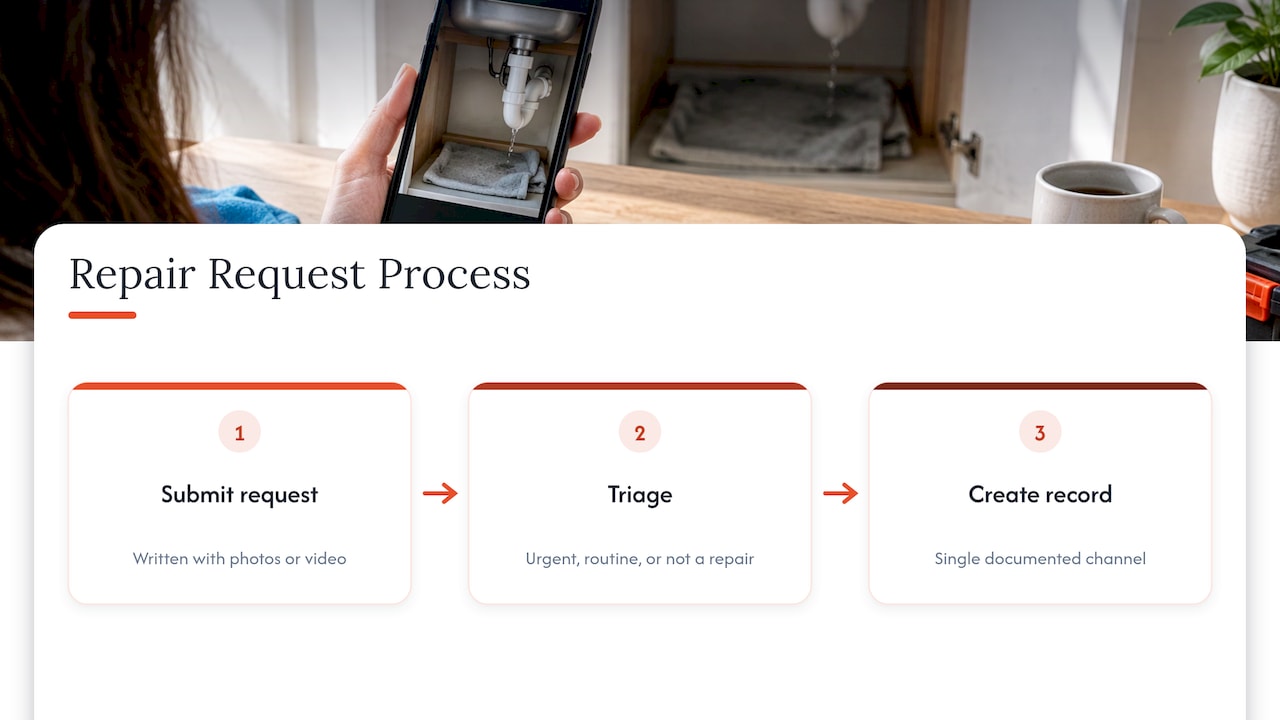
Tell tenants exactly how to report a problem, and accept it only that way. A written request with photos or video lets you or your coordinator triage quickly: urgent, routine or not a repair at all. Text threads and phone calls get lost. A single documented channel creates a record you can use later.
Define emergencies in writing
An emergency plan should answer these questions before anything happens:
- What counts as an emergency (active leak, no heat in winter, gas smell, loss of power, security issue)?
- Who does the tenant call, and who answers after hours?
- Which vendors are on call at night?
- How much can the local contact spend without your approval?
- When do you need to hear about it?
Put this in the lease package so tenants know it from day one. Our emergency maintenance protocol shows how we structure it, and our post on the three kinds of maintenance a rental will need helps you budget for routine, preventive and emergency work.
Know what you owe the tenant
Distance doesn’t change your obligations. HUD’s tenant-briefing examples list owners as responsible for maintaining common areas, keeping appliances in working order, making necessary repairs and complying with health, housing and building codes, as shown in HUD’s tenant briefing exhibit. That exhibit comes from HUD’s housing program materials, so check your own state and city rules for how they apply to a private lease.
Inspect on a schedule
Schedule documented inspections with your local contact: a move-in inspection, periodic checks and a move-out inspection. Use the same checklist each time and require dated photos. Those photos protect you when a security deposit is disputed and show you the property’s condition without a trip.
Software and communication habits that keep you in control
Technology doesn’t replace local people, but it makes the distance manageable. A good setup lets you see rent status, open maintenance requests, expenses and documents in one place, ideally without relying on your memory.
A few habits matter more than any specific tool:
- Pick one channel for each type of communication and stick to it.
- Respond within a set window. Tenants and vendors judge you by speed.
- Keep a log. Note every repair, call and decision with the date.
- Review monthly. Once a month, look at income, expenses, open repairs and upcoming lease dates.
- Give tenants a portal. An online tenant portal for payments and requests keeps everything in one place.
Laws and taxes to check before you go remote
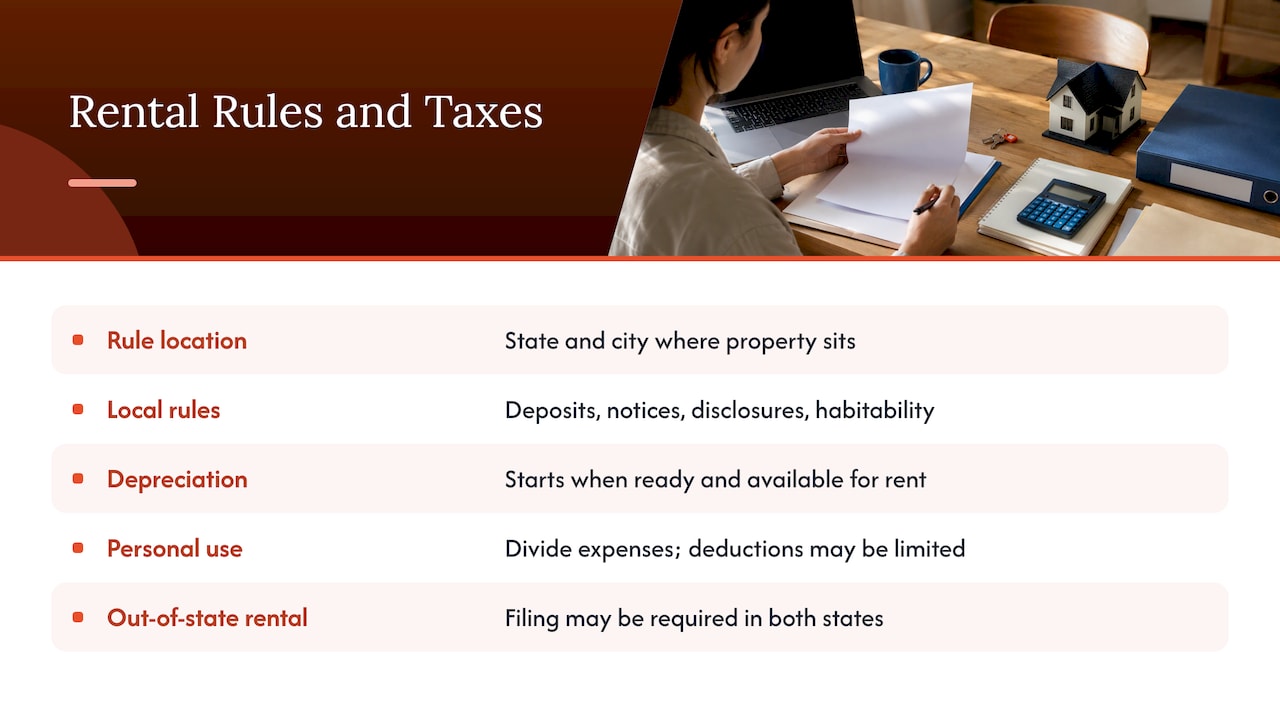
This part depends on where the property sits, not where you live. Landlord-tenant rules differ by state and often by city, covering security deposit handling, notice periods, required disclosures and habitability standards. Review the rules in the state where the rental is located, and speak with a local attorney before you draft a lease or serve any notice.
On taxes, rental income is reported as income and certain costs can be deducted. The IRS explains in Publication 527 that depreciation is a capital expense used to recover the cost of an income-producing property over its expected life, and it can begin once the property is ready and available for rent. The same publication says that if you use the property personally, you must divide expenses between rental and personal use, and your deductions may be limited. That 2020 edition is the version we’ve reviewed, so confirm the current rules with the IRS or a CPA before filing. If you live in a different state from your rental, a tax professional can tell you whether you have filing obligations in both.
When self-managing from afar stops making sense
Many owners start by self-managing and it works until it doesn’t. Common signals that it’s time to hand off the on-site layer:
- You’re making repair decisions without being able to see the problem.
- Vendor calls keep pulling you away from your job or family.
- You own more than one property, or a multi-unit building.
- Turnover is rising and vacancy is costing you.
- You’d rather own the asset than run it.
Handing off doesn’t mean giving up control. A good manager reports to you, but handles tenants, vendors, inspections and compliance on the ground. If you’re an investor adding properties across markets, the same logic applies at larger scale. Our post Built by Investors, for Investors explains how we think about it.
Our perspective on remote ownership
We’ve worked with owners who live across town and owners who live across the country. The ones who feel least stressed share one trait: they stopped treating distance as the problem and built a system around it.
Our approach is built on a pod-based team structure, so the people who know your property and your tenants are the same people answering your calls. We keep maintenance in-house, which means fewer unknowns when a repair comes in. We choose vendors transparently, so you can see why a contractor was picked. We also focus on resident retention, because a tenant who stays is the cheapest, calmest form of income a remote owner can have.
After more than 15 years and 2,700 properties served across 10 regional markets, we’ve come to a simple view: you shouldn’t have to choose between owning real estate and having a life. Our goal is for you to see clear numbers and make the big decisions, while our team handles everything that needs a person on site.
MediaBeast
Let us handle the on-site work
If you own a rental in one of our markets and don’t want to coordinate vendors, inspections and tenants from a distance, our property management service covers leasing and tenant placement, rent collection, maintenance and ongoing resident care. We work in Charleston and Columbia, SC, Fort Worth and Dallas-Fort Worth and Houston, TX, Kansas City and Overland Park, and Jacksonville and Jacksonville Beach, FL. Investors with larger plans can also look at our asset management and multifamily and build-to-rent services.

Tell us about your property and we’ll explain how management would work for it. Start at aubenrealty.com.
FAQ
Can I really manage a rental in another state by myself?
Yes, many owners do. Marketing, screening, leasing, rent collection and bookkeeping can all be handled online. What you can’t do remotely is physical work, so you need a reliable local contact and vetted vendors for repairs, inspections and emergencies.
What is the biggest risk for a remote landlord?
Slow or poorly informed responses to maintenance problems. Without someone who can see the unit, small issues grow into expensive ones. A written request process, an emergency plan with spending limits and primary and backup vendors reduce that risk.
Do fair housing rules still apply if software screens my tenants?
Yes. HUD’s 2024 guidance says housing providers stay responsible for discriminatory decisions even when an automated service made the recommendation. Use written criteria, apply them consistently and review the underlying report yourself.
Should I use a property manager or hire a local helper?
A local helper can cover a single property with light needs. A property manager makes more sense when you have several units, want after-hours coverage, or don’t want to coordinate vendors and compliance yourself. Choose based on how much on-site work you want to oversee.
Sources
- HUD: Guidance on Application of the Fair Housing Act to the Screening of Applicants for Rental Housing (2024)
- HUD: Exhibit 6-6, Examples of Tenant Briefing Topics
- IRS: Publication 527, Residential Rental Property (2020)
- Shuk Rentals: How to Manage Rental Property Remotely