Property Manager vs. Self-Management: Which Is Right for Your Rental?
October 30, 2026
Self-management keeps the management fee in your pocket but costs you hours, and it puts every legal and maintenance decision on you. A property manager costs roughly 8% to 12% of collected rent plus a few add-on fees, and in return takes over the daily work. The right choice depends on how much your time is worth, how many units you own, how far you live from them, and how comfortable you are with landlord-tenant law. This guide puts real numbers on each side so you can decide with a calculator instead of a hunch.
TL;DR
- Professional management in the US typically runs 8% to 12% of collected rent, with a national average near 8.49%, plus leasing, setup and renewal fees.
- Self-managing owners often spend 8 to 12 hours a month per rental on core tasks, and far more during turnovers or emergencies.
- Self-management makes sense for one or two nearby, simple properties and an owner with flexible time. Past roughly five to ten doors, informal processes tend to break.
- The costliest self-management mistakes are legal: fair housing violations and botched evictions.
- Whichever route you pick, put the numbers and the duties in writing before you commit.
Table of Contents
- What each option actually means
- What professional management costs in the US
- What self-management costs in time
- Vacancy, turnover and rent performance
- The legal risk most self-managing owners underestimate
- Taxes: the fee is usually deductible
- Pros and cons side by side
- How to decide: six questions
- What to put in a management agreement
- Perspective: where we see owners get this wrong
- When Auben Realty fits
- FAQ
- Sources
What each option actually means
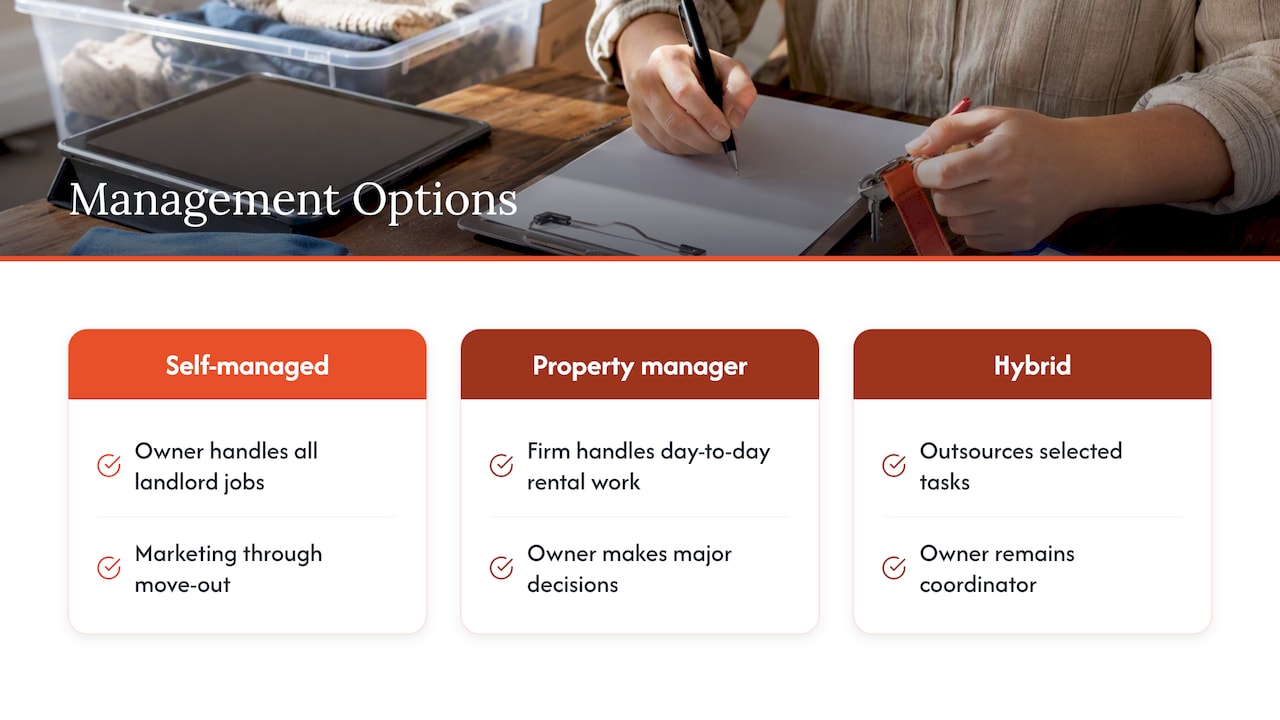
Self-management means you do every landlord job yourself: marketing the unit, screening applicants, signing the lease, collecting rent, answering repair calls, arranging contractors, handling renewals and running the move-out. The UK’s National Residential Landlords Association describes the same split: property management is the day-to-day running of a rental, and self-managing is doing all of it yourself, from marketing to check-out inspections. The rules differ by country, but the workload is the same.
Hiring a manager hands that work to a firm. In the US, a property manager is typically the tenants’ primary point of contact and handles lease management, maintenance coordination, rent collection and financial reporting on the owner’s behalf. You still own the asset and make the big calls, such as selling, major capital spending or changing rent strategy, but you stop being the person who gets the 9 p.m. call about a dead water heater.
There is also a middle path. Some owners self-manage the relationship but hire out single tasks: a leasing agent to fill a vacancy, a handyman network for repairs, an accountant for bookkeeping. That can work, but you remain the coordinator, so the time cost does not disappear.
What professional management costs in the US
The monthly fee is only the headline. Industry research from iPropertyManagement puts the average monthly management fee at 8.49% of rent, with a nationwide range of about 6% to 10%. Steadily’s cost guide describes the typical range as 8% to 12% of collected rent. Percentages run higher on low-rent properties and lower on multifamily buildings, because a manager needs a minimum amount of revenue to cover the work.
On top of the monthly fee, owners may see:
- Leasing or tenant placement fees: typically 50% to 100% of one month’s rent.
- Setup fees: averaging $185.24 per contract in the same national survey.
- Lease renewal fees and inspection fees: charged by some firms, not all.
- Maintenance markups: a percentage added to vendor invoices at some companies.
A worked example
Take a single-family rental that brings in $2,000 a month and is occupied all year, with a manager charging the national average of 8.49%:
| Item | Math | Cost |
|---|---|---|
| Monthly management fee | $2,000 × 8.49% | $169.80 |
| Annual management fees | $169.80 × 12 | $2,037.60 |
| One tenant placement fee (50% to 100% of one month) | $1,000 to $2,000 | $1,000 to $2,000 |
In a year with a turnover, the all-in cost can land around $3,000 to $4,000 before any setup fee. That is real money against a rental that may net a few hundred dollars a month. It is also the price of not doing a leasing cycle and twelve months of rent collection and repair coordination yourself. Your own figures will differ, so ask every firm you interview for a written fee schedule that lists every charge, not just the monthly rate.
What self-management costs in time
Self-management has no line item on your statement, which makes it feel free. It is not. One decision guide estimates that US self-managing landlords often spend 8 to 12 hours a month on core rental tasks, rising sharply during turnovers, late-payment cycles and maintenance emergencies. A property management calculator cited by Hemlane found averages of 47.5 hours for leasing and 46.6 hours for management per rental property. Treat those as indicators, not guarantees: a newer, well-maintained home with a long-term tenant will take far less, and an older duplex with a revolving door will take far more.
Here is a simple way to price your time. Estimate the hours you would really spend in a year, including the unpleasant ones, and multiply by the hourly value you place on your time. If 10 hours a month at $50 an hour comes to $6,000 a year, the $2,037.60 management fee in our example looks very different. If you value the time at $15 an hour and enjoy the work, self-management wins on cost. The point is to run the comparison honestly, not to assume one side always wins.
Two more costs hide in the time column. The first is the learning curve: a first-time landlord prices a unit by guesswork, writes a lease from a template and learns local rules from mistakes. The second is the mental load of being on call. Many owners say that is the real reason they hire out.
Vacancy, turnover and rent performance
The strongest financial argument for a manager is not saved time but shorter gaps between tenants. A 2024 trend survey summarized by Steadily reported an average 4-week vacancy for managed properties versus 4.6 weeks for self-managed ones. The difference is small, and the survey is one data point, but even a few days matter: at $2,000 a month, each vacant week costs roughly $460 in lost rent.
What drives faster lease-ups is boring and repeatable: pricing against current local comparables, professional photos, same-day showing responses, and a turnover process that gets the unit rent-ready quickly. A clean, well-presented unit helps too, and turnover cleaning guidance is worth reading if you handle prep yourself. If you want to dig into this side, our own guides on tips for minimizing vacancy rates and reducing your rental vacancy rate walk through the tactics.

Professional management can also limit repair overpayments. A manager with established vendors and a maintenance coordinator can usually get faster, cheaper service than an owner calling a contractor for the first time. Whether that offsets the fee depends on the portfolio, which is why the next section matters.
The legal risk most self-managing owners underestimate
Money and time get the attention, but legal exposure is where self-management goes wrong in expensive ways. One property management firm’s analysis lists fair housing violations, with average settlements of $10,000 to $50,000, and botched eviction procedures that can cost months of lost rent among the common pitfalls for self-managing landlords. It is a company blog, so read the figures as a rough scale rather than a statistic, but the risk itself is real.
The federal Fair Housing Act applies to small landlords as well as large firms. Among other duties, housing providers must make reasonable accommodations in rules and policies when needed for people with disabilities, and may allow a requested physical modification on the condition that the renter restores the interior afterward, where that is reasonable. Advertising wording, screening criteria and how you answer an inquiry can all create exposure. Our guide to fair housing for landlords covers what the law requires in plain terms, and our walkthrough of tenant screening shows how a consistent process reduces risk.
Eviction, security deposit handling, required notices and habitability standards are set by state and local law, so they differ between Texas, Florida, South Carolina and Missouri. If you self-manage, read your own state’s landlord-tenant statutes and consider a short consultation with a local landlord-tenant attorney before you write your first lease. If you hire out, confirm that the manager knows your state’s rules and carries the appropriate licensing and insurance there.
Taxes: the fee is usually deductible
Hiring a manager does not have to hurt as much as the sticker price suggests. According to the IRS guidance on rental real estate, rental owners can deduct ordinary and necessary expenses for managing, conserving and maintaining the property, such as advertising, insurance, maintenance and utilities. Improvements are different: they are recovered through depreciation over time rather than deducted at once. The IRS also publishes a full guide to residential rental property with the detail. Ask your tax professional how your management fees and any leasing fees should be reported on your return.
Pros and cons side by side
| Factor | Self-management | Professional management |
|---|---|---|
| Direct cost | No management fee | Typically 8% to 12% of collected rent, plus leasing and other fees |
| Your time | Often 8 to 12 hours a month per rental, more in emergencies | Mostly owner reporting and approvals |
| Control | Every decision is yours | Shared, defined by the management agreement |
| Vacancy | Depends on your marketing and speed | Established marketing and screening systems |
| Legal compliance | You carry the learning curve | Manager applies a standard process |
| Scalability | Strains past a handful of units | Built to handle more doors |
| Distance | Hard if you live far away | Local presence on your behalf |
For a more detailed list, see our breakdown of the pros and cons of using property management and the benefits of hiring a property management company.
How to decide: six questions
Owners should weigh available time, the location and complexity of their properties, portfolio size, and whether systems or a professional can support operations. Turn that into six questions:
- Do you live close enough to respond in a day? A rental an hour away, or in another state, makes self-management much harder.
- How many units do you own, or plan to own? The same source notes that beyond five to ten properties, inconsistent processes start breaking. If you are building a portfolio, you need systems either way.
- What is your time worth, and what would you rather do with it? Use the hourly math above.
- How thin is your margin? If a $170 monthly fee turns a profitable rental into a loss, price the rent, financing or property before blaming the manager.
- How comfortable are you with fair housing, notices and evictions? If the honest answer is not very, the legal risk alone may justify a professional.
- Is the property simple? A newer single-family home with a stable tenant is far easier than an older multi-unit building needing constant maintenance.
If you answered yes to one and two, have flexible time and a simple property, self-management is a reasonable choice, especially while you learn the business. If you answered no to distance, own several units or are building a portfolio, professional management usually pays for itself in time and risk.
What to put in a management agreement
If you hire a manager, the contract matters as much as the rate. The National Apartment Association stresses that a formal management agreement optimizes the owner-manager partnership by defining deliverables, financial responsibilities and the thresholds above which the owner must approve spending. In practice, check for:
- The exact fee schedule: management percentage, leasing fee, renewal fee, setup fee, inspection fee and any maintenance markup.
- A repair approval limit, for example the dollar amount a manager can spend without calling you.
- How and when rent is deposited to you, and how often you get statements.
- Who selects vendors and how bids are handled.
- Termination terms: notice period, any cancellation fee and who keeps tenant files.
- Responsibilities for seasonal services. In snowy markets, for instance, snow removal contract essentials such as liability and response times should be spelled out rather than assumed.
If you want a second opinion on what owners typically ask before signing, read our answers to common questions owners have about property management.
Perspective: where we see owners get this wrong
We manage rentals across Charleston and Columbia, SC, the Dallas-Fort Worth area, Houston, Kansas City and Overland Park, and Jacksonville, and the owners who struggle most are rarely the ones who chose the wrong model. They are the ones who never priced their own time, or who hired a manager without reading the fee schedule and repair approval terms.
Our view is simple. Self-management is a legitimate choice for a small, local, simple portfolio, and we would rather you choose it knowingly than hire us out of anxiety. Once you add doors, distance or a plan to build wealth through investing, systems become the product. That is why we run a pod-based team structure, keep maintenance in house, select vendors transparently and put effort into retaining good residents, since a stable tenant is the cheapest vacancy fix there is. We combine local market knowledge with an investor mindset, so the goal is long-term return, not just a filled unit.
— MediaBeast
When Auben Realty fits
If you have decided that your time or risk tolerance is better spent elsewhere, we can take on the work. Our property management service covers leasing and tenant placement, rent collection, maintenance and resident relations, and we also support owners with renovation oversight, asset management and brokerage when they buy or sell. Fees are specific to each property and market, so we quote them after learning about your rental.

Investors who are building a larger single-family, multifamily or build-to-rent portfolio can look at our multifamily and build-to-rent services or asset management. If you simply want to see how the market looks for your property before deciding, talk to us through our home page.
FAQ
Is it cheaper to self-manage a rental property?
On paper, yes, because you avoid the fee, which is typically 8% to 12% of collected rent. In practice, you pay with your time, and costly mistakes in leasing, maintenance or compliance can erase the savings. Compare the annual fee with your realistic hours and the risk you carry.
How many properties can I self-manage?
There is no fixed limit, but one decision guide says processes tend to break beyond roughly five to ten properties. Distance and property age matter as much as the count. Two older units in another city can be harder than six newer ones nearby.
Is a property management fee tax deductible?
Ordinary and necessary expenses for managing and maintaining a rental are generally deductible under IRS guidance, and management costs commonly fall into that group. Improvements are treated differently and are depreciated. Your accountant can confirm how to report your own fees.
Can I switch from self-management to a manager later?
Yes, and many owners do once they add a property or move away. Review your lease files, gather tenant contact details, and agree with the new manager on how existing tenants will be transitioned. Read the new agreement’s start date and fee terms carefully.
Sources
- Your Ultimate Guide to Managing a Rental Property, NRLA
- Becoming a Landlord, Fannie Mae
- Average Property Management Fees, iPropertyManagement
- Property management costs for rental properties explained, Steadily
- 6 Explanations to the Cost and Time of Property Management, Hemlane
- Self-Managing vs. Hiring a Property Manager, Shuk Rentals
- Property Manager vs. Self-Management, PropsManager
- Joint Statement on Reasonable Modifications, HUD
- Tips on rental real estate income, deductions and recordkeeping, IRS
- Publication 527, Residential Rental Property, IRS
- Management Agreement, National Apartment Association