Rental Portfolio Management: How to Run Many Rentals as One Business
October 28, 2026
Rental portfolio management is the practice of running all your rental properties as a single investment, not as a pile of separate landlord jobs. It covers the daily work of leasing, maintenance and rent collection, but it adds a second layer: deciding which properties to improve, hold, refinance or sell, and how much risk sits in any one market, tenant base or property type. This guide shows how that works, which numbers matter, and when it makes sense to bring in a full-service manager.
TL;DR
- Property management keeps each home rented and in good repair. Portfolio management decides where your capital should sit across all of them.
- Track a small, standard set of numbers for every property: net operating income, occupancy, expense ratio and return on equity.
- Review the whole portfolio at least once a year and sort every asset into keep, improve, refinance or sell.
- Outside management usually pays off when properties are far away, turnovers overlap, or your time is worth more than the fee.
- The best setup splits the work: a manager runs operations, and you (or an asset manager) steer strategy.
Table of Contents
- What rental portfolio management actually means
- What a rental management company does for you
- The numbers that run a portfolio
- Keep, improve, refinance or sell
- Growing a portfolio without losing control
- When professional management makes sense
- Our perspective: manage the portfolio from both ends
- How Auben can run the operations layer
- A simple annual portfolio review
- FAQ
- Sources
What rental portfolio management actually means
One rental is a task list. Ten rentals are a business. The difference is the kind of decision you make.
With a single property, you ask: is the tenant paying, is the roof sound, is the rent right? With a portfolio, the questions change. Which of these ten assets earns the least on the equity trapped in it? Are three of them exposed to the same employer, the same flood zone or the same insurance market? Should the next dollar go into a renovation, a down payment on a new door, or paying down debt?
Research from a property analytics publisher describes this shift well: portfolio management makes capital-allocation and exposure decisions across assets, rather than judging each property only on its own. That is the core idea. Property-level work feeds the portfolio, and portfolio-level thinking tells you what the property-level work should aim for.
Property management vs. portfolio management
| Property management | Portfolio management | |
|---|---|---|
| Focus | One building or home at a time | All assets as one investment |
| Typical questions | Who pays late? What needs repair? | Which asset underperforms? Where is risk concentrated? |
| Time horizon | Days to months | Years |
| Typical owner of the task | Property manager | Investor or asset manager |
| Output | Leases, work orders, monthly statements | Hold, improve, refinance or sell decisions |
Most owners need both layers. Small landlords do both themselves. Larger investors usually delegate the first layer and keep the second.
What a rental management company does for you
Before you can manage a portfolio, the operations underneath it have to run smoothly. A rental management company can price and market the property, vet tenants, collect rent, handle emergency repairs, send monthly reports and tax documents, and make property visits.
Two of those items deserve a closer look because they shape portfolio results more than owners expect.
Tenant selection. One bad placement can erase a year of profit. Consistent, documented screening criteria are what protect your occupancy and your reserves. If you want to see what that process looks like in practice, our guide on how a property management company handles tenant screening walks through it.
Maintenance. The National Association of Realtors notes that maintenance satisfaction is likely the greatest driver of overall renter satisfaction. Satisfied renters renew, and renewals are the cheapest way to protect cash flow, because you skip vacancy, turnover work and new leasing costs.
The numbers that run a portfolio
A portfolio is only manageable if every property reports the same way. Comparing a duplex in one city to a single-family home in another is meaningless unless both are measured on common benchmarks. Standardized reporting and shared benchmarks are exactly what the research on portfolio-level management points to, with the usual measures being net operating income (NOI), occupancy, expense ratios and portfolio exposure.
Here is a practical dashboard, one row per property:
| Metric | What it tells you | Question to ask |
|---|---|---|
| NOI | Income after operating expenses, before debt service | Is it trending up or flat while rents rise? |
| Occupancy | Share of time the unit is rented | How long does each vacancy last, and why? |
| Expense ratio | Operating costs as a share of income | Which property spends more than its peers? |
| Return on equity | Annual cash flow plus appreciation and principal paydown, divided by equity | Could this equity earn more elsewhere? |
| Exposure | Share of the portfolio in one market, type or tenant group | What happens if this one area weakens? |
We go deeper on the operating side in our post on key factors investors need to track for their rental properties, including how reporting should look from your manager.
Why return on equity gets overlooked
Most landlords watch cash flow and ignore equity. Yet a home you bought years ago may have grown substantially in value, which means a large amount of your money is parked in a property earning a modest rent. Ranking assets by return on equity makes that visible. One investor-education source advises ranking properties by return on equity at least once a year to decide which to keep, refinance or sell. The annual rhythm is the useful part: it turns a vague feeling about “the weak one” into a list.
Turnover is a portfolio metric, not a nuisance
If one property shows high expenses and long vacancies, look at turnover first. Short-term and vacation rentals make this most obvious, because every guest change needs a clean, a restock and an inspection. Dependable cleaning crews keep days-vacant down, and local services such as Vilano Beach turnover cleaning show the kind of vendor support that helps separate a property that is truly underperforming from one that is simply poorly turned over.
Keep, improve, refinance or sell
Once the numbers are on one page, each asset gets one of four labels. At the portfolio level, management involves capital allocation decisions such as which properties to improve, hold or sell, along with exposure and risk across markets and tenants.
Keep. Strong NOI, stable occupancy, reasonable return on equity. Leave it alone and keep the service steady.
Improve. Decent location but rents below the neighborhood, or expenses inflated by deferred maintenance. A targeted renovation can lift rent and cut repair calls. Oversight matters here: scope, bids and schedule need a single accountable party. Our project management service exists for that reason.
Refinance. High equity, low return on that equity, and a property you still like. Pulling equity out can fund the next acquisition, but run the debt service against realistic rents first.
Sell. Chronic underperformance, concentrated risk, or a market you no longer want to be in. We cover the logic of selling single-family rentals in The SFR Exit Playbook.
A worked example
Imagine a portfolio of five single-family rentals. Four earn a solid return on the equity in them. The fifth was bought long ago, has appreciated considerably, and rents for only a modest amount. Cash flow looks fine, so the owner never questions it. On a return-on-equity ranking, it sits last by a wide margin. Selling it, and moving the proceeds into a newer property or into paying down higher-rate debt, may increase total income without adding a single tenant. The numbers are illustrative, but the pattern is common, and it only shows up when you rank every asset side by side.
Before you sell any rental, talk to a CPA. Rental income generally has to be reported, and rental expenses are generally deducted in the year paid, while depreciation is recovered over a prescribed period, according to the IRS’s Publication 527 (2019 edition; check the current edition for your tax year). If you ever use a rental unit personally, expenses must be divided between rental and personal use, which can limit what you deduct. Depreciation also matters at sale, so get the tax picture before you list.
Growing a portfolio without losing control
Growth changes what is hard. A common progression runs from one or two properties (learning), to three to five (standardizing), to six to ten or more (managing a business). The bottleneck moves from knowledge, to your time and cash, to financing limits and portfolio quality.
That has practical consequences:
- Build repeatable systems early. Use the same lease, the same screening criteria, the same vendor process and the same reporting for every unit. Systems are what let a portfolio grow without growing your workload at the same pace.
- Review concentration and insurance. Several properties on one street, one flood zone or one employer’s payroll act like one big bet. Check coverage and exposure at least annually.
- Plan financing before you need it. Conventional loans have limits on how many mortgages one borrower can carry. Investors near those limits often look at DSCR or portfolio loans, so talk to a lender before the next purchase, not after you find the deal.
- Know the law where you invest. The NAR advises investors to research their market and understand state and federal legal requirements for landlords. Rules on deposits, notices and fair housing differ from South Carolina to Texas to Florida to Missouri and Kansas.
- Diversify deliberately. Mixing property types or sub-markets can smooth results, but only if each addition passes the same numbers test as the rest.
One real-estate glossary describes the move from ground-floor management to a bird’s-eye view as necessary for scaling, because it brings in higher-level decisions such as 1031 exchanges and risk reduction. A tax adviser should confirm whether an exchange fits your situation.
If you are weighing single-family against larger assets, our posts on whether single-family rental investing is a good idea and on build-to-rent management lay out the tradeoffs.
When professional management makes sense
Self-managing is a legitimate choice for a small portfolio nearby. Several signals suggest it has stopped being the best one. Investors are advised to consider professional management when properties are far from home, turnovers frequently overlap, or the time spent exceeds the opportunity cost of hiring help. Missed legal deadlines, such as notice periods, are another sign that the system has outgrown you.
When you compare options, use these criteria:
- Scope. The NAR suggests reviewing company ratings and looking for agencies that offer comprehensive services to cover all operating needs. Gaps mean you end up hiring a second vendor.
- Fees in writing. Get at least three quotes and ask for the complete fee schedule: management, leasing, renewal, maintenance markups and renovation charges. Compare total annual cost, not only the headline percentage.
- Reporting. Monthly statements, year-end tax documents and a consistent format across every property.
- Maintenance model. Ask who does the work, how vendors are chosen, and how fast emergencies are answered.
- Fit for your strategy. A manager who understands investors will talk about NOI and renewals, not just rent collection.
Our perspective: manage the portfolio from both ends
We have spent more than 15 years managing and investing in residential real estate, and we have served 2,700 properties across 10 regional markets. The pattern we see most often is an owner who is excellent at finding deals and exhausted by running them.
Our view is that operations and strategy should be separate jobs with separate owners. Operations should be quiet: a team that knows your properties, answers residents fast, and reports in the same format every month. We organize that work in pods, so a focused group serves each set of properties, and we keep maintenance in-house where we can, because speed and cost control on repairs drive both resident satisfaction and renewals. Vendor selection should be transparent, so you can see why a contractor was chosen and what was paid.
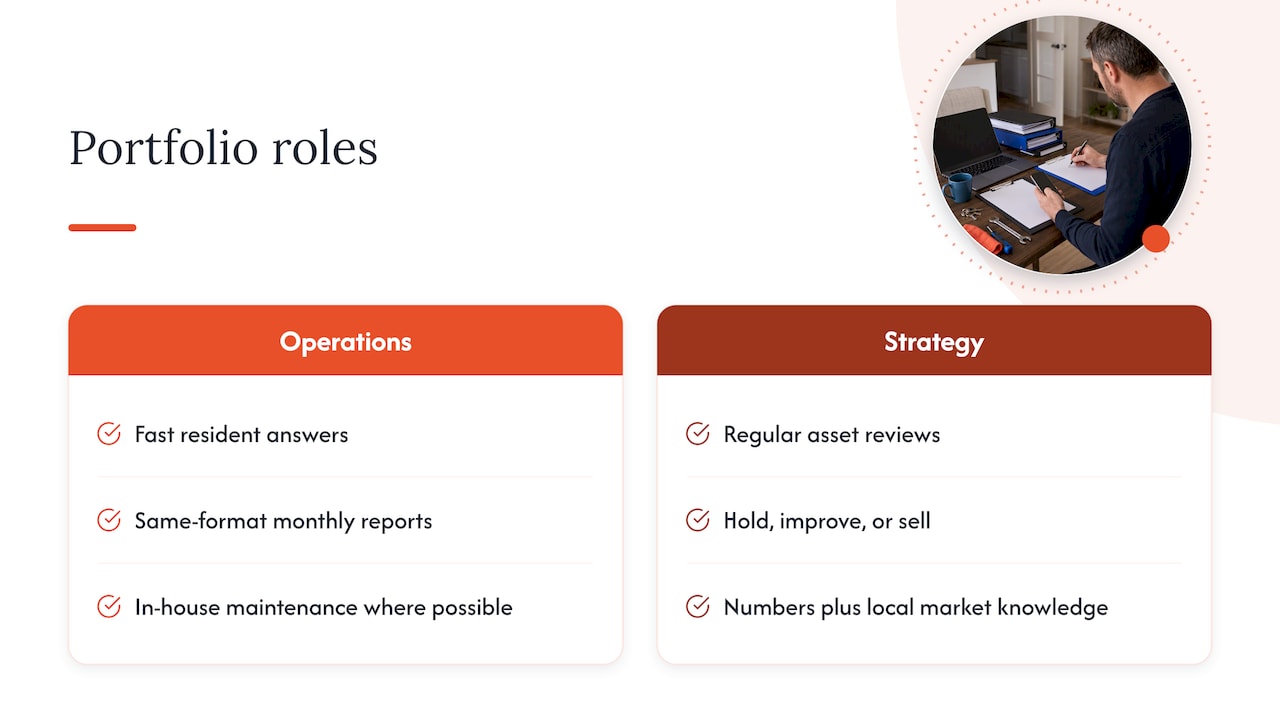
Strategy, meanwhile, should be loud. It should be a regular conversation about which assets to hold, improve or sell, based on numbers and local market knowledge, not on instinct or sentiment. That is why we pair day-to-day management with asset management and brokerage: the same team that sees a property’s repair history and rent trend can tell you honestly whether it still deserves your capital. For more on how we think about it, read Built by Investors, for Investors.
The goal is not to remove you from your investments. It is to make sure your attention goes to the few decisions that move returns.
— MediaBeast
How Auben can run the operations layer
If your portfolio has reached the point where operations eat the hours you would rather spend on strategy, our property management team handles leasing, tenant placement, maintenance and reporting for single-family, multifamily and build-to-rent homes in Charleston and Columbia, SC; Fort Worth, Dallas-Fort Worth and Houston, TX; Kansas City and Overland Park; and Jacksonville and Jacksonville Beach, FL.

For the investment side, our asset management service helps you review performance across properties, and our brokerage services support buying and selling when a review says it is time to move. Investors building larger holdings can start with our multifamily and build-to-rent services. Pricing is scoped to your portfolio, so contact us for a quote through aubenrealty.com.
A simple annual portfolio review
You do not need special software to start. Once a year, set aside an afternoon and do this:
- Pull twelve months of income and expense statements for every property.
- Calculate NOI, occupancy, expense ratio and an estimated return on equity for each.
- Rank the properties by return on equity.
- Mark each one keep, improve, refinance or sell, and write one sentence on why.
- Check concentration: how much of your income depends on one market, one property type or one insurance region?
- Set one goal for the next twelve months, such as raising renewals, trimming expenses at the weakest asset, or funding one acquisition.
Repeat it every year, and your decisions will rest on a record, not a memory.
FAQ
What is rental portfolio management?
It is the practice of managing all your rental properties as one investment. That includes operating each home well, but also comparing assets on common metrics, allocating capital among them and controlling risk across markets and tenants.
What does a rental management company do?
A management company typically markets and prices the rental, screens tenants, collects rent, handles repairs and emergencies, and sends monthly reports and tax documents. Many also make periodic property visits. Exact services and fees vary, so ask for the full list and fee schedule in writing.
How many rentals before I should hire a manager?
There is no magic number. The better test is whether distance, overlapping turnovers or missed deadlines are costing you money, or whether your hours are worth more elsewhere. Many owners hire help somewhere between a handful of properties and ten, but one distant property can justify it sooner.
Which metrics matter most for a rental portfolio?
Start with NOI, occupancy, expense ratio and return on equity for each property, then look at exposure across the whole portfolio. Measure every property the same way so you can compare them fairly.
Sources
- Property Portfolio Management: Metrics, Software, and Risk
- What Does a Property Manager Do? (Realtor.com)
- Rental Properties (National Association of Realtors)
- Scaling Playbook: Growing From 1 to 10+ Rentals
- IRS Publication 527, 2019 edition
- Property Portfolio glossary entry (REI Prime)
- Vilano Beach Airbnb cleaning and turnovers