Fair Housing for Landlords: What the Law Requires
October 20, 2026
If you rent out property in the United States, the Fair Housing Act applies to you. It bars discrimination in how you advertise, screen, price, and treat tenants, and it holds you responsible for what your agents and screening vendors do on your behalf. This guide covers the rules that trip landlords up most often, with plain examples of compliant and risky practice and a process you can put in place this month.
TL;DR
- The federal Fair Housing Act protects seven characteristics: race, color, religion, sex, national origin, familial status, and disability. Many states and cities add more, such as source of income.
- Ads, phone answers, showings, screening criteria, and lease terms all count. Treat every step of the rental the same way for every applicant.
- Hiring a screening company or property manager does not move your liability to them. Use written criteria and apply them consistently.
- Disability-related accommodations, including assistance animals, need individual review, not a blanket policy.
- Write down your criteria before the first applicant calls, and keep records of each decision.
Table of Contents
- Who and what the Fair Housing Act covers
- Advertising: what you can and cannot say
- Screening applicants without creating liability
- Source of income and housing vouchers
- Occupancy limits and families with children
- Disability: reasonable accommodations and modifications
- Harassment, retaliation, and day-to-day treatment
- What a complaint looks like and what it costs
- Our perspective: fair housing is a process problem
- A fair housing checklist for your next vacancy
- Let us carry the compliance work
- FAQ
- Sources
Who and what the Fair Housing Act covers
The Act, 42 U.S.C. 3601 and following, prohibits discrimination by direct providers of housing, such as landlords and real estate companies, as well as by lenders, municipalities, and others. The Department of Justice lists the protected characteristics as race, color, religion, sex (which includes gender identity and sexual orientation), national origin, familial status, and disability.
Familial status is the one landlords misunderstand most. It covers families with children under 18, people in the process of securing legal custody, and pregnant individuals. A rule that quietly steers families away from your upper-floor unit, or from the “quiet” building, is a familial status problem even if you never say the word “children.”
HUD says housing discrimination is illegal in nearly all housing, including private, public, and federally funded housing. There are narrow exemptions for some small owner-occupied buildings and single-family homes rented without an agent, but they are easy to lose, and state and local laws often have none. Do not build your business on the assumption that you are exempt. Ask a landlord-tenant attorney in your state before you rely on one.
Federal law is the floor
Many states and cities protect more than the seven federal classes. Common additions include source of income, marital status, age, military or veteran status, and criminal history limits. If you own in more than one market, you may be working under several rule sets at once. Check your state civil rights agency and your city or county ordinances before you write your criteria.
Advertising: what you can and cannot say
Fair housing advertising rules are some of the most enforced because a violation is visible and permanent. A discriminatory ad is evidence on its face. In one HUD enforcement matter, respondents were charged with posting a discriminatory advertisement and making a discriminatory statement to a prospective tenant, as two separate violations.
The rule of thumb: describe the property, not the person you imagine living there.
| Risky wording | Why it is a problem | Safer wording |
|---|---|---|
| “Perfect for young professionals” | Signals a preference by age or familial status | “One bedroom near downtown, open floor plan” |
| “No kids” or “adult community” | Familial status | Describe the unit and amenities only |
| “Christian neighbors” | Religion | Leave out |
| “Walking distance to church” | Can imply a religious preference | Name the street or neighborhood instead |
| “Not suitable for wheelchairs” | Disability | State accessible features that exist, such as a step-free entry |
| “English speakers only” | National origin | State screening requirements that apply to everyone |
A few habits keep ads clean:
- Describe features: bedrooms, square footage, parking, appliances, pet policy, rent, deposit, and availability date.
- Use the same ad copy and the same photos on every platform. Photos that show only one type of person can send a message too.
- Add the Equal Housing Opportunity logo or statement. HUD recommends including it in advertising.
- Do not limit ads to channels that reach only one community if you serve a mixed-language market. Consider offering key terms in the languages your area speaks.
Social media posts, yard signs, and text replies count as advertising and statements too. If a prospect asks “is this a good area for families?”, answer with facts about the property and point them to public resources. Do not offer opinions about who would fit in.
Screening applicants without creating liability
Screening is where good landlords get into trouble, usually through a process that is applied unevenly or an automated report nobody checked.
Write the criteria first
Decide your standards before you meet applicants: minimum income as a multiple of rent, credit thresholds, rental history, and which criminal records matter and for how long. Put them in writing, give the same document to every applicant, and apply it in order of application. Landlords get in trouble when criteria change after they have met someone.
Our own approach is laid out in our guide to a six-step tenant screening process that meets HUD and FCRA rules. A second walkthrough explains how a property manager handles applications day to day.
Your vendor’s mistakes are your mistakes
HUD’s guidance on screening says that housing providers remain responsible for discriminatory outcomes even when they outsource screening to a third party. Practical steps:
- Ask the screening company how it matches records to applicants. Name-only matching is a known source of error. A reliable report should match on several identifiers, such as full name plus date of birth or address.
- Give applicants a chance to dispute inaccurate records before you deny them.
- Do not treat an automated “decline” as a decision you cannot override. Review the underlying record yourself.
- Keep the report, your criteria, and the reason for each decision in the applicant file.
Eviction filings and criminal records
The same HUD guidance warns against blanket denials based on past eviction filings. A filing that never ended in a judgment against the tenant does not show a failure to meet tenancy obligations, and the guidance advises disregarding it. Recent and current rental history is a better predictor than a generic background record.
Criminal history needs the same care. A blanket “no felonies” policy can have a disproportionate effect on protected groups and is hard to defend. Use a narrow, written policy tied to specific conduct and a time window, consider individual circumstances, and check whether your state or city limits the use of criminal records in housing. Have counsel review the policy before you adopt it.
We cover related ground in our post on avoiding discrimination in residential property management.
Source of income and housing vouchers
Federal law does not list source of income as a protected class, but many states, cities, and counties do. Where they do, refusing a housing choice voucher is unlawful. HUD’s page on source of income protections explains that refusing vouchers, and other policies that disadvantage otherwise qualified voucher holders, can be source of income discrimination.
Indirect practices can cause trouble too: asking voucher holders for a larger deposit, adding screening hurdles only they face, or ignoring the voucher payment when you calculate whether a tenant can afford the rent. Even where no local protection exists, these practices can draw scrutiny if they fall disproportionately on a protected group. The safest approach is one income standard applied to everyone, with the voucher counted as income.
Occupancy limits and families with children
Many landlords set a cap of two people per bedroom and stop there. HUD’s guidance treats that figure as a general reasonable guideline but expects you to look at the facts: the size and configuration of the unit, the ages of the children, and the other circumstances. A rigid, blanket limit can end up shutting out families.
In practice: set your limit based on building code and the unit itself, document the reasoning, and apply it the same way to every household. Do not restrict families to certain floors or buildings, and do not charge extra rent or deposits for children.
Disability: reasonable accommodations and modifications
The Act requires housing providers to make reasonable accommodations in rules, policies, practices, or services when a person with a disability needs them to have equal opportunity to use and enjoy a dwelling. The HUD and DOJ joint statement on reasonable accommodations is the plain-language reference.
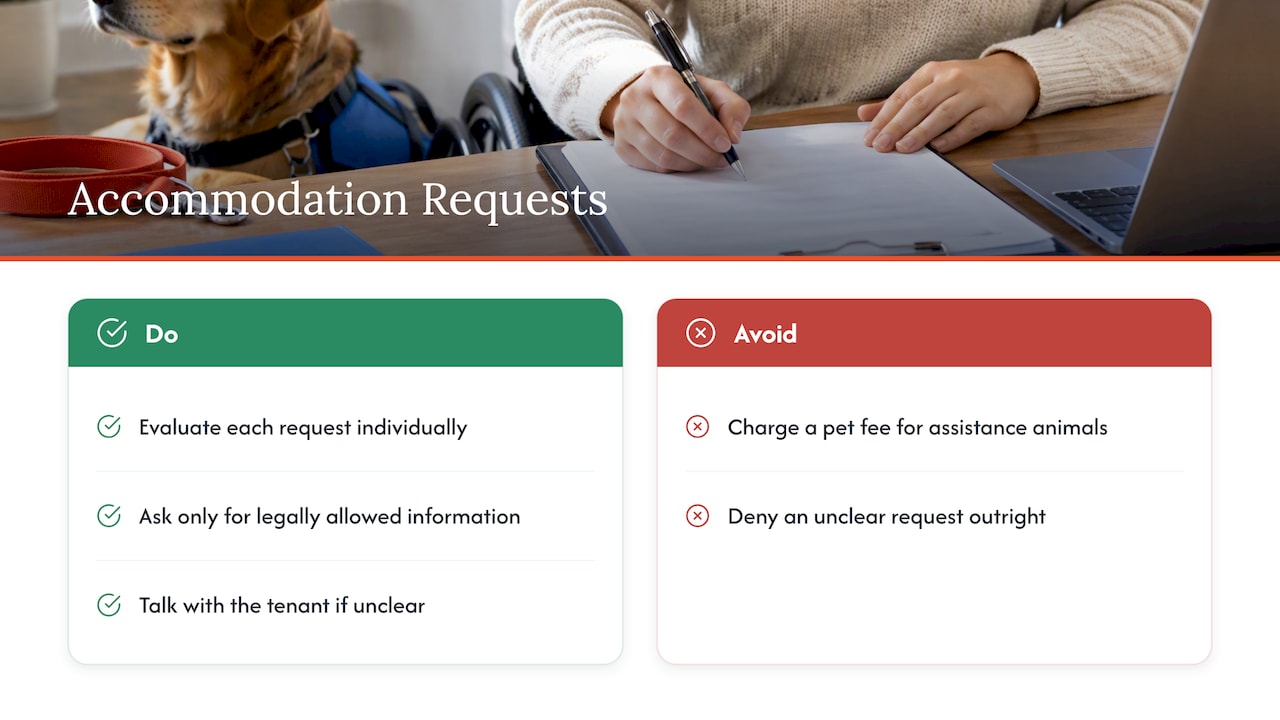
The common case is an assistance animal at a “no pets” building. Pet rules, pet fees, and pet deposits are not a valid reason to refuse an accommodation request. Evaluate each request on its own, ask only for the information the law allows you to ask, and never charge a pet fee for an assistance animal. Our post on property management and pets explains how pet policies and accommodation requests sit side by side.
Other accommodations include a reserved parking space near an entrance, a change in how rent is paid, or allowing a tenant to install grab bars at their own expense. If a request is unclear, talk with the tenant. Do not simply deny it. If you are unsure whether a request is reasonable, get advice from a fair housing attorney or your local fair housing center before you respond.
Harassment, retaliation, and day-to-day treatment
Fair housing does not end at lease signing. Treat tenants equally on repairs, response times, fees, late-rent enforcement, and renewals. Two patterns cause problems:
- Uneven service. Slower maintenance or stricter enforcement for one household than for comparable ones.
- Retaliation. Raising rent, threatening eviction, or cutting services after a tenant files a complaint or asks for an accommodation.
On-site staff and vendors also need to know the rules. A maintenance contractor who makes a discriminatory comment while working a unit creates a problem for you.
What a complaint looks like and what it costs
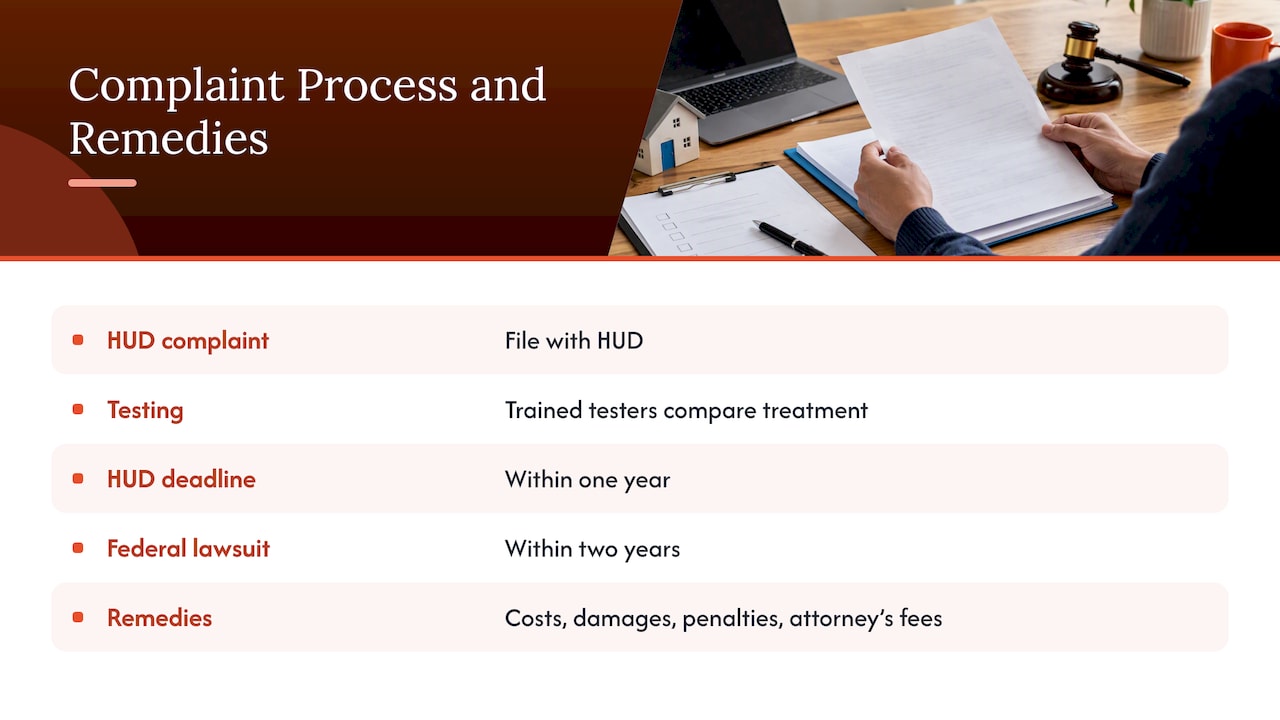
A person who believes they were discriminated against can file a complaint with HUD, and fair housing groups also run testing, where trained testers pose as applicants and compare how they are treated. According to one fair housing organization, complaints can be filed with HUD within one year of an incident, and a federal lawsuit can be filed within two years. The same source notes that remedies can include out-of-pocket costs, damages for humiliation or mental anguish, civil penalties, and attorney’s fees. Penalty amounts are adjusted for inflation, so check HUD’s current table before you quote a number.
In a complaint, the question is not whether you meant to discriminate. Policies that look neutral but fall harder on a protected group can still be challenged. Your best defense is a documented, consistent, legitimate business reason for each decision.
Insurance is part of the picture, too. Not every liability policy responds to discrimination claims, so ask your agent exactly what is covered. A guide to commercial real estate insurance requirements is a useful way to see which coverage types owners are commonly asked to carry.
Our perspective: fair housing is a process problem
We manage rental homes and multifamily communities across ten regional markets, and the fair housing mistakes we see are rarely malicious. They come from improvising: a quick text reply, a one-off exception, a screening report accepted without review. The cure is a process.
That is why we run our teams in pods, so the same people handle a property’s leasing, screening, and resident questions and apply the same written standards each time. It is also why vendor selection is transparent and why we keep maintenance in-house where we can: consistent service is easier to deliver and to document when fewer hands are involved. Technology helps by logging every inquiry, application, and decision in one place, so a record exists if anyone asks why a choice was made.
Our advice to owners, whether you hold one rental or a hundred units: do not decide in the moment. Decide in advance, in writing, and then follow it.
— MediaBeast
A fair housing checklist for your next vacancy
- Check your state and local laws for added protected classes, especially source of income and criminal history.
- Write your screening criteria and give the same copy to every applicant.
- Review your ad: features only, Equal Housing Opportunity language included.
- Script your phone and text answers, and train anyone who speaks for you.
- Confirm how your screening vendor matches records, and review adverse results yourself.
- Set an accommodation process: who receives requests, how you respond, and how you document.
- Keep each applicant file, with the criteria, the report, and the reason for the decision.
- Review your policies once a year, or whenever the law changes.
Let us carry the compliance work
If you would rather not run this process yourself, our property management team handles advertising, tenant screening, leasing, and resident communication under written standards. Owners who want help acquiring or selling can start with our brokerage services. You can also see how we compare screening and leasing practices before you talk to us.
FAQ
Who is not protected under the Fair Housing Act?
The federal law does not list characteristics such as age, source of income, marital status, or criminal history as protected classes. Many states and cities do protect some of them, and a policy built on one of them can still be unlawful if it disproportionately affects a protected group. Check your local rules before you rely on that gap.
What are some examples of fair housing violations?
Common examples include ads that signal a preference for or against a group, refusing to rent or quoting different terms because of a protected characteristic, and refusing a reasonable accommodation for a person with a disability. Rigid occupancy limits that shut out families and blanket denials from unreliable screening data also appear in enforcement cases.
Can I be liable if my property manager or screening company discriminates?
Yes. HUD’s screening guidance says outsourcing does not shield housing providers from liability for discriminatory outcomes. Choose vendors carefully, ask how they screen, and review adverse decisions yourself.
Can I charge a pet fee to a tenant with an assistance animal?
No, not for a legitimate assistance animal request. Evaluate each request individually and ask only for the information the law allows. If you are unsure whether a request qualifies, consult a fair housing attorney before denying it.
What must be shown in a fair housing complaint?
A complainant generally has to show they were treated differently, or harmed by a neutral-looking policy, in connection with a protected characteristic. Intent is not always required. Consistent written criteria and records of each decision are the best way to answer a claim.
Sources
- Civil Rights Division, The Fair Housing Act (U.S. Department of Justice)
- Housing Discrimination Under the Fair Housing Act (HUD)
- HUD v. Dangtran (U.S. Department of Justice)
- Guidance on Application of the Fair Housing Act to the Screening of Applicants for Rental Housing (HUD)
- Source of Income Protections for Housing Choice Voucher Holders (HUD)
- Reasonable Accommodations Under the Fair Housing Act (HUD and DOJ)
- Individual Claims of Discrimination in Housing (U.S. Department of Justice)
- Penalties for Fair Housing Act Violations (Fair Housing Center)