Where to Invest in Kansas City Real Estate in 2026
November 11, 2026
The best places to invest in Kansas City right now depend on what you want from the property. Northern submarkets and Independence lead on rent growth and cap rates. Waldo and Volker offer deep renter pools near UMKC and the streetcar. Overland Park and Leawood are steadier, lower-yield stability plays. This guide compares them with the numbers, then shows how to match an area to your budget and risk tolerance.
We manage and sell rental property across 10 regional markets, Kansas City and Houston among them. Investors often ask us to set the two side by side, so we point to that comparison where it helps.
TL;DR
- Northern submarkets (Platte, North Kansas City, Gladstone/Liberty) and Independence are where recent rent growth and higher cap rates show up.
- Waldo and Volker suit investors who want renter demand tied to UMKC, young professionals and the streetcar corridor.
- Overland Park and Leawood are stability plays: higher entry prices, thinner yields.
- At today’s mortgage rates, rent covers a loan at 1.25 debt coverage in only a narrow slice of ZIP codes, so underwrite every deal line by line.
- Kansas and Missouri differ on taxes, eviction timelines and rent control, so pick the side before you pick the street.
Table of Contents
- What the Kansas City market looks like right now
- The northern submarkets: where rents are growing
- Waldo and Volker: renter demand near the core
- Crossroads and the urban core
- Overland Park, Leawood and Parkville: the stability plays
- Neighborhood comparison
- Missouri or Kansas: rules that change the math
- The financing reality check
- How to match an area to your budget and goals
- Looking at Houston as well?
- Our perspective
- How Auben can help
- FAQ
- Sources
What the Kansas City market looks like right now
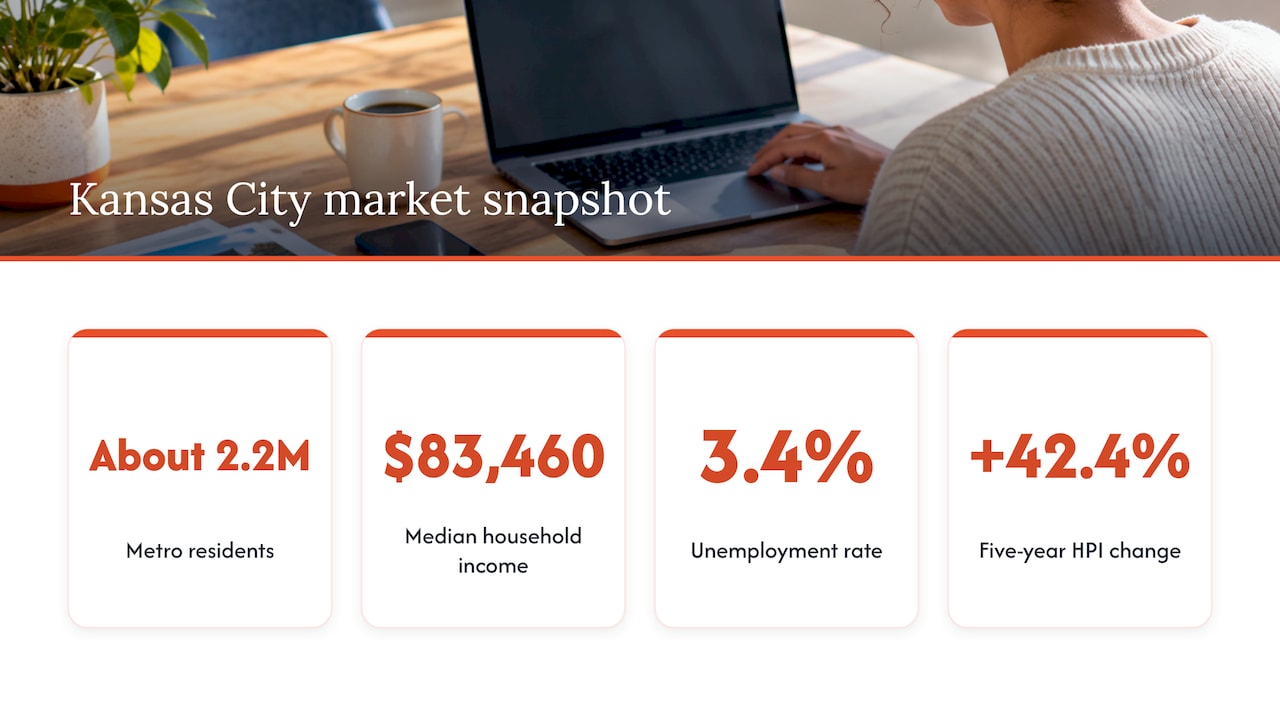
The metro holds about 2.2 million residents, with a median household income of $83,460 and unemployment of 3.4%, close to the national figure, according to REI Prime’s 2026 market data. The same source puts the price-to-income ratio at 3.4, a little under the national median, and shows the House Price Index up 42.4% over five years.
Prices have kept rising, but not fast. Saving KC Research reported in October 2026 a metro median home price of $315,000, up 4.7% from a year earlier, with 19.0% of MLS sales paid in cash. Homes took a median 35 days to sell, up from 32, and pending sales fell 15.8%.
On the multifamily side, the picture is mixed. Northmarq’s Q2 2026 report shows vacancy trending higher as completions accelerate, with net absorption under 100 units in the first half of 2026 against more than 1,300 in the same period of 2025. Vacancy is estimated to reach 8% by the end of 2026. Absorption should stay positive, though, which leaves operators room to keep raising rents where new construction has been light.
Capital is still moving in. Institutional Property Advisors reports that the average price per unit climbed 4% year over year as of March 2026, with deals from $1 million to $10 million up 35% and deals above $20 million up 65%.
The northern submarkets: where rents are growing
If your priority is rent growth, look north of the river. Northmarq found the northern submarkets were the metro’s top performers in Q2 2026. Platte led, with vacancy down 150 basis points. North Kansas City, Gladstone/Liberty and Independence were the top areas for rent growth, with asking rents up an average of 3.1% year over year.
The pipeline explains part of this. IPA’s report says development is shifting to the Missouri side, with Central Kansas City anchoring 23% of deliveries and Lee’s Summit-Blue Springs-Raytown about 20%. Submarkets that get fewer new units face less new supply competing for tenants.
Independence and North Kansas City
These are the cash-flow markets. Crown Mortgage’s September 2026 guide cites Independence median prices of $170,000 to $220,000 against rents of $1,100 to $1,400, producing cap rates around 6.5 to 7%, and some stabilized properties reaching 7 to 8%. North Kansas City cap rates are commonly cited between 7 and 9%.
What to check: these are older housing stocks. Budget for roofs, sewer laterals and HVAC, and price renovation before you offer. Cap rates quoted in guides are starting points, not your numbers.
Waldo and Volker: renter demand near the core
Waldo
Waldo sits in the heart of Kansas City, Missouri, with an active business association, the Waldo Area Business Association, founded in 1965. Its Community Improvement District, established in 2009, funds daily trash removal, graffiti removal, landscape maintenance and daily security patrols. That kind of upkeep helps hold tenant interest on the commercial streets near your rental.
On price, sources differ with the property type and date. DSCR Direct’s March 2026 guide lists Waldo single-family homes at $220,000 to $400,000 with rents of $1,400 to $2,200. Crown Mortgage describes entry costs generally from $350,000 with cap rates of 4 to 5%, backed by a deep pool of UMKC students and young professionals. Treat Waldo as a balanced play: appreciation and tenant depth over top yield.
Volker
Volker runs from 31st Street to 43rd Street, with State Line Road on the west, per Flatland KC. Lendmire’s July 2026 guide reports duplex rents of $2,450 a month near UMKC, a location directly on the extended KC Streetcar line, and more than 150 properties bought by local investors along the corridor before the line opened.
If you plan to rent short term in Volker, read the rules first. The neighborhood association president told Flatland KC that unlicensed short-term rentals have multiplied and that enforcement is a concern. Licensing and compliance should be part of your plan, and a long-term lease to a UMKC-area tenant sidesteps the question.
Crossroads and the urban core
The Crossroads Arts District sits just south of downtown Kansas City, Missouri, north of Union Station, east of I-35 and west of Troost. It is a strong lifestyle address. For investors, the numbers deserve care: Lendmire cites the Crossroads, Midtown and Crown Center corridor running vacancy above 13%, even as citywide occupancy is projected near 93.4% by year-end.
In practice, urban-core units compete with new apartment deliveries. Parking can also affect rentability: the district lists public garage parking at $55 a month and public lot parking at $40 a month. Include parking in your tenant offer.
Overland Park, Leawood and Parkville: the stability plays
Northmarq expects Overland Park to remain the leading area for multifamily sales activity, though its share may thin as deals close elsewhere. The city’s official recreation page lists a 300-acre arboretum, a 96-acre soccer complex with 12 lighted turf fields and the Deanna Rose Children’s Farmstead. Those amenities help keep family tenants in place.
Leawood is the high-price end of the Kansas side. Lendmire puts the median sale price near $761,000 and describes it as a stability play rather than a yield play, with cap rates of 4 to 6%. Repit’s 2026 data for ZIP 66206 shows an average home value of $769,928 against rent of $2,285, a 2.3% cap rate, and a 5-year CAGR of 7.5%. Buy here for preservation and long-tenure tenants, not monthly cash flow.
Parkville is more moderate. Prop:Metrics data as of May 2026 shows a median price of $354,000 (up 1.9%), median rent of $1,820 (up 5.0%) and 45 median days on market. Price figures vary by source and ZIP definition, so compare like with like.
Neighborhood comparison
| Area | Typical entry price | Typical rent | Cap rate signal | Best for |
|---|---|---|---|---|
| Independence, MO | $170,000 to $220,000 | $1,100 to $1,400 | 6.5 to 7%, some 7 to 8% | Cash flow |
| North Kansas City, MO | Varies by property | Rents up 3.1% in the northern submarkets | 7 to 9% commonly cited | Yield with rent growth |
| Waldo, MO | $220,000 to $400,000 | $1,400 to $2,200 | 4 to 5% (entry $350,000+) | Balanced, deep tenant pool |
| Volker, MO | Varies by property | Duplex $2,450 | Not stated | Streetcar and UMKC demand |
| Parkville, MO | $354,000 median | $1,820 median | Not stated | Moderate-price suburban |
| Leawood, KS | About $770,000 | $2,285 | 2.3% in ZIP 66206 | Stability |
Missouri or Kansas: rules that change the math
The state line changes your costs. First Home Start Guide’s February 2026 analysis notes the Kansas side has no state transfer tax and no mortgage registration tax, a 3-day nonpayment eviction notice versus Missouri’s 5-day, and a statewide rent control ban under K.S.A. 12-16,120. The Missouri side offers lower median home values in Kansas City proper and no Wyandotte County mill levy cutting into net operating income.
Rules change, so confirm current law and local ordinances with a licensed Missouri or Kansas attorney before you sign a lease template or serve a notice.
One more development: the Kansas City Business Journal reported on November 9, 2026 that the federal government designated Opportunity Zones across the KC area, from downtown to Olathe, on both sides of the state line. If a property sits in one, ask your tax adviser how the incentive applies to your situation.
The financing reality check
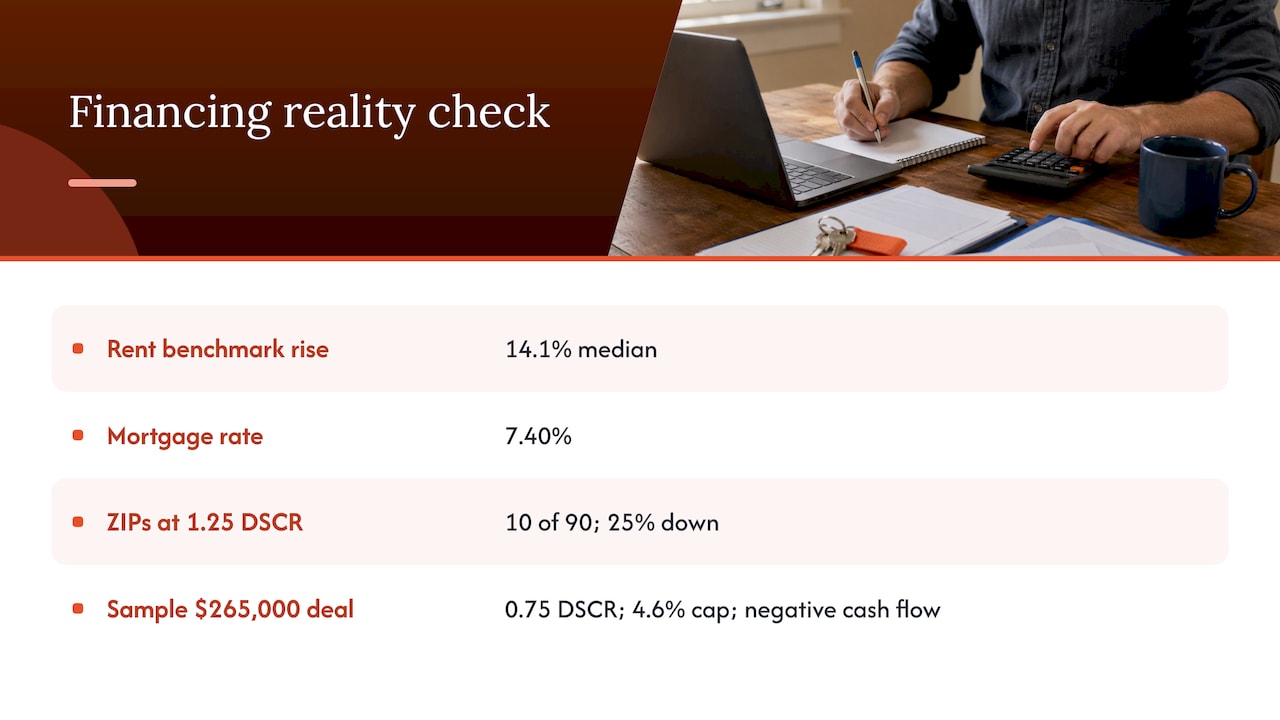
Higher rents do not automatically mean easy deals. Saving KC Research found that after HUD’s Kansas City rent benchmarks rose a median 14.1% on October 1, 2026, at a 7.40% mortgage rate rent covered a 25%-down loan at 1.25 debt coverage in only 10 of 90 ZIP codes with enough sales.
Price bands matter too. Of 4,385 closed sales in August and September, only 260 sold under $150,000, and 53.1% of those were paid in cash. In the $150,000 to $250,000 band, there were 762 sales with a 19.0% cash share. Sub-$150,000 homes draw cash buyers, so a financed offer faces more competition there.
TrueCap’s FY2026 data shows how thin a financed deal can run: a sample $265,000 purchase using a 3-bedroom HUD Fair Market Rent of $1,769 as a placeholder came to negative cash flow, a 4.6% cap rate and a 0.75 DSCR. Underwrite with real rent comps, real repair costs and a management fee.
How to match an area to your budget and goals
Start with the number you need the property to do, then work backward.
- Under about $250,000, cash flow first. Independence and North Kansas City are the obvious places to look. Plan a renovation budget and a reserve.
- $250,000 to $400,000, balanced return. Waldo, Parkville and parts of Volker give you tenant depth and appreciation potential. Expect cap rates in the middle range.
- $400,000 and up, preservation. Overland Park and Leawood suit investors who value stable, long-tenure tenants and can accept a thinner yield.
- Larger capital, multifamily or build-to-rent. Look at where the pipeline is thin, since less new supply supports rent growth, and at submarkets where vacancy is already falling.
Then check three risks for any area: new supply nearby, the true cost of repairs, and how you will handle leasing and maintenance if you live elsewhere. Our single-family rental guide walks through the single-family case.
Looking at Houston as well?
Many Kansas City investors weigh a second market. How investors compare rental markets across regions tends to come down to the same few measures: vacancy, rent growth and price-to-rent. How investors compare rental markets shows that approach in another region. For Houston, we have written about why Houston keeps attracting long-term investors and what makes Houston a top rental market.
Our perspective
Kansas City rewards investors who match the neighborhood to the plan and then run the property well. We have served 2,700 properties across 10 regional markets in over 15 years, and the pattern is consistent: returns are decided as much by operations as by the purchase price.
That is why our approach pairs local market expertise with investor-focused strategy. Our pod-based teams give each owner a focused point of contact. Our in-house maintenance and transparent vendor selection are designed to keep repair costs and turnaround under control. Proactive resident retention is meant to keep units occupied.
For an investor who does not live in Kansas City, we think the right setup is a partner who can handle acquisition, leasing, renovation oversight and asset management in one place, so you keep the returns and give up the day-to-day.
MediaBeast
How Auben can help
Whether you are buying your first rental or growing a portfolio, we cover the full path. Our brokerage services help you find and buy, property management covers leasing, maintenance and resident care, and asset management keeps a portfolio working toward your goals. For larger holdings, see our multifamily and build-to-rent services.
Talk to our team through aubenrealty.com about the Kansas City area that fits your budget.
FAQ
Is Kansas City a good place to invest in real estate?
It can be, depending on strategy. REI Prime shows prices a little below national norms relative to income, and Northmarq reports rent growth in the northern submarkets. Rising vacancy from new completions and tight financing math mean each deal needs careful underwriting.
Which Kansas City suburbs are best for rental property?
For cash flow, look at Independence and North Kansas City. For a balance of tenant depth and appreciation, Waldo and Parkville are common picks. Overland Park and Leawood suit stability-minded investors who accept lower yields.
Is Kansas City growing or declining?
The metro is growing. REI Prime reports net migration of 2,315 households and building permits for 12,321 units over the trailing twelve months, up 29.7%.
Should I invest on the Missouri or Kansas side?
It depends on costs and rules. Kansas has no state transfer tax and a 3-day nonpayment eviction notice, while Missouri’s Kansas City proper has lower median home values. Confirm current law with a local attorney.
Sources
- REI Prime: Kansas City Real Estate Market 2026
- Saving KC Research: KC investor update, October 2026
- Northmarq: Kansas City Multifamily Market Insights, Q2 2026
- Institutional Property Advisors: Kansas City Multifamily Market Report, Q2 2026
- Crown Mortgage: Top 10 KC neighborhoods for rental property
- DSCR Direct: Best Kansas City neighborhoods for rental properties
- Lendmire: Investment property loans in Kansas City
- Waldo KC
- Waldo KC: Community Improvement District
- Flatland KC: Unlicensed short-term rentals
- Crossroads Arts District: Visitor information
- City of Overland Park: Recreation and Fun
- Repit: ZIP 66206 data
- Prop:Metrics: ZIP 64151 data
- First Home Start Guide: Kansas vs Missouri real estate investment
- TrueCap: Kansas City rental market data
- Kansas City Business Journal: Opportunity Zones designated
- Guide to comparing rental markets by region