Rental Showing Scheduling: A Practical Playbook for Landlords
November 6, 2026
The best way to schedule rental showings is to stop negotiating times one text at a time. Set fixed availability windows, ask a few screening questions before you book, confirm instantly, remind twice, and follow up the same day. A system like that fills your calendar with serious prospects and keeps your unit from sitting empty while you play phone tag.
This guide walks through each step, from the first inquiry to the post-tour application link. It also covers the questions owners ask most, including what to do when the unit is still occupied.
TL;DR
- Offer set tour windows instead of open-ended times. Weekend afternoons and early weekday evenings are the usual sweet spots.
- Keep tours short, leave drive-time gaps, and stack several showings back to back at one property.
- Send a confirmation right away, a reminder 24 hours ahead, and another 1 to 2 hours before the tour to cut no-shows.
- When the unit is occupied, follow your lease and your state’s entry-notice rules. Many require about 24 hours’ written notice.
- Send an application link right after the tour and follow up if it is not started.
Table of Contents
- Scheduled tours or self-guided showings
- Set availability, duration and buffers
- Screen before you book
- Confirm and remind: the no-show sequence
- Scattered single-family homes: batch by area
- When the unit is still occupied
- Safety, privacy and fair housing
- After the tour: follow-up wins the lease
- Choosing tools without overbuilding
- Perspective: scheduling is a leasing system, not a calendar task
- Let us handle the showings
- FAQ
- Sources
Scheduled tours or self-guided showings
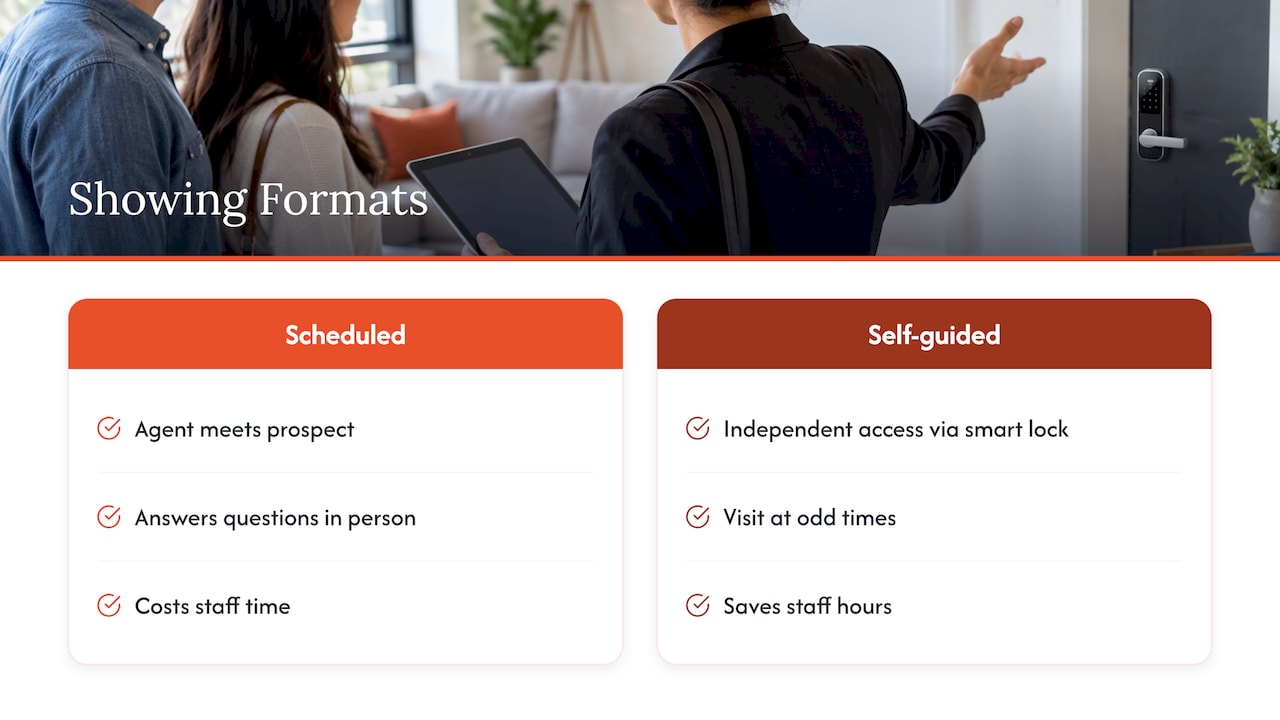
Start with the format, because it decides everything else. A scheduled tour means a person meets the prospect at the property. A self-guided tour means the prospect gets access on their own, usually through a smart lock or lockbox code.
Scheduled tours give you a conversation. You answer questions, point out what matters and read the room. They cost you time, which is why the rest of this guide is about making that time efficient.
Self-guided tours save staff hours and let prospects visit at odd times. Industry reporting says AI-enabled self-guided tours can bring efficiency gains, though technology does not perfectly replicate a skilled leasing agent. For a vacant single-family home or a small multifamily building, many owners use a mix: self-guided for early-stage browsers, scheduled tours for finalists and for anyone with questions about the neighborhood, the lease or the renovation work.
A simple rule: if your average prospect needs reassurance, schedule a person. If your average prospect just needs to see the layout, self-guided is a reasonable fit. Whichever you choose, the scheduling principles below still apply, because even a self-guided visit needs a booked window, an identity check and a reminder.
Set availability, duration and buffers
The number one mistake is leaving your calendar open. Prospects then propose times that suit them, you counter, and half the conversations die before a tour is booked.
Instead, publish specific windows. Early afternoons on weekends, primarily Saturdays, and early evenings on weekdays while it is still daylight tend to work best. Pick one or two weekday evenings and one weekend block, and keep them consistent so you build a rhythm.
How long should a showing be?
Short. Scheduling guidance from a showing platform’s own documentation recommends showing durations of no more than 15 minutes unless there is a good reason, and suggests allowing drive-time gaps between listings. Fifteen minutes is enough for a typical apartment or small home. Larger homes, or a property with a yard, garage and outbuildings, may justify 20 to 30.
Cluster showings and add buffers
If you have one vacant property, offer several appointments in a row. A common approach is to group several showings at the same property and set buffer time between appointments. You travel once, you open the door once, and prospects who arrive while another group is leaving see that the unit is in demand.
A sample block for one Saturday:
| Time | What happens |
|---|---|
| 1:45 p.m. | You arrive, unlock, turn on lights, open blinds |
| 2:00 p.m. | Tour 1 (15 minutes) |
| 2:20 p.m. | Tour 2 (15 minutes) |
| 2:40 p.m. | Tour 3 (15 minutes) |
| 3:00 p.m. | Walk-through, lock up, log notes |
Require advance notice
Same-day requests are tempting, but they produce the most no-shows and the most rushed prep. Some booking tools enforce this automatically. One platform’s documentation says automatic booking requires calendar integration and a 24-hour minimum notice, offering the earliest time that meets the rule when someone asks for a same-day or next-day tour. You can apply the same logic by hand: if you do not have a window in the next 24 hours, say so and offer the next one.
Screen before you book
Every wasted tour costs you an hour or more. A few questions before the appointment filter out people who cannot qualify. Ask:
- What is your target move-in date?
- How many people will live in the home?
- Do you have pets, and what kind?
- Are you comfortable with the monthly rent and the application requirements as listed?
Put your published criteria (income requirements, pet policy, lease length) in the listing so prospects self-select. Apply the same questions and the same criteria to everyone. Consistency protects you under fair-housing rules and makes your process easier to defend. For more on what a good screening process looks like after the tour, read how a property manager screens prospective tenants.
You can collect these answers through a booking form, so they arrive attached to the appointment. Pre-qualification questions and scheduling rules are the first two steps of a workable showing workflow, followed by automatic confirmations and reminders.
Confirm and remind: the no-show sequence
A tour that is booked but forgotten is the same as an empty slot. The fix is a short, predictable message sequence:
- Immediately after booking: a confirmation with the address, date, time, your name and a way to cancel or reschedule.
- 24 hours before: a reminder, with parking or entry instructions.
- 1 to 2 hours before: a short day-of reminder.
This three-step pattern is the one recommended for reducing no-shows. Make rescheduling effortless. A prospect who can tap a link to move their slot is far less likely to ghost you than one who has to text an apology.
Two small additions help. First, ask prospects to reply to confirm in the 24-hour message. A non-reply tells you to expect a gap and gives you time to fill it from a waitlist. Second, keep a short list of people who asked about times you could not offer, so a canceled slot becomes a booked one.
Scattered single-family homes: batch by area
If you manage houses spread across a metro area, scheduling gets harder. Showing scattered-site single-family rentals is a different job from showing units in one building, and batching showings by geographic zone prevents the zigzagging that eats an afternoon.
In practice, that means assigning each property to a zone, such as north side, south side or the beach communities, and offering tours by zone on set days. In a market like Dallas-Fort Worth or Houston, where traffic can turn a 10-mile trip into 45 minutes, this is the difference between five showings in an afternoon and two. Tell prospects honestly that a given day covers a given area, and offer them the next day for that zone if they miss it.
When the unit is still occupied
Occupied units add a second party to your schedule. Your first stop is the lease, and your second is your state’s landlord-tenant law. Rules vary a lot.
- Notice: Many states require advance notice and reasonable hours for non-emergency entry. According to one legal-clause summary, Alabama requires at least two days’ notice, Alaska requires 24 hours, and California presumes 24 hours’ written notice is reasonable. Verify your own state’s statute before you rely on any summary.
- California example: The Los Angeles County consumer office says a landlord must give 24-hour advance written notice before entering, stating a specific entry time during normal business hours. Emergencies are the exception, and the right of entry cannot be used to harass a tenant.
- Tenants are not your leasing agents. Reporting on New York City practice notes that most leases require tenants to allow access for showings with reasonable notice, but tenants are not responsible for doing the agent’s job. Agents there typically give at least 24 hours’ notice, and tenants do not have to be present.
Permission matters even when notice alone would be enough. One housing-advice article quotes a lawyer who says a tenant given 24 hours’ notice must allow entry whether or not they agree, while another voice in the same piece says asking permission makes tenants more likely to tidy up. The second approach wins on results. A clean, well-lit unit shows better.
Practical habits for occupied showings:
- Send written notice with the exact time window, and keep a copy.
- Cluster showings into one or two blocks per week so the tenant is not disrupted daily.
- Thank the tenant, and follow up when the visit is done.
- Never stack so many entries that they start to look like harassment.
Good relationships with departing tenants also shape the condition of your unit at turnover. See three ways to make sure tenants take care of a rental home.
Safety, privacy and fair housing
Scheduling is also a risk-management step. A few protections cost nothing:
- Verify who is coming. Collect a name and phone number at booking. For first-time visitors, let someone else know your schedule if you are showing alone.
- Keep the process consistent. Offer the same windows, the same questions and the same follow-up to every prospect, and write down your criteria in advance.
- Be careful with identity technology. Some self-guided systems ask visitors for face scans. Consumer advocates quoted by The Markup warn that scans may be improperly shared or used to exclude renters, and may falsely flag people of color. If you use access technology, collect only what you need, tell prospects what you collect and why, and ask your attorney about your state’s privacy rules.
- Control access. Use time-limited codes for self-guided tours, and make sure the unit is secure after each visit.
For how technology and personal service fit together, see why human-centered service still matters in a tech-driven rental world.
After the tour: follow-up wins the lease
Most owners treat the tour as the finish line. It is the middle of the process. One leasing-automation firm argues that the post-tour handoff is where conversion is won or lost: send the application link right away and follow up if it is not started.
A simple follow-up plan:
- Within an hour: a thank-you message with the application link, the screening criteria and the deposit and move-in terms.
- Next morning: a short feedback question, such as whether anything about the home gave them pause.
- Two days later: a nudge if the application has not been started, and a clear note if another applicant is moving forward.
Automated feedback requests are a recommended final step, and the answers are useful. If three prospects in a row say the rent is high or the photos looked better than the carpet, you have market feedback you can act on before the vacancy drags on. To go further, read our landlord’s playbook for reducing vacancy and our tips for minimizing vacancy rates.
Choosing tools without overbuilding
You do not need a big system to start. A shared calendar, a booking link, a form with your screening questions and a set of message templates will carry you through a handful of showings a week. As volume grows, look for these features:
- Calendar sync, so double-bookings cannot happen
- Automatic confirmations and reminders
- Buffer time and duration settings per property
- Pre-qualification questions attached to each booking
- Cancel and reschedule links
- A record of every showing and its outcome
At portfolio scale, a unified system that handles scheduling, tracking and follow-up replaces spreadsheets and shifts you from reactive scrambling to proactive management. Pricing for these tools changes often, so check each provider’s current page before you commit. Our post on how great property managers embrace technology covers how to choose tech that helps rather than clutters.
Perspective: scheduling is a leasing system, not a calendar task
We manage rentals across ten regional markets, and the lesson repeats in every one: showings go wrong when they are treated as errands. They go right when they are treated as part of a leasing system that starts with the listing and ends with a signed lease.
That is why our pod-based team structure matters. A focused group of people knows your properties, your zones and your criteria. The person who answers an inquiry understands the home, the maintenance history and the neighborhood, and can book the right tour for the right prospect.
Our in-house maintenance team also helps at the showing stage. A unit that is cleaned, repaired and ready on the day of the tour shows better and leases faster. Technology handles confirmations and reminders, and our people handle the conversations that technology cannot.
For owners, the aim is simple: less time on the phone, fewer empty days, and a tenant who stays.
MediaBeast
Let us handle the showings
If you would rather not coordinate tours, reminders and follow-up yourself, our property management services include leasing and tenant placement, with local teams in each of our markets. You get the leasing coverage without giving up your weekends.

Looking for a home to rent instead? Browse our current rental listings and book a tour. If you are weighing a management company against a private landlord, this comparison of renting from property management companies and private landlords may help. Owners planning ahead for busy months can also use our leasing season tips.
FAQ
How many showings does it take to rent a home?
It varies by market, price and condition, so there is no reliable universal number. Some landlords report needing several showings per qualified applicant. Pre-screening questions, clear listing criteria and strong photos reduce the count, because they bring in people who can actually qualify.
What are the best times to show a rental?
Weekend early afternoons, primarily Saturdays, and early weekday evenings while it is still light tend to work best according to leasing guidance. Offer a consistent set of windows, and add a second weekday if demand is high. Always show in daylight when you can, so the unit looks its best and you stay safe.
Are tenants responsible for showings?
Generally, tenants must allow access with proper notice if the lease and state law say so, but they are not responsible for showing the home. In New York City practice, tenants are not expected to do the agent’s job. Check your lease and your state’s entry rules, and ask an attorney if you are unsure.
How much notice do I need to show an occupied unit?
It depends on your state. Many require 24 hours’ written notice, while others require more, such as two days in Alabama. Look up your state’s statute or ask a local landlord-tenant attorney before you schedule entries.
Should I use self-guided tours?
They can save time and widen your availability, especially for vacant units. Many owners pair them with scheduled tours for serious applicants. Whatever you choose, use time-limited access, collect only the identity information you need, and apply the same process to every prospect.
Sources
- How to organize and track property showings
- Single family rentals: leasing challenges
- Configure a calendar for individual clustered showings
- How to book tours and viewings automatically
- Schedule rental showings without texting back and forth
- How to automate tour scheduling for rental leads
- AI is changing the calculation on self-guided apartment tours
- Touring a rental? A face scan may be required
- Landlord entering your unit, LA County Consumer and Business Affairs
- Do I have to help show my apartment?
- Do I have to let a realtor show my apartment?
- Landlord entry for showings