Rental Renovation ROI: How to Calculate It and Spend Wisely
November 12, 2026
Rental renovation ROI is the annual rent your upgrade adds, divided by everything the project costs you, including lost rent while the unit sits empty. A $10,000 upgrade that adds $100 a month returns 12% a year before financing, taxes and vacancy. The number only holds if the rent premium is real for your submarket, so the work is in testing that premium before you spend. Owners who want the calculation, the contractors and the rent comparison handled by one team can bring the project to Auben’s project management service.
TL;DR
- Simple ROI is (annual rent increase ÷ total renovation cost) × 100. Count lost rent, carrying costs and a contingency in the cost, not just the contractor’s bid.
- Work backward: divide the cost by 12 and by your target yield to get the monthly rent premium you need, then check it against comparable rents nearby.
- Match the scope to the submarket’s rent ceiling. Finishes that outrun the neighborhood do not earn their cost back.
- Capital improvements to a residential rental are depreciated over 27.5 years, and permits may be required. Confirm both with a tax advisor and your local building department before work starts.
- Renovate between tenants and sequence multi-unit work as units turn over, so you never pay for avoidable vacancy.
Table of Contents
- The basic ROI formula for a rental renovation
- What belongs in the cost side
- What counts on the benefit side
- How to estimate whether an upgrade will actually raise rent
- Avoiding over-renovation
- Timing, sequencing and multi-unit work
- Tax and permit rules to check first
- Where owners lose money on renovations
- Perspective
- Let us run the numbers and the project
- FAQ
- Sources
The basic ROI formula for a rental renovation
The most common version is simple: annual rent increase divided by renovation cost, times 100. One investor guide states it exactly that way. Another landlord resource gives a worked case: a $10,000 upgrade that adds $1,200 a year in rent yields a 12% return.
A quick screen many landlords use is the 1% rule for upgrades: the monthly rent increase should be at least 1% of the cost, so a $10,000 project should add $100 a month. HonestCasa pairs it with a payback test, calling under 24 months a strong investment and under 12 months excellent. Treat these as screens, not guarantees. They tell you whether a project deserves a closer look.
Payback period: the second number to know
ROI tells you the yearly yield. Payback tells you how long your cash is tied up. Divide the total cost by the added monthly income to get months to recover the spend. One interior renovation analysis shows how much the market matters: a $4,000 per-unit scope that earns an $80 monthly premium pays back in about 4.2 years, while the same scope in an over-improved submarket earning only $40 a month takes about 8.3 years.
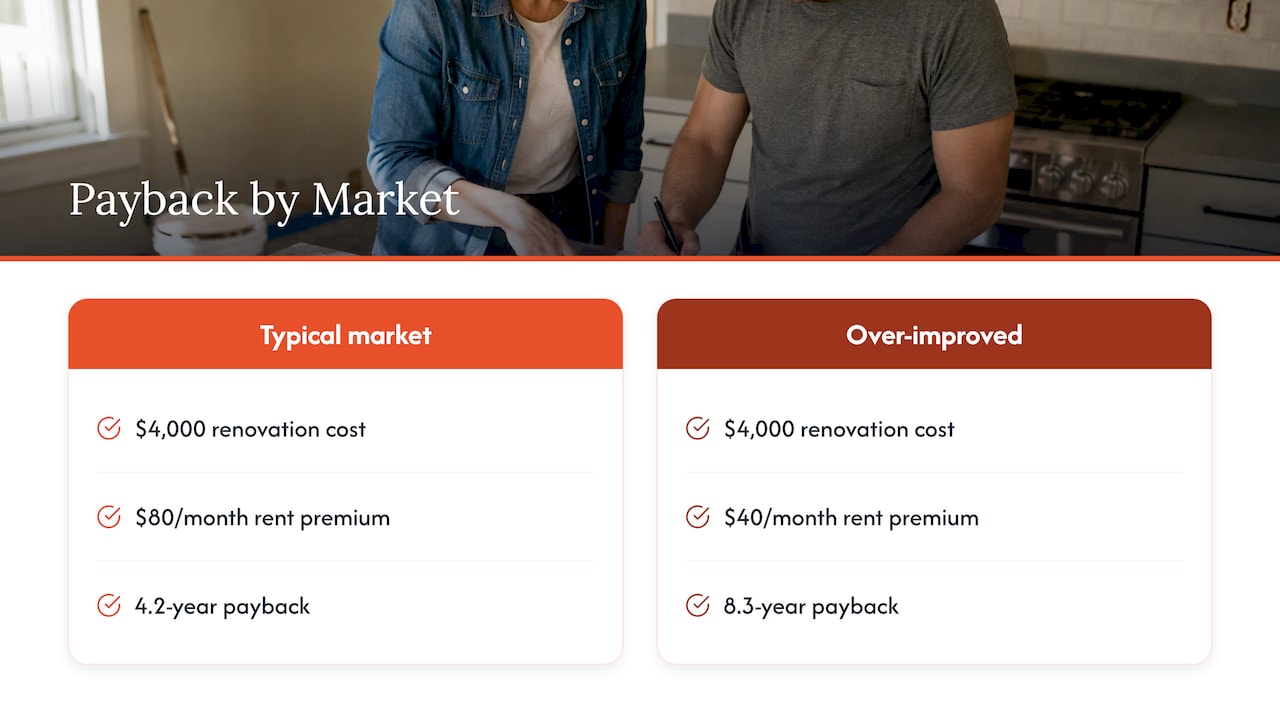
The same work, the same cost, and a payback that doubles. That is why comparing the payback to your planned holding period matters more than any rule of thumb.
What belongs in the cost side
Most ROI mistakes happen in the denominator. A contractor’s quote is only part of what the project costs you.
Costs that are easy to forget
- Lost rent while the unit is down. One payback calculator adds the prior monthly rent multiplied by the months with no rent to the renovation cost, which is the honest way to count it.
- Carrying costs. Experienced investors count construction, permits, financing, insurance, property taxes and utilities. A hard-money lender’s guide points out that a six-month renovation that stretches to nine months adds three more months of interest, taxes, insurance and utilities.
- Permits and contingency. One per-unit budgeting guide shows a $14,000 hard-cost renovation becoming $17,000 to $19,000 once you add 15% contingency, $1,500 in carry cost and $800 in permits.
- Management fees for running the project. If someone else coordinates bids, schedules and inspections, that fee is part of the project cost, and so is your own time if you do it yourself.
- Financing. Borrowing changes the math. A 12% cash return on a renovation can shrink once interest is deducted, so run the calculation both with and without the loan.
Worked example
Say you plan a $9,000 refresh of a three-bedroom single-family rental: paint, flooring, a new vanity and lighting.
| Line item | Amount |
|---|---|
| Contractor bid | $9,000 |
| 15% contingency | $1,350 |
| Lost rent (3 weeks at $1,800/month) | about $1,250 |
| Permits and carry | $600 |
| Total cost | about $12,200 |
If the work lifts rent from $1,800 to $1,950, the added income is $150 a month, or $1,800 a year. Simple ROI is $1,800 ÷ $12,200, about 14.8%. Payback is roughly 81 months of the premium alone. The example is illustrative, not a market figure. The point is that the bid alone ($9,000) would have suggested a 20% return, and the full cost cuts it by a third.
What counts on the benefit side
Rent increase is the headline, but three benefits can feed the return:
- Higher rent. The premium over comparable unrenovated units.
- Lower vacancy. Cosmetic work often earns its keep by getting units rented faster rather than by lifting rent. Our guide to reducing your rental vacancy rate covers the days-on-market side. Count the saved vacancy days in dollars: at $1,800 a month, each week saved is worth roughly $420.
- Lower operating cost and higher value. New systems can reduce repair calls. Added net income also raises what the property is worth: divide the annual net income increase by the local cap rate. That calculator-style estimate only holds if buyers price the property on income, and it ignores financing, taxes and the time value of money.
Institutional operators set the bar higher than most small landlords. One value-add guide for asset managers says they commonly target a 15% to 25% unlevered return on renovation cost, with payback under 36 months. Another investor guide cites a common goal of $2 back in value or rent for every $1 spent over the hold period.
How to estimate whether an upgrade will actually raise rent
This is the question that decides the whole calculation, and it is answered by comparison, not by theory.
- Pull comparable listings. Find at least five active and recently leased rentals within a mile or so, same bedroom count and similar age. Separate renovated from unrenovated and note the gap in rent.
- Identify what the premium units have. If every renovated comp has quartz counters and luxury vinyl plank, those are the features tenants are paying for. If they only have fresh paint, a full kitchen gut will not be paid for.
- Check days on market. A renovated unit priced at the top of the range but sitting for six weeks has not earned its premium.
- Apply a haircut. Use the low end of the premium range in your base case, not the average.
- Ask which kind of return you are buying. Kitchen and bathroom work tends to move rent most, and paint and flooring tend to shorten vacancy rather than raise rent, according to a 2026 landlord publication reporting on the UK market. US results depend on the submarket, so verify with local comps. If you are weighing bathroom updates, this guide to bathroom renovation ideas can help you compare scopes and budgets before you collect bids.
Our own write-up on the best renovations for your rental property goes through which upgrades tenants respond to, and the guide on making a single-family home more appealing to renters covers the smaller touches.
Avoiding over-renovation
Over-renovating is the most common way a rental project loses money. The rent ceiling in your submarket limits what any scope can earn.
The backward formula
Instead of asking what a renovation will earn, ask what it must earn. One budgeting guide uses: required monthly rent premium = (renovation cost × target yield) ÷ 12. For a $15,000 per-unit budget at a 10% target yield, that is $125 a month. If comparable rents do not show a $125 gap, the scope is too big.
The hold-period test
Take the target post-renovation rent, subtract the current rent, and divide by 12 if you are working from annual figures, or use the monthly gap directly. Then compute payback. If payback runs longer than you plan to own the property, the project is over-scoped for your business plan.
Match the neighborhood
The best-returning scope is the one calibrated to the submarket’s rent ceiling and your property’s position within it. The same analysis notes that a Class C submarket where Class B rents are $1,200 a month cannot support the renovation spend of a Class B submarket where Class A rents are $1,800. Another guide puts it plainly: luxury finishes in a Class C neighborhood do not command a premium.
Stress-test the deal
Professional investors pressure-test deals: if costs rise, does the project still work? If the property sells for less than expected, is the margin still acceptable? Rerun your numbers with costs 15% higher and the rent premium 25% lower. If the return survives, the plan is sound.
Timing, sequencing and multi-unit work
Vacancy is the hidden cost of renovation, so schedule work to coincide with natural turnover. For multifamily, renovate as units turn over rather than emptying a building at once. For a single-family home, line the work up between tenants and aim to finish just ahead of the strongest leasing months. Our notes on leasing season explain why timing the listing matters as much as the work itself.
Curb appeal is a low-cost lever that sits outside the interior budget. See our curb appeal tips for what tends to matter at showing time.
Tax and permit rules to check first
These are the two items that can change your return after the check is written.
Depreciation. For residential rental property, the IRS sets a recovery period of 27.5 years under the general depreciation system. The same IRS publication says the cost of improvements is recovered through depreciation. In practice, a capital improvement is typically spread over decades instead of deducted in one year, while a true repair may be deductible right away. The line between repair and improvement is a judgment call, and bonus depreciation rules change, so talk to your CPA or tax advisor before a large project.
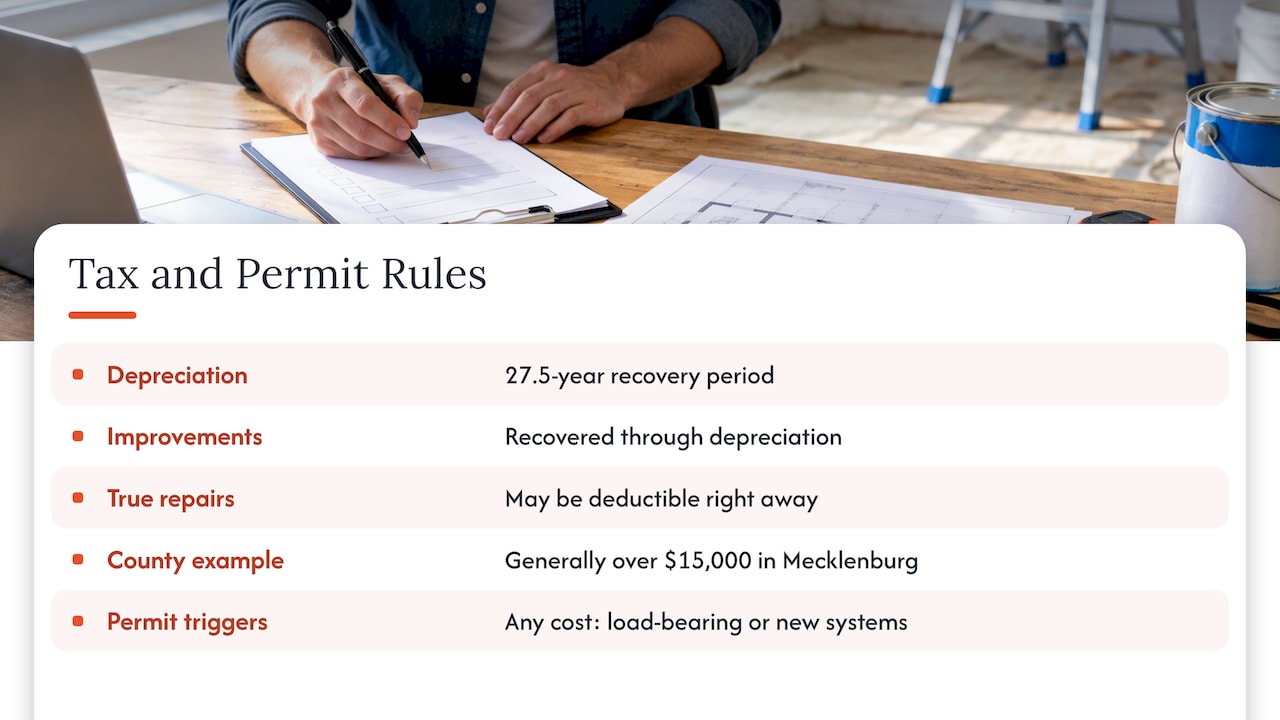
Permits. Rules are local. As one example, in Mecklenburg County, NC, permits are generally required for work costing more than $15,000, and regardless of cost for work involving load-bearing structures or new plumbing, heating, air conditioning or electrical systems. Check your own city or county building department before you sign a contract, because unpermitted work can create problems at resale and with insurance.
Where owners lose money on renovations
- Budgeting the bid, not the project: no contingency, no carry, no lost rent.
- Copying a neighbor’s finishes without checking what the neighbor’s tenants pay.
- Choosing scope by taste instead of by the rent gap in comps.
- Letting a project drift from six months to nine while interest and taxes keep running.
- Skipping the tax conversation until after the work is done.
Perspective
Most renovation disappointments we see start before the first contractor shows up: the scope was set by what looked good, not by what the submarket would pay. After more than 15 years and 2,700 properties served across 10 regional markets, our view is that the return is decided on paper first.
That is why we pair local market knowledge with an investor’s discipline. We ask what rent the neighborhood supports, work backward to the budget that earns it, and hold the scope to that number. A pod-based team means the people who know your property and your market stay close to the project, and our in-house maintenance and transparent vendor selection are built to keep costs visible and the schedule honest.
Renovation is also a leasing decision. We think about resident retention and days on market from day one, because a unit that rents quickly and stays rented is where the real yield comes from. Our goal for owners is a property that performs, with as little of their own time spent as possible.
MediaBeast
Let us run the numbers and the project
If you would rather not coordinate bids, schedules and inspections yourself, our project management service covers renovation oversight, and our property management team handles leasing and day-to-day operations once the work is done. Investors looking at the portfolio level can look at asset management. We serve Charleston and Columbia, SC, Dallas-Fort Worth and Houston, TX, Kansas City and Overland Park, and Jacksonville and Jacksonville Beach, FL, among our markets.

For a deeper walk-through of planning, see our practical owner’s guide to rental renovation management.
FAQ
What is a good ROI on a rental renovation?
It depends on your hold period and financing. A common small-landlord screen is a monthly rent increase of at least 1% of the project cost, which equals a 12% annual return. Larger operators often aim higher, with 15% to 25% unlevered returns and payback under 36 months.
Should I count lost rent in the calculation?
Yes. Add the rent you give up while the unit is empty to the renovation cost. Add carrying costs such as taxes, insurance and utilities too, since they continue during the work and rise if the schedule slips.
How much contingency should I budget?
A 15% contingency is a common planning figure in per-unit renovation budgets. Older homes with unknown conditions behind walls may warrant more, so ask your contractor what has not been inspected.
Are renovation costs tax deductible for a rental?
Capital improvements are generally recovered through depreciation, 27.5 years for residential rental property, while repairs may be deductible in the year they are paid. The classification depends on the work, so confirm with a CPA or tax advisor before a large project.
Sources
- How to Estimate ROI on Rental Property Renovations
- How to Measure ROI on Renovations for Rental Properties
- Rental Renovation Payback and Value Added Calculator
- Rental Property Amenities That Actually Pay for Themselves
- How Investors Evaluate Real Estate Deals Before an Offer
- Sizing a Value-Add Renovation Budget Per Unit
- Value-Add Renovation ROI for Interior Finishes
- Value-Add Renovations and Forced Appreciation
- Value-Add Multifamily Strategy Guide for Asset Managers
- Which Rental Property Upgrades Actually Increase Rent?
- IRS Publication 527, Residential Rental Property
- Permit assistance brochure, Mecklenburg County