Rental Listing Syndication: Get More Qualified Leads Fast
September 22, 2026
Yes, syndicate your listing. Post once, push it to a mix of major portals and local channels, then qualify leads fast rather than chasing every inquiry. The math is simple: one master listing that reaches renters on Zillow, Apartments.com, and a couple of hyper-local channels fills vacancies faster than any single site working alone.
Your fastest path depends on how hands-on you want to be:
- DIY workflow: Build one clean listing, sync it through a syndication tool or your PMS, then post manually to one or two local groups for extra intent.
- Managed syndication: Hand the listing, distribution, and lead screening to a property manager and skip the busywork entirely.
Key Takeaways
Rental listing syndication fills vacancies faster when you pair broad-reach portals with local channels and a tight pre-screen, not just more platforms.
| Point | Details |
|---|---|
| Build a layered stack | Combine major portals like Zillow and Apartments.com with local Facebook groups and Nextdoor for higher-intent leads. |
| Complete every required field | Missing rent, fees, or lease terms are the top cause of listings failing to sync or appearing incomplete. |
| Centralize your leads | Route inquiries to one inbox or your PMS instead of checking each portal’s dashboard separately. |
| Pre-screen before showings | A short form covering move-in date, income range, and pets filters out unqualified inquiries early. |
| Match effort to portfolio size | One or two units suit DIY syndication; larger portfolios or limited time favor a managed service like Aubenrealty. |
Table of Contents
- What Is Rental Listing Syndication and Why Does It Matter?
- Which Platforms Should You Include in Your Listing Stack?
- How Does Rental Listing Syndication Actually Work?
- How Do You Set Up a Syndicated Listing Step by Step?
- What Makes a Rental Listing Convert Better Than Average?
- Why Do Some Syndicated Listings Stop Working?
- What Fair Housing and Disclosure Rules Apply to Syndicated Listings?
- Rental Listing Syndication for Landlords: What Actually Moves the Needle
- Should You DIY Syndication or Hire a Manager?
- Frequently Asked Questions
- Sources
What Is Rental Listing Syndication and Why Does It Matter?
Rental listing syndication is the process of creating one master listing and automatically distributing it to multiple rental websites at once instead of posting to each one by hand. Think of it as a wire service for your vacancy: write it once, and it shows up everywhere your renters are already searching.
The upside is straightforward:
- Wider reach without repeating data entry on five different sites
- Faster fill times because more eyes see the unit sooner
- Consistent pricing, photos, and terms across every channel
- One inbox for leads instead of six logins to check daily
There are trade-offs, too. You lose some platform-level control over how a listing displays, and broad-reach channels can bring in a higher share of unqualified or scam inquiries. Fair housing compliance and required disclosures also need to travel with the listing to every partner site, not just your primary one.
Syndication tools commonly distribute a single listing to dozens of marketplaces at once, and network composition (which partner tiers a service reaches) matters more than the raw count of sites. A listing that hits three high-traffic portals and two local groups usually outperforms one blasted to twenty low-traffic directories.
Which Platforms Should You Include in Your Listing Stack?
Build your stack in layers: start with the highest-volume portals, then add local and niche channels based on your unit type and market. The American Association of Landlords recommends anchoring on Zillow and Apartments.com as your core, then layering in Facebook Marketplace, local Facebook housing groups, and Nextdoor for higher-intent traffic.
Here’s how the common channels break down:
- Zillow Rentals — the biggest audience for single-family and small multifamily units, strong for general market reach.
- Apartments.com (CoStar network) — deep coverage of multifamily and larger communities, useful if you manage several units in one building.
- Realtor.com Rentals — pulls in renters who are also comparing buying, a good fit for higher-end single-family homes.
- Zumper — popular with younger renters and those searching by neighborhood filters; strong mobile traffic.
- Craigslist — still generates volume in many metros but requires aggressive pre-screening since classified channels tend to attract more low-quality inquiries and scam attempts.
- Apartment List — indexes millions of units nationally and is worth including for broad matching volume in metro markets.
- Rental Beast — feeds listings into agent and MLS-adjacent networks, helpful if local agents refer tenants in your market.
- Buildium — a property management platform with built-in syndication for owners already using it to manage leases and maintenance.
- Reallyo — a syndication-focused service built to push listings across multiple marketplaces with a focus on complete, accurate field mapping.
Skip a channel if it doesn’t accept your listing type (some don’t support furnished or short-term units) or if past experience shows it brings mostly noise for your market.
How Does Rental Listing Syndication Actually Work?
Under the hood, syndication follows a simple chain: your master record feeds into a syndication platform, which pushes it out to partner portals, and leads flow back to one central inbox or your property management system (PMS).
Three common integration methods:
- PMS two-way sync — your property management software and the syndication tool stay updated automatically, so a price change or a “rented” status posts everywhere at once.
- Direct API or scheduled feed — a data feed (often CSV or XML) refreshes on a set schedule, common with tools built for PMS integrations and centralized lead capture.
- Manual posting — used for local Facebook groups, Nextdoor, or community boards that don’t accept automated feeds.
Every partner site has its own quirks: identity verification steps, moderation delays before a listing goes live, and slightly different required fields. Missing or mismatched fields are a leading cause of listings failing to sync or appearing incomplete. Route leads to one central inbox rather than checking six portal dashboards. Centralized capture is the difference between responding in minutes and losing a renter to whoever answers first.
How Do You Set Up a Syndicated Listing Step by Step?
- Gather your listing data: rent, deposit, lease term, availability date, pet policy, utilities included, and parking.
- Shoot 10 to 15 photos, including a strong hero image for the listing thumbnail.
- Write your master listing description with neighborhood anchors and clear terms.
- Enter the listing into your syndication tool or PMS and map every required field.
- Push to your core portals first, then add local channels manually.
- Set up a central inbox or auto-responder so leads land in one place.
- Check each platform within 24 to 48 hours to confirm the listing actually went live.
Quick troubleshooting checklist:
- Listing stuck in review? Check for missing required fields first.
- Showing twice on one site? You likely have a duplicate feed pushing the same data.
- No leads after a few days? Confirm the listing actually cleared moderation, not just submitted.
What Makes a Rental Listing Convert Better Than Average?
More views mean nothing if the leads aren’t real prospects. The fix starts with the listing itself, not the platforms it’s on.
Cover these basics every time: clear rent and fee breakdown, lease term, exact availability date, pet policy, what utilities are included, parking situation, laundry setup, and storage. Anchor the description with real neighborhood details, a specific grocery store, a school district name, a commute time to downtown, not vague phrases like “close to everything.” Use a strong primary photo and 10 to 15 total images with captions that call out features and nearby landmarks.

Add a short pre-screen form before you hand out a showing time. Ask move-in date, household income range, credit range, and whether the applicant has pets. This alone filters out a large share of unqualified inquiries before they hit your calendar.
Pro Tip: Run your major portals for volume, but hand-post to one or two local Facebook groups or a university housing board. That hybrid approach consistently pulls in higher-intent, lower-scam applicants than automated syndication alone.
Why Do Some Syndicated Listings Stop Working?
Most syndication problems trace back to a handful of repeat offenders:
- Listing not appearing on a partner site — usually a missing required field or a feed that hasn’t refreshed yet.
- Duplicate listings on the same platform — often caused by re-submitting manually while an automated feed is still active.
- Slow updates after a price or status change — check whether that partner uses a scheduled feed instead of real-time sync.
- Verification holds — some portals require identity or ownership verification before a listing goes live, which can take a day or two.
- Low-quality leads flooding your inbox — tighten your pre-screen questions rather than abandoning that channel.
Audit your feed mapping when the same error repeats across listings. Re-post manually only when a single listing is affected. If troubleshooting eats more hours than it saves, that’s the signal to hand syndication to a managed service instead of chasing partner support tickets.
What Fair Housing and Disclosure Rules Apply to Syndicated Listings?
Every syndicated copy of your listing carries the same legal weight as your original post. Federal fair housing law prohibits discrimination based on race, color, religion, sex, national origin, familial status, or disability in any advertisement, and that rule doesn’t loosen just because a partner site rewrote your description or auto-generated a summary.
Review language before it goes live. Phrases like “perfect for young professionals,” “no kids,” or “ideal for a single tenant” can violate fair housing rules even when the intent seems harmless. Photos matter too: avoid captions or descriptions that suggest a preference for or against any protected class.
Disclosures vary by state and sometimes by city, covering things like lead paint notices for older buildings, security deposit handling rules, or required move-in condition statements. When you syndicate to multiple partners, confirm each one displays your full listing text rather than truncating it in a way that drops a required disclosure. A shortened auto-summary that cuts your pet policy or lease term isn’t just confusing, it can create liability if a renter claims they weren’t informed.
Keep one master version of your compliant listing language and treat every partner site as a copy of it, not a place to write something new. If you manage several units across different states, the disclosure requirements can differ property by property, so don’t assume one boilerplate works everywhere.
Rental Listing Syndication for Landlords: What Actually Moves the Needle
The industry loves to sell syndication as a numbers game: more platforms, more eyeballs, more leads. That’s not wrong, but it’s incomplete. The landlords who actually fill units faster aren’t the ones blasting listings to the most sites. They’re the ones pairing broad reach with a tight pre-screen and a fast response time.
Conventional advice tends to stop at “syndicate everywhere.” The gap is what happens after the listing goes live. A flood of unqualified messages from a wide-net platform wastes more time than it saves if there’s no filter catching them before they hit your calendar. Response speed matters just as much as reach: automated lead capture and fast initial responses noticeably improve conversion compared to manual follow-up, and that advantage compounds across every channel you’re syndicated to.
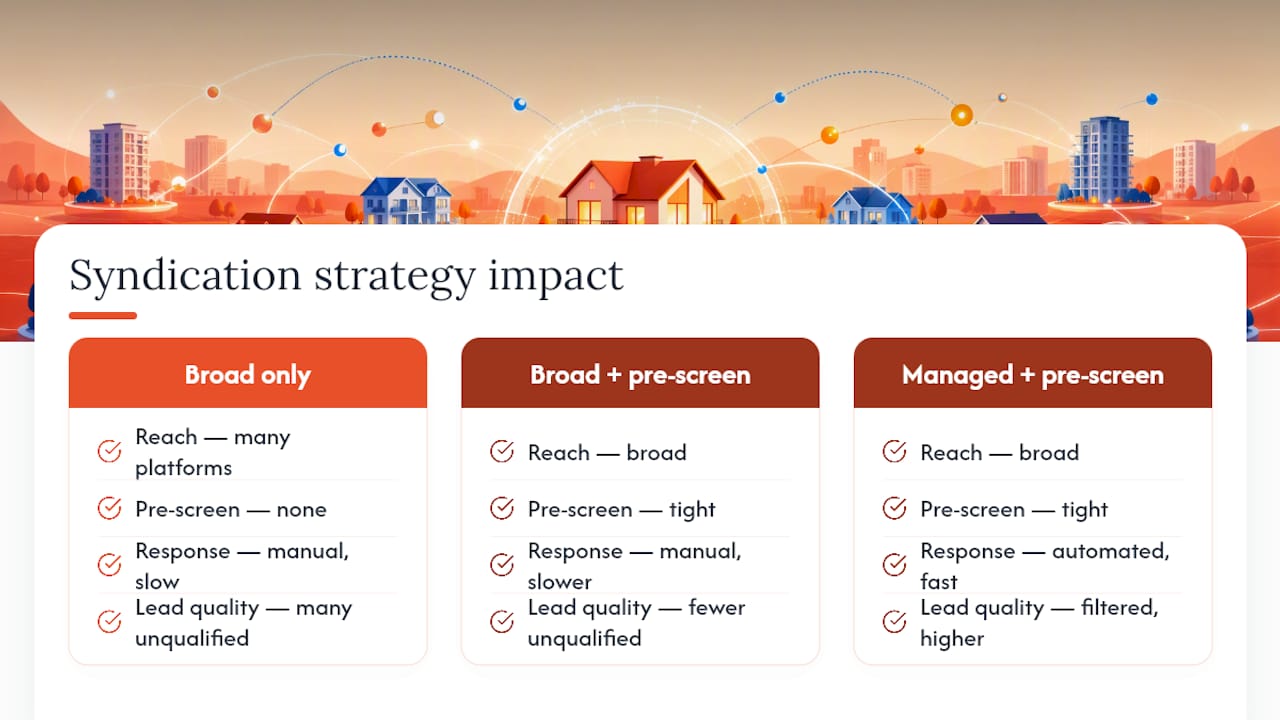
If you take one thing from this, prioritize the pre-screen and the inbox setup before you worry about adding a tenth platform to your stack. Reach without filtering just means more noise to sort through.
Should You DIY Syndication or Hire a Manager?
There’s a real DIY path here, and plenty of landlords run it well: a syndication tool, a clean master listing, and a Saturday morning to check partner sites. But if you’re managing more than a unit or two, or you’ve ever spent an evening chasing down why a listing vanished from one portal, you know the hours add up fast.
Aubenrealty handles the entire syndication process for owners who’d rather not manage six logins and a screening queue themselves. That includes building the master listing, pushing it across the major portals and local channels covered above, routing every lead into one screened pipeline, coordinating showings, and handling the lease paperwork once a qualified applicant is ready to sign. With more than 15 years managing rental properties and 2,700 properties served across ten regional markets, Aubenrealty has already worked through the partner-specific quirks that trip up DIY syndication, from verification holds to fair housing language review.
The decision usually comes down to inventory and time. One unit with some flexibility on your schedule? DIY is reasonable. Several units, a full-time job, or a track record of slow fills? The math tips toward managed syndication fast. Browse current rental listings to see how Aubenrealty presents properties across its markets, or reach out about property management services to get your next vacancy syndicated and screened without doing it yourself.
Frequently Asked Questions
What is rental listing syndication?
It’s the process of creating one master rental listing and distributing it automatically to multiple websites, like Zillow, Apartments.com, and Zumper, instead of posting to each site by hand.
Is Zillow or Apartments.com better for syndication?
They serve slightly different audiences. Zillow tends to draw broader single-family and small multifamily traffic, while Apartments.com’s CoStar network has deeper coverage of larger multifamily communities. Most landlords benefit from including both.
Should I use Zillow Rental Manager or a tool like Avail?
Zillow Rental Manager syndicates directly to Zillow’s own network and a few partners, while broader tools or a managed service can push your listing to a wider mix of major portals and local channels at once. Choose based on how many channels you actually want covered.
How long does it take for a syndicated listing to appear on partner sites?
It varies by platform. Some update within hours, others take a day or two due to moderation or identity verification holds.
Do I still need to post manually to local channels if I use syndication software?
Yes, for best results. Automated syndication covers the major portals, but manual posts to local Facebook groups or community boards tend to bring in higher-intent, lower-scam leads.
What’s the biggest reason syndicated listings stop showing up correctly?
Incomplete or mismatched required fields, followed by duplicate feeds pushing the same listing twice on one platform.
Sources
- Best Places to List a Rental Property Online (Plus a Simple Listing Strategy)| American Association of Landlords
- Leasey
- Apartment Rental Listing Syndication
- How Listing Syndication Can Save You Time & Make You Money | American Apartment Owners Association