$1,240 Cost Gap Owners Can’t Ignore: Leasing vs Management Fees
September 28, 2026
Leasing fees are one-time tenant-placement charges, while management fees are recurring costs for day-to-day operations, and both affect your cash flow differently. A leasing fee typically runs 50% to 100% of one month’s rent, charged when a tenant signs. A management fee usually runs 6% to 10% of collected rent, charged every month the property is occupied. Budget for the first as a lump vacancy cost and the second as a permanent line item.
TL;DR:
- Leasing fees typically range from 50% to 100% of one month’s rent and are paid only once per new tenant, while management fees usually run 6% to 10% of monthly rent and recur as long as the lease is active.
- Management fees based on collected rent align incentives with occupancy, but owners should verify whether arrangements include minimum fees, vendor markups, and if they cover accounting and reports.
- Contract language matters; landlords should watch for hidden costs like billing on scheduled rent, vague renewal terms, or uncapped vendor markups that can lead to unexpected expenses.
- Higher management fees are often justified by faster lease times, lower vacancy rates, and fewer costly repairs, making the lowest fee not always the most profitable choice.
Table of Contents
- What is a leasing fee and what does it cover?
- What is a property management fee and when does it apply?
- Side-by-side comparison: timing, scope, and cash-flow impact
- Typical fee ranges and benchmark examples owners can apply
- Are leasing and management fees tax deductible?
- How to evaluate and compare management proposals
- Red flags in management contracts that quietly cost you
- What experience should you look for in a property manager?
- Is the cheapest fee ever the best choice?
- Auben Realty: how our property management service bundles leasing and management
- Sources
- FAQ
What is a leasing fee and what does it cover?
A leasing fee, sometimes called a tenant-placement fee, pays for the work of finding and installing a new resident: marketing the unit, scheduling showings, screening applicants, and preparing the lease. It is a one-time charge tied to a specific event, not a monthly obligation.
The contract language matters here. Some agreements say the fee is “earned” the moment a signed lease is in hand, while others tie it to the tenant actually moving in and paying first month’s rent. That distinction affects what happens if a tenant backs out after signing.
Owners should also watch for services that sound included but are billed separately, like professional photography, lockbox installation, or an extra fee for expedited screening. Understanding how a property management company handles tenant screening helps clarify what a placement fee is actually buying.
The owner almost always pays the leasing fee, not the tenant, though some markets have shifted certain junk fees onto renters through separate lease-signing charges. Before signing a management agreement, ask directly:
- Is the leasing fee a flat amount or a percentage, and of what rent figure?
- What triggers the fee: a signed lease or a move-in with rent collected?
- Are marketing, photography, and screening costs bundled or itemized separately?
- Does a lease renewal count as a new placement, triggering a second fee?
What is a property management fee and when does it apply?
A property management fee covers the ongoing work of running a rental: collecting rent, coordinating maintenance requests, handling accounting, and keeping the property compliant with local landlord-tenant rules. Unlike a leasing fee, it applies every month the lease is active, not just once.
Two billing models dominate. A percentage-of-collected-rent model charges a set share, often 6% to 10%, only on rent actually received, which means a vacant month costs the owner nothing in management fees. A flat monthly fee charges the same dollar amount regardless of occupancy or rent level, which can favor owners with higher-rent properties but works against owners during vacancy since some flat-fee contracts still bill during vacant months.
Minimums matter too. A company advertising 8% might apply a $100 monthly minimum that effectively raises the rate on lower-rent units. Owners should also scrutinize pass-throughs and vendor markups: a management company that marks up a $150 plumbing repair to $220 before billing the owner is quietly padding its margin beyond the stated fee.
- Ask whether the fee is charged on collected rent or scheduled rent, since collected-rent billing aligns the manager’s incentive with actually getting the property occupied.
- Confirm whether there’s a minimum monthly fee that changes the effective percentage on lower-rent properties.
- Request a cap or disclosure policy on vendor markups for maintenance and repairs.
- Clarify whether the fee includes accounting and owner statements or bills those separately.
Side-by-side comparison: timing, scope, and cash-flow impact
The two fees affect your cash flow at completely different points in the rental cycle. Treating them as interchangeable line items is where a lot of budgeting goes wrong.
- Scope: A leasing fee covers a single event (marketing through move-in); a management fee covers continuous operations (rent collection, maintenance, reporting) for as long as the lease runs.
- Timing: The leasing fee hits once, typically at lease signing or move-in; the management fee recurs monthly, drawn from collected rent.
- Vacancy effect: During vacancy, you pay a leasing fee to fill the unit but owe no management fee on that empty month if billing is based on collected rent.
- Renewal effect: Some contracts charge a reduced renewal fee (often a flat amount smaller than the original placement fee) each time an existing tenant signs a new lease term.
- Annual cost: A property renting for $1,800 a month with an 80% leasing fee and an 8% management fee would generate roughly $1,440 in placement cost at turnover and about $144 per occupied month in management fees, or close to $1,728 over a full year of occupancy.
Add a renewal fee, a maintenance markup, or a mid-year vacancy, and the total annual cost of professional management can swing meaningfully even when the advertised percentages look identical between two companies. That is why comparing only the headline percentage, without looking at how nominal fees compare against resident retention and profitability, tends to mislead owners shopping on price alone.
Typical fee ranges and benchmark examples owners can apply
Fee ranges vary by market, property type, and how bundled the services are, but industry surveys give owners a useful baseline. National data puts average management fees at around 8.49% of collected rent, with tenant-placement fees commonly landing between 50% and 100% of one month’s rent when billed as a standalone charge, according to the same survey.
That same benchmarking data shows real spread depending on structure:
- Flat monthly management fees range roughly from $49 to $250 per unit depending on market and portfolio size.
- Percentage-based fees range from about 3.75% to 14% of collected rent.
- Renewal fees average roughly $200 to $300 or a fraction of a month’s rent when charged separately.
- Multi-family and larger portfolios tend to see lower percentage rates than single-family homes, since per-unit overhead drops with volume.
The gap between those two scenarios, over a year with one turnover, is roughly $1,240, which is real money that a percentage comparison alone won’t reveal. Seasonal timing also affects lease-up speed and therefore how much placement cost actually delivers value, something covered in more depth in seasonal leasing strategy.
Are leasing and management fees tax deductible?
The IRS treats both fees as ordinary rental expenses in most cases. 414 on rental income and expenses](https://www.irs.gov/taxtopics/tc414), property management fees and commissions paid for tenant placement are generally deductible when they are ordinary and necessary for producing rental income. Publication 527 confirms management fees as a common deductible rental expense and offers guidance on pre-rental costs, vacant-property treatment, and recordkeeping.
Timing depends on your accounting method. Most individual landlords use cash basis, meaning a fee is deducted in the year it’s actually paid, not the year the service was performed. That distinction matters when a December leasing fee doesn’t get paid until January.
Not every fee is expensed immediately. A cost tied to a capital improvement, such as a renovation project a manager oversees, is typically capitalized and depreciated rather than deducted in full the year it’s paid.
- Keep every management statement and leasing invoice separately labeled by property and date.
- Reconcile monthly management statements against your bank deposits to confirm collected-rent figures match what you were billed on.
- Track any capital-improvement-related fees separately from routine operating fees for depreciation purposes.
Pro Tip: Save every itemized management statement in a dedicated folder by tax year. It turns a stressful Schedule E filing into a ten-minute reconciliation.
How to evaluate and compare management proposals
Comparing two management proposals side by side only works if you’re comparing the same scope of service, not just two percentages.
- Request the fee model in writing: percentage of collected rent, flat fee, or a hybrid, along with any minimums.
- Ask directly how and when the leasing fee is earned, since a signed-lease trigger and a move-in trigger carry different risk for you.
- Ask whether billing is based on scheduled or collected rent, since collected-rent billing keeps the manager’s incentive aligned with your occupancy.
- Ask for the vendor markup policy on maintenance and repairs, and request a cap if none exists.
- Review the termination clause for notice period, early-termination penalties, and whether unearned fees are refunded.
- Score each proposal by weighting service scope (maintenance response time, reporting frequency, retention programs) against the nominal percentage, rather than picking the lowest number outright.
Negotiation levers worth requesting include a trial period before a long-term contract, written performance benchmarks tied to vacancy days or maintenance response time, and a cap on how much a vendor invoice can be marked up before it requires owner approval. When maintenance vendor bids are part of the conversation, a structured scoring approach like the snow removal bid evaluation rubric illustrates how owners can apply objective criteria instead of just picking the cheapest bid.
Pro Tip: Ask for the last three months of maintenance invoices from a prospective manager’s existing clients (with owner names redacted) to see real-world markup practices before you sign.
Red flags in management contracts that quietly cost you
Some contract language looks routine but ends up costing owners far more than the advertised fee suggests.
- Billing on scheduled rent instead of collected rent charges you a management fee even when a tenant hasn’t paid, which misaligns the manager’s incentive with your actual cash flow.
- Vague “earned” language on leasing fees can leave you owing a full placement fee even if a tenant breaks the lease within days.
- Automatic renewal clauses with long notice windows can trap you in a contract you’re unhappy with for months after you decide to leave.
- Uncapped vendor markups on repairs let a manager quietly inflate maintenance bills well beyond the stated management percentage.
- Lease-break penalties charged to the owner, not just the tenant, can appear buried in boilerplate language.
Require pass-through transparency in writing, meaning every vendor invoice is shown at cost or with a disclosed, capped markup. Insist on audit rights to review statements, and get clear termination terms with a defined notice period and no penalty for cause.
What experience should you look for in a property manager?
Track record matters more than a stated percentage. A reputable property management company may have extensive experience serving many properties across multiple regional markets, combining leasing, ongoing management, and maintenance under a single contract rather than splitting them across vendors.
That integration changes the fee calculus. When maintenance, leasing, and retention programs sit inside one team instead of being outsourced piecemeal, owners avoid the markup layers that come from a management company subcontracting every repair. Investor reporting becomes more consistent when the same team handles placement and the monthly books.
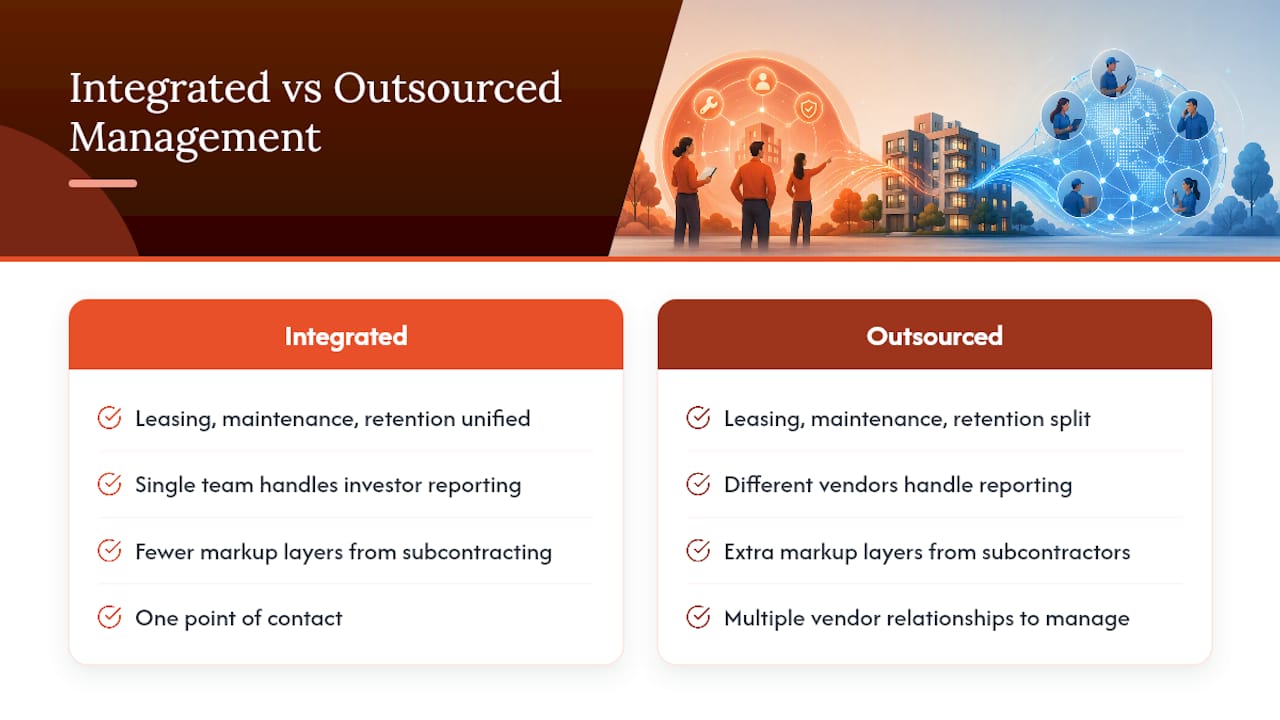
A full-service model like this tends to fit owners who want one point of contact and predictable reporting across multiple properties. Owners with a single unit and time to manage vendor relationships themselves may find an unbundled, a la carte approach more cost-efficient.
Is the cheapest fee ever the best choice?
The lowest nominal fee rarely produces the best net return. A manager charging a lower percentage but leaving units vacant longer, or missing maintenance issues that turn into bigger repairs, can cost you more than the fee difference ever saved.
Higher fees are worth paying when they come with faster lease-up, lower turnover, and fewer legal or maintenance surprises. A useful heuristic: the less time and risk tolerance you have, the more a full-service, higher-fee model tends to pay for itself.
— MediaBeast
Auben Realty: how our property management service bundles leasing and management
Some property management providers package tenant placement and ongoing management into a single agreement to avoid coordinating separate vendors for leasing, maintenance, and monthly accounting.

- Tenant placement and screening handled by the same team responsible for ongoing occupancy.
- In-house maintenance coordination instead of third-party vendor handoffs.
- Investor reporting built for owners tracking performance across multiple properties.
This approach can suit owners who prefer integrated, full-service management across regional markets rather than managing separate leasing and management contracts. Visit the property management page to request a proposal.
Sources
- Publication 527 (Residential Rental Property) | Internal Revenue Service
- Average Property Management Fees (2026): by Type & by State
FAQ
Is it normal to pay a leasing fee?
Yes, paying a leasing fee to cover tenant placement is standard practice among property management companies. It typically runs 50% to 100% of one month’s rent and is charged once per new tenancy, not monthly.
What is the 2% rule for rental properties?
It is a rough screening tool, not a guarantee, and doesn’t account for fees like leasing or management costs that reduce actual net return.
How much should a management fee be?
Management fees average around 8.49% of collected rent nationally, though flat-fee models and percentage rates both vary by market and property type. The right fee depends on what services are bundled in, not just the percentage itself.
Who typically pays the leasing fee?
The property owner almost always pays the leasing fee to the management company, not the tenant. Some markets have introduced separate lease-signing charges billed directly to tenants, but the placement fee itself is an owner cost tied to the management agreement.