Get a Dallas Eviction Hearing in 10–21 Days: Legal Steps for Landlords
October 8, 2026
An eviction in Dallas is a forcible-detainer lawsuit that a landlord files in Justice Court after giving the required written notice. If you are a tenant who was served, file an Answer with the court that issued the citation and show up to your hearing. If you are a landlord, confirm your notice was correct and file in the justice precinct where the property sits before anything else.
TL;DR:
- The default notice period is three days unless the lease changes it; mail adds two days, and hearings occur 10 to 21 days after filing.
- A summary disposition motion cuts the tenant’s response deadline to four days; tenants facing a squatter allegation must attach documentary proof of tenancy.
- Tenants should file an Answer before the hearing and bring leases, payment records, repair requests, and landlord communications to support defenses that match their facts.
- An appeal is due within five days, with a bond, cash deposit, or Statement of Inability to Pay; staying requires rent in the court registry.
- Dallas County lists an example $134 filing fee, with citation, service, and writ charges separate; confirm current totals with the JP clerk before filing.
Table of Contents
- How long does the Dallas eviction timeline take from notice to writ?
- Which notice applies, and how must it be served in Dallas County?
- How do you file an eviction in the correct Dallas Justice of the Peace court?
- What should tenants do after receiving an eviction notice?
- What happens at the hearing, and how does an appeal work?
- What does an eviction cost in Dallas, and what timing quirks matter?
- What should you bring on filing day and hearing day?
- What Auben Realty’s eviction experience teaches Dallas landlords
- How Auben Realty helps Dallas landlords manage the eviction process
- FAQ
- Sources
How long does the Dallas eviction timeline take from notice to writ?
The clock starts the day notice is delivered, and the delivery method changes that date. Hand delivery counts immediately, but mail delivery adds two extra days before a landlord can file. Posting notice on the door also triggers the standard waiting period under Dallas County JP guidance. Once the waiting period passes and the landlord files, most hearings happen 10 to 21 days later, though a Motion for Summary Disposition shortens the tenant’s response window dramatically.
- Notice period: three days by default, unless the lease sets a different number.
- Filing: the landlord submits a sworn petition to the correct Justice Court.
- Hearing: typically scheduled 10 to 21 days after filing.
- Summary disposition exception: if filed, the tenant has only four days to respond with proof of tenancy.
- Appeal window: the losing side has five days to appeal to county court.
- Writ of possession: once issued, constables give 24 hours’ notice before physically removing belongings.
Holidays and court closures can push any of these dates further out, so neither side should treat a calendar estimate as a guarantee.
Which notice applies, and how must it be served in Dallas County?

Nonpayment of rent calls for a Notice to Pay or Vacate, while lease violations or holdover situations call for a plain Notice to Vacate. Both default to a three-day period under Texas eviction law, but a signed lease can extend or shorten that window, so the lease governs first.
Dallas County JP courts recognize three delivery methods, and each affects the filing date differently:
- Personal delivery: handing the notice to the tenant or someone in the household who is 16 or older.
- Mail: adds two extra days to the waiting period before the landlord can file, per Dallas County JP procedures.
- Door posting: taping the notice to the inside of the main entry when no one answers.
Pro Tip: Keep a dated photo of the posted notice and a copy of any mailing receipt, since a challenge to service is one of the most common ways a tenant gets a judgment set aside.
How do you file an eviction in the correct Dallas Justice of the Peace court?
Venue is not optional. Under Texas Property Code Sections 24.004 and 24.0041, the suit must be filed in the justice precinct where the rental property is located, not where the landlord’s office sits or where the tenant now lives.
- File a sworn petition that follows the Texas Rules of Civil Procedure and the local JP form.
- Bring an original petition plus a copy for each defendant and one for the filing-stamped record, since Dallas clerks prefer parties arrive prepared rather than requesting copies on site.
- Confirm you are filing in the correct precinct court before paying, since Dallas County JP court pages list precinct boundaries by address.
- Ask the clerk about current filing, citation, and service charges, since these are updated periodically.
What should tenants do after receiving an eviction notice?
Receiving a citation is not a judgment. Tenants keep real options if they act quickly and file an Answer in the Justice Court that issued the citation.
- File an Answer any time before the hearing, according to the TexasLawHelp defense guide, unless the landlord has filed a Motion for Summary Disposition, which shortens that deadline to four days.
- Raise defenses that fit your facts: improper service, payment already made, unaddressed repair requests, retaliation, or mistaken identity if you are not actually the named tenant.
- Bring organized proof: the lease, a payment ledger, photos, repair requests, and any written communication with the landlord, each in multiple copies.
- If you missed the hearing, ask the court about a Motion to Set Aside the default judgment, since strict deadlines apply.
Pro Tip: A tenant responding to a summary disposition motion on a squatter allegation must attach documentary proof of tenancy within four days, or the court can rule without a trial.
What happens at the hearing, and how does an appeal work?
The hearing itself is informal by Justice Court standards, but it still follows evidence rules, and either side may request a jury in most cases. A summary disposition motion skips the live hearing entirely when the tenant fails to respond in time.
- If the landlord wins, the losing party has five days to appeal by filing a bond, a cash deposit, or a Statement of Inability to Pay.
- Staying in the home during an appeal generally requires paying rent into the court registry, with the amount set by the court.
- Once a judgment becomes final and unappealed, the court issues a writ of possession.
- Constables must give 24 hours’ notice before carrying out a physical removal under that writ.
What does an eviction cost in Dallas, and what timing quirks matter?
Dallas County lists an example eviction filing fee of $134, with citation, service, and writ charges billed separately, according to the Dallas County filing fees page. Those added charges can roughly double the upfront cost of a straightforward nonpayment case, so budgeting for the lawsuit alone understates what a landlord will actually pay.
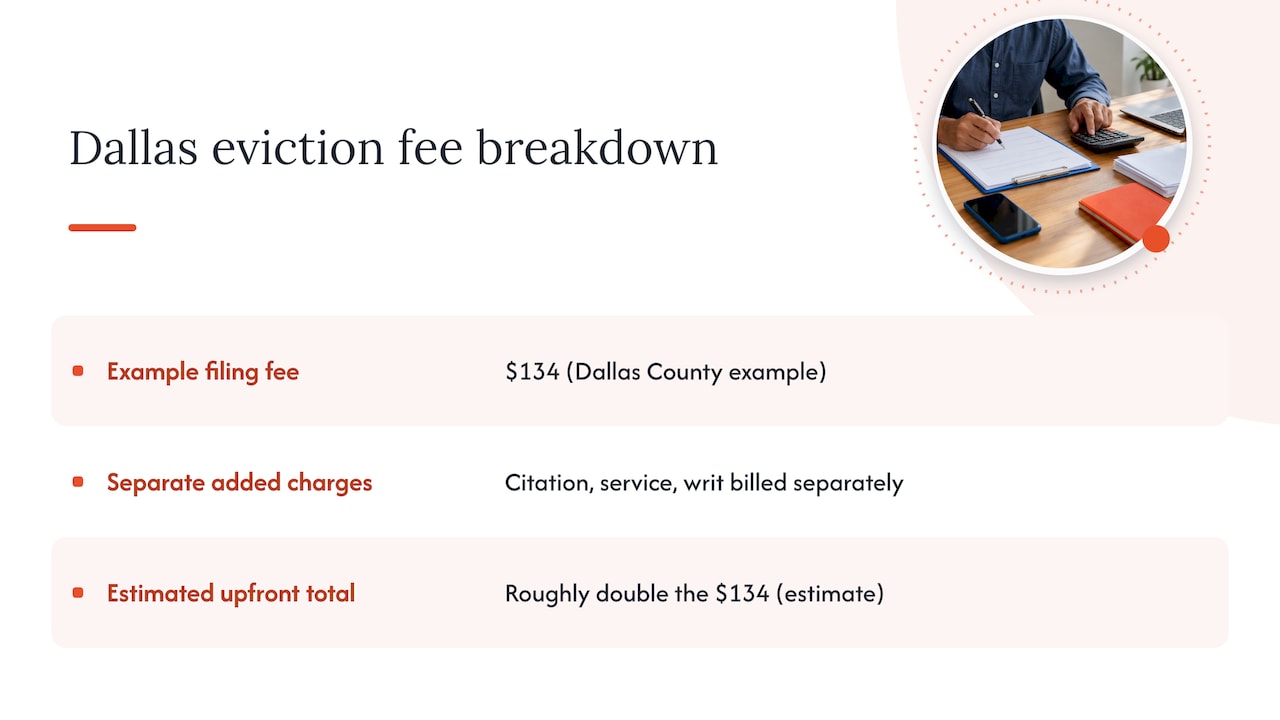
Timing quirks matter just as much as the dollar figures. Mailing a notice adds two days before the waiting period even starts to run, and a holiday or court closure can push a hearing date by a week or more without warning. Always confirm current fee amounts directly with the Dallas County JP clerk before filing, since schedules are updated periodically.
What should you bring on filing day and hearing day?
Court days move fast, and being unprepared costs time on both sides.
- Landlords should bring the lease, a complete payment ledger, the served notice with proof of delivery, photos of any posted notice, and witness names if the case involves a dispute.
- Tenants should bring the same lease and ledger, plus repair requests, texts or emails with the landlord, and documentary proof of tenancy if a summary disposition motion alleges otherwise.
- At the clerk window, state your case number and precinct clearly, and ask directly whether any paperwork is missing before leaving.
- After judgment, act immediately: file an appeal within five days, request a set-aside if you missed the hearing, or begin complying with the writ timeline.
What Auben Realty’s eviction experience teaches Dallas landlords
Most eviction cases fall apart on paperwork, not on the merits. Common issues include challenges to service, incorrect notice forms, or lack of dated payment records, causing cases to restart.
Consistent habits prevent most of that. Using the same notice template every time, logging payments the same way across every unit, and documenting repair requests in writing the moment they come in all reduce the chance a judge finds a procedural gap to exploit. The gap between a clean filing and a dismissed one often traces back to documentation created after the fact instead of in real time.
Not every case needs a lawyer, but those facing contested hearings, retaliation claims, or inconsistent lease histories should consider bringing in counsel or management before the filing date.
— MediaBeast
How Auben Realty helps Dallas landlords manage the eviction process

Filing an eviction correctly the first time saves weeks compared to refiling after a dismissed case, and proper handling of notice, documentation, and coordination with legal counsel helps landlords manage Justice Court procedures under deadline pressure.
- Property management includes tracking lease terms, payment history, and notice timing to help filings hold up under challenge.
- In-house maintenance aims to resolve repair complaints quickly, which can prevent tenant defenses.
- Tenant communication involves keeping documented records of notices and exchanges, supporting contested hearings.
If you are weighing whether to self-manage a difficult eviction or hand it to a team that has coordinated hundreds of these cases, start with our Dallas property management page to see how we work, or reach out through our property management services to talk through your specific case.
This article is general information, not a substitute for advice from a qualified lawyer. Consult a qualified legal professional about your own circumstances before acting on anything here.
FAQ
How long does a Dallas eviction usually take from notice to hearing?
Most Dallas hearings are scheduled 10 to 21 days after the petition is filed, following a notice period that defaults to three days unless the lease says otherwise. Mailing the notice adds two extra days before that clock even starts.
Can a landlord evict a tenant without going to court in Dallas?
No. Every eviction in Dallas requires a forcible-detainer suit filed in the Justice Court for the precinct where the property is located, and a judge must rule before a tenant can be removed.
What happens if a tenant does not respond to an eviction notice in Dallas?
If a tenant never files an Answer and misses the hearing, the court can enter a default judgment, and a writ of possession can follow once the five-day appeal window passes. A missed hearing can sometimes still be addressed through a Motion to Set Aside, but strict deadlines apply.
How much does it cost to file an eviction in Dallas County?
Dallas County lists an example eviction filing fee of $134, with citation, service, and writ fees charged separately. Exact current amounts should be confirmed directly with the JP clerk before filing.
Can a tenant stay in the home while appealing a Dallas eviction judgment?
Yes, but generally only by paying rent into the court registry in an amount the court sets, and by filing the appeal within five days of judgment. Filing a bond, a cash deposit, or a Statement of Inability to Pay is required to perfect the appeal.
Sources
- Texas Property Code chapter 24
- Eviction | TexasLawHelp
- JP 1-1 | Eviction for Non-Payment of Rent (Dallas County)