Contractor Management for Rentals: A Owner’s Guide
November 14, 2026
Contractor management for a rental means finding licensed, insured trades, getting the scope and price in writing, scheduling work around the tenant, checking the result and paying only against proof. Done well, it protects your cash flow and your legal position. Done badly, it produces surprise invoices, lapsed insurance, tenant complaints and, in the worst cases, liens and federal penalties. At Auben Realty, in-house maintenance, transparent vendor selection and credentialed vendors are part of how we manage rentals, so owners do not run this process themselves.
TL;DR
- Contractor management is a repeatable cycle: qualify the vendor, define the scope, collect bids, sign a written agreement, supervise the work, verify it, pay against lien waivers and keep records.
- Verify the license with the state board, get a certificate of insurance and a W-9 before any work starts, and never rely on what a contractor tells you.
- Pre-1978 rentals add a federal layer: EPA lead-safe rules apply to renovation work, and owners have been fined for ignoring them.
- Tenant access is governed by state law, usually reasonable notice of around 24 hours for non-emergency repairs.
- A property manager with an established vendor bench and in-house maintenance takes the sourcing, coordination and paperwork off your desk.
Table of Contents
- What contractor management actually involves
- Step 1: Qualify every contractor before the first job
- Step 2: Write the scope before you ask for bids
- Step 3: Get bids, and read them properly
- Step 4: Put it in writing
- Step 5: Coordinate the tenant, the schedule and the access
- Step 6: Pay correctly and keep the tax paperwork
- Step 7: Know the lead paint rule if the building predates 1978
- Step 8: Track the work and the performance
- Why owners hand this to a manager
- Promo: Hand off contractors, keep the returns
- Perspective
- FAQ
- Sources
What contractor management actually involves
Most owners think of it as “calling a plumber.” In practice it is a lifecycle with six distinct phases, and each one is a place where money leaks:
- Qualification: confirming the license, insurance and references before the contractor is allowed near your property.
- Bidding: defining the work and collecting comparable quotes.
- Contract: putting scope, timeline, payment terms and change-order rules in writing.
- Supervision: scheduling, tenant access, photos and a final walk-through.
- Payment: paying against completed milestones and collecting lien waivers.
- Records: keeping invoices, certificates and results so the next job is easier.
The National Property Management Authority describes the same lifecycle, including bid solicitation to at least three qualified bidders and on-site supervision with photo documentation and punch lists.
The work itself is wide. Typical rental needs include plumbing, electrical, HVAC, appliances, roofing, gutters, painting, flooring, landscaping, pest control, cleaning and turnover crews, and a practical overview of why property managers rely on contractors shows how many trades touch a single rental over its life. We break maintenance into three kinds in our guide to the three kinds of maintenance a rental will need: routine upkeep, repairs that come up unexpectedly, and larger projects. Each kind calls for a different level of oversight.
Step 1: Qualify every contractor before the first job
The cheapest time to catch a problem is before work starts. A sound qualification file contains:
- A state license, checked at the source. Look up the license number on the state licensing board’s website. The record shows whether it is active and whether there are disciplinary actions. A business card or a verbal “I’m licensed” is not verification.
- A certificate of insurance. General liability is the baseline, and workers’ compensation matters if the contractor has employees. Ask for the certificate to come from the insurance agent, and have your property listed as an additional insured where appropriate. Certificates expire, so the file needs a renewal date.
- A Form W-9. This gives you the legal name and tax ID you need for reporting (more on that below).
- References for similar jobs. A roofer’s glowing review for a deck repair tells you little. Ask whether recent comparable work finished on time, on budget and cleanly, and whether the crew treated the tenant respectfully.
Where it goes wrong: the file is built once and never refreshed. A vendor whose insurance lapsed in March is still on your list in November. Unvetted contractors and lapsed certificates are among the most common sources of owner disputes, according to the National Property Management Authority.
Where we take it off your hands: we credential our vendors as a standing process rather than a one-off check, and we explain why in our piece on vendor credentialing for a property manager. Owners who work with us do not build or maintain that file themselves.
Cleaning crews deserve the same screening as trades. Turnover cleaning is a regular rental expense, and a guide on how often to clean a rental home is a good reference when you set the frequency and scope for a cleaning vendor.
Step 2: Write the scope before you ask for bids
The National Apartment Association’s maintenance course material calls accurate, complete job specifications the most important part of bidding. If the specifications are vague, bids differ for reasons that have nothing to do with price, and change orders fill the gap later.
A usable scope states:
- What is being done, room by room or system by system.
- Materials, including brand or grade where it matters (flooring, fixtures, water heaters).
- Who pulls permits, where they are required.
- Start and finish dates, and working hours.
- Cleanup and debris removal.
- What happens if hidden damage turns up behind a wall.
Worked example. A $1,200 bathroom quote and an $1,800 quote look like a big gap. Put both against one written scope and you may find the lower bid assumed reusing the existing vanity and left out debris hauling. Same specifications for every bidder is what makes the comparison honest.
Step 3: Get bids, and read them properly
The NAA material says to solicit bids from at least three separate contractors using identical specifications, then check references and Better Business Bureau records before accepting. It also notes that the cheapest bid is not necessarily the best. For rentals, compare these four things side by side:
| Compare | Why it matters |
|---|---|
| Total price against the same scope | Exposes missing line items |
| Time to complete | Every vacant day is lost rent |
| Warranty on labor and materials | Decides who pays if it fails in month two |
| Insurance and license status | Decides who pays if someone is hurt |
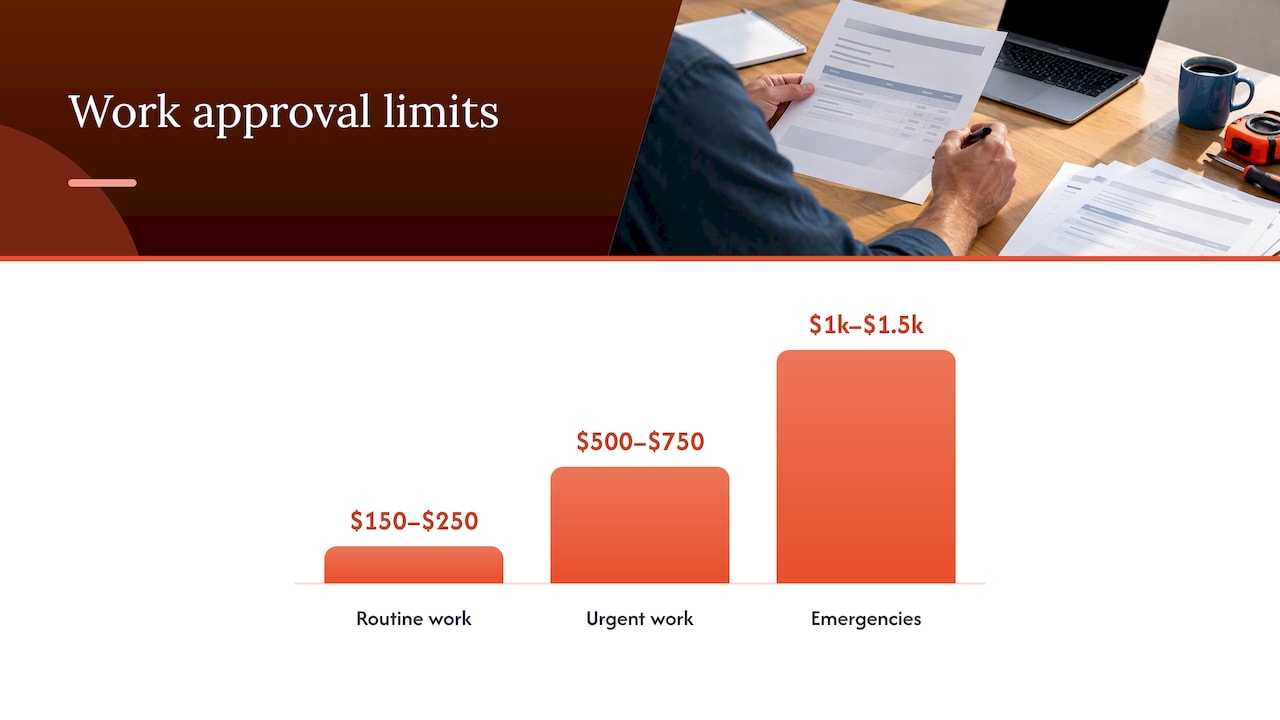
For routine repairs you will not bid every job, so set a not-to-exceed amount: a dollar limit under which the vendor may proceed without calling you. One published example from a property-management call center uses tiered limits of $150 to $250 for routine work, $500 to $750 for urgent work and $1,000 to $1,500 for emergencies, with quotes required above the limit and for appliance replacements, structural repairs and permit work. Treat those as an illustration, and set limits that fit your rent level and your reserves.
On larger renovations, general contractors typically add a markup for coordinating multiple trades. One published range puts it at 15% to 25%. Read it as the price of coordination: if you are not on site, someone has to be, and the markup pays for it.
Step 4: Put it in writing
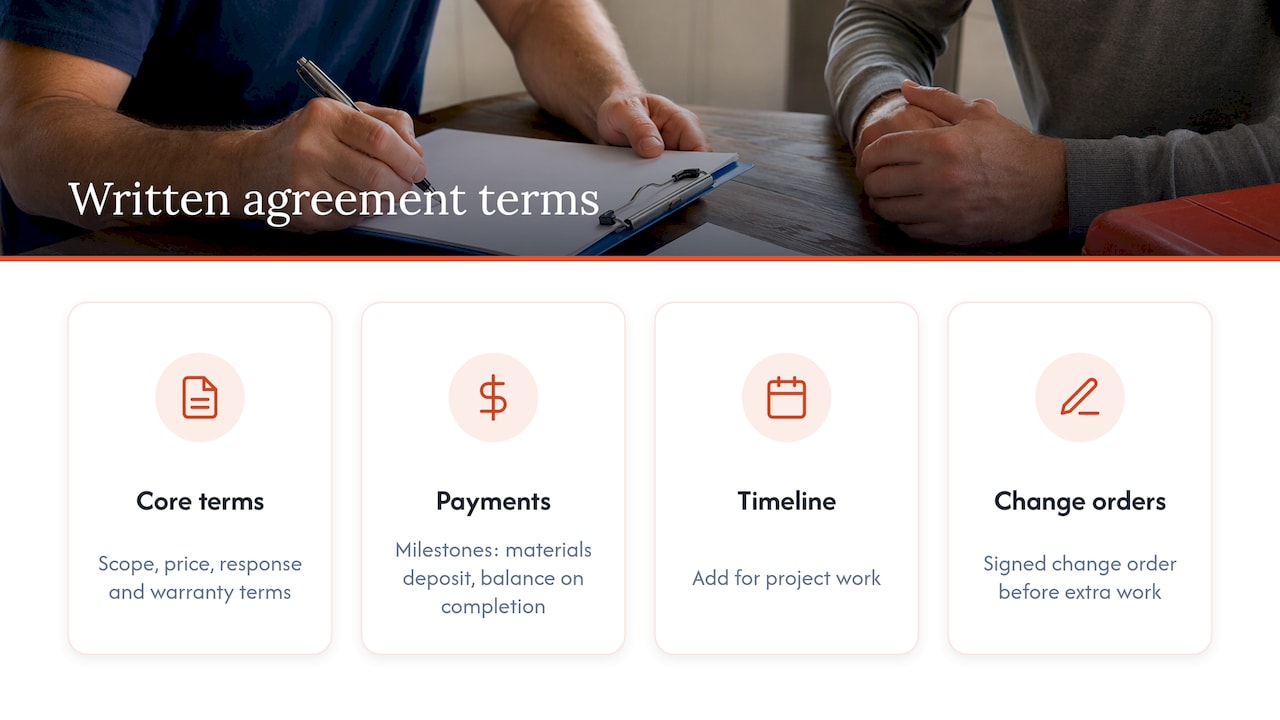
A written agreement should cover scope, price, response expectations, warranty terms and a payment schedule. For project work add the timeline and a rule that no extra work is done without a signed change order. For payment, tie money to milestones. A common structure is a deposit for materials and the balance on completion, never full payment up front.
Lien waivers
A contractor or supplier who is not paid can, in many states, file a mechanic’s lien against your property, even if you paid the general contractor in full. A lien waiver is the contractor’s written release of that right. State law decides when and how waivers are valid. In Texas, for example, a law firm’s overview of mechanic’s liens notes that waivers in advance generally cannot be required except in narrow situations such as a written contract for a single-family house. Rules differ across the states we operate in, including South Carolina, Missouri, Kansas and Florida, so for any sizeable project ask your attorney to confirm the right waiver forms for the state where the property sits.
Step 5: Coordinate the tenant, the schedule and the access
This is the step owners underestimate. Contractors are working inside someone’s home, and the law protects the tenant’s privacy.
State rules vary. Maine’s statute, Title 14 §6025, lets landlords enter to make repairs but requires reasonable notice and presumes 24 hours is reasonable, except in emergencies. Oregon’s ORS 90.322 generally requires at least 24 hours’ actual notice and entry at reasonable times, and treats a tenant’s written repair request as permission to enter for that repair for seven days. Those are examples, not your rules: look up the landlord-tenant statute and your lease for the state where your property is.
Good practice that works in every state:
- Give written notice with a defined appointment window rather than “sometime Tuesday.”
- Tell the tenant who is coming, from which company, and what they will do.
- Use a lockbox or smart lock with an entry log if access without the tenant is agreed.
- Ask the contractor to photograph the work before and after.
- Confirm completion with the tenant, not just with the invoice.
Where it goes wrong: the vendor shows up unannounced, the tenant refuses entry, the trip is billed anyway and the repair slips another week. Multiply by a dozen repairs a year and the friction costs you renewals. Our approach to proactive resident retention is built on this: fast, courteous repairs keep good tenants in place.
Step 6: Pay correctly and keep the tax paperwork
If you own rentals as a business, contractors you pay are usually reported on Form 1099-NEC. The IRS explains that Form 1099-NEC generally applies to payments of $600 or more to a nonemployee for services, rising to $2,000 for payments made after December 31, 2025. The same page explains that worker classification depends on the facts, including the right to control how the work is done.
The practical rule: collect the W-9 before the first payment. The IRS notes in its information-returns guidance that when a payer lacks the contractor’s taxpayer ID before payment, 24% backup withholding generally applies. Ask your tax adviser how this applies to your ownership structure.
Step 7: Know the lead paint rule if the building predates 1978
This is the one regulatory trap that surprises owners. The EPA’s Renovation, Repair and Painting (RRP) Rule requires certified firms and renovators for covered work, and contractors working on pre-1978 housing must test for lead or presume it is present and use lead-safe work practices. The agency enforces it against owners as well as contractors: in 2024 it cited a Denver-area owner who agreed to a $125,000 penalty over uncertified renovations at six multi-unit rentals, and in 2025 it announced penalties of $31,916, $9,781 and $68,402 against three Connecticut firms for certification, record and disclosure failures.
So for any older rental, put “EPA lead-safe certified” into your qualification checklist for painting, window, demolition and similar work. Our guides to what property managers and tenants need to know about lead paint and lead paint disclosure walk through the owner side in detail.
Step 8: Track the work and the performance
The last phase is the one that makes the next job cheaper. Keep a simple record for each vendor: jobs done, cost against bid, response time, callbacks, tenant feedback and insurance expiry date. A vendor who answers in an hour and fixes it once is worth a higher rate than one who is cheap and returns three times.
What the record needs to capture for each work order:
- The request, with the tenant’s description and urgency.
- The vendor assigned and the approval amount.
- Appointment date and access arrangement.
- Completion photos and the invoice.
- Tenant confirmation and any follow-up.
A spreadsheet works for a single rental. Past a handful of properties, owners usually hit the limit, because the real cost is not the software but the hours spent chasing vendors and tenants.
Why owners hand this to a manager
Every step above is doable. The question is whether it is the best use of your time and risk. The work is repetitive, urgent when it arrives and unforgiving when a detail is missed: a lapsed certificate, an advance waiver that is not valid, a lead-safe requirement nobody checked.
This is what our property management is built around. We run a pod-based team structure so each property has a focused group behind it, we keep maintenance in-house, we select vendors transparently and we use technology to keep requests and work orders moving. We serve single-family, multi-family and build-to-rent owners across our regional markets, with over 15 years of experience and 2,700 properties served. For larger renovation work, our rental renovation management guide shows how oversight of scope, schedule and spending works for an owner.
Promo: Hand off contractors, keep the returns
If you would rather own the rental than manage the trades, our property management service covers leasing, maintenance and vendor coordination for owners in Charleston, Columbia, Fort Worth and Dallas, Kansas City, Houston and Jacksonville. For renovations and turnovers, project management puts oversight of the contractors and the scope in our hands.

Pricing is not published, so the first step is a conversation about your property and your goals through aubenrealty.com.
Perspective
Contractor management looks like a maintenance task, but it is really a risk and returns task. A rental earns when it is occupied, and it stays occupied when repairs are fast, honest and done by people who are licensed and insured.
That is why we keep maintenance in-house and why vendor selection is transparent: owners should be able to see who is working on their property and why. A pod-based team means the people answering your question know your property rather than starting from zero.
For investors, the point is scale. Two hundred work orders a year across a portfolio cannot depend on one person’s memory. They need a standard for qualifying vendors, one way to document the work and a team that treats a repair as part of retention, not only an expense.
Our view is simple: the owner sets the goals and the budget, and a manager who does this every day runs the trades.
MediaBeast
FAQ
How many bids should I get for a rental repair?
For significant work, at least three, all based on the same written scope. Routine repairs under a pre-set dollar limit do not need bids, but anything above the limit, and any appliance replacement, structural repair or permit work, should be quoted first.
Do I need to send a 1099 to every contractor?
Not necessarily. The IRS generally requires Form 1099-NEC for business payments of $600 or more to a nonemployee, and the threshold is $2,000 for payments made after December 31, 2025. Your tax adviser can confirm how it applies to your ownership structure, so collect a W-9 from every vendor regardless.
How much notice must I give a tenant before a contractor enters?
It depends on your state and lease. Many states require reasonable notice for non-emergency repairs, frequently about 24 hours, and Maine and Oregon both use that benchmark. Check your state’s landlord-tenant statute, and give written notice with an appointment window.
Does the lead paint rule apply to my rental?
If the building was built before 1978 and the work disturbs painted surfaces, the EPA’s RRP Rule generally applies. Use an EPA-certified firm and keep records of the work.
Sources
- National Property Management Authority: Vendor and Contractor Management
- NAA: Property Maintenance for Managers
- AMBS Call Center: Managing Property Management Service Providers
- VerticalRent: Hiring Contractors for Rental Properties
- Maine Title 14 §6025: Access to premises
- Oregon Revised Statutes §90.322
- IRS: Form 1099-NEC and independent contractors
- IRS: Information returns (Forms 1099)
- EPA: Denver building owner and lead-safe renovation
- EPA: Three Connecticut firms and federal lead paint laws
- Ghrist Law Firm: How to Avoid Mechanic’s Liens
- Why property managers need contractors
- How often to clean a rental home