Build to Rent: 61,700 Units, Risks Investors Must Model
October 10, 2026
Build-to-rent is a viable, income-oriented real estate strategy for investors who can underwrite phased lease-ups and operationally manage dispersed single-family communities. The sector has shifted from rapid, growth-chasing expansion toward a more selective, income-focused posture, and the biggest risks now sit in construction costs, lease-up pacing, and exit cap rates rather than in demand itself. What follows breaks down the current data, the underwriting mechanics, a practical deal-evaluation checklist, and how professional management changes the math.
TL;DR:
- As of early May 2026, about 61,700 units were under construction, over 60% in the South; local job growth, migration, and permitting deserve close review.
- Model operating expenses at 35% to 45% of effective gross income, and size deficit reserves to the deal’s absorption case, not a generic percentage.
- Stress test a 50 basis point exit cap rate increase, and forecast lease up by monthly unit deliveries tied to occupancy approvals.
- Before committing, verify entitlement status, HOA covenants, warranties, forward purchase protections, and completion guarantees; favor the sponsor’s actual lease up record over projections.
- Investors without operating capacity should secure an experienced partner and hold through stabilization; quick flips carry construction and lease up risk.
Table of Contents
- What Is Build-to-Rent and How Does It Differ From Other Rental Models?
- Where Is the Build-to-Rent Pipeline Concentrated Right Now?
- Why Are Investors Allocating to Build-to-Rent Now?
- What Underwriting Risks and Mechanics Should You Model?
- How Do You Evaluate a Build-to-Rent Deal Before Committing Capital?
- How Does Professional Management Change Build-to-Rent Outcomes?
- Who Should Actually Pursue a Build-to-Rent Strategy?
- How Auben Realty Supports Build-to-Rent Investors
- FAQ
- Sources
What Is Build-to-Rent and How Does It Differ From Other Rental Models?
Build-to-rent (BTR) refers to purpose-built rental communities, typically detached single-family homes, paired townhomes, or small cottage-style units, designed and constructed from the ground up as rental housing rather than for-sale product. Unlike scattered-site single-family rentals, which are individually acquired homes spread across a city, BTR communities are planned as cohesive developments with shared amenities, centralized leasing offices, and unified branding.
The format sits between two established asset classes. It offers the privacy and space of a single-family home with the operational centralization of a multifamily apartment complex. That distinction matters for underwriting, because BTR communities carry some multifamily-style efficiencies (one leasing team, one maintenance crew) while also inheriting single-family-style costs (more roof area, more landscaping, more linear feet of infrastructure per unit).
Key operational features that separate BTR from both comparables include:
- Community-level amenities, such as pools, dog parks, or clubhouses, shared across the rental population rather than attached to a single home.
- HOA governance structures, often established by the developer and later transferred to the operator or investor group.
- Centralized property management, with one operator handling leasing, maintenance, and resident retention across the entire community instead of a patchwork of individual landlords.
Readers who want a deeper look at how community design shapes long-term performance can review this build-to-rent strategy overview.
Where Is the Build-to-Rent Pipeline Concentrated Right Now?
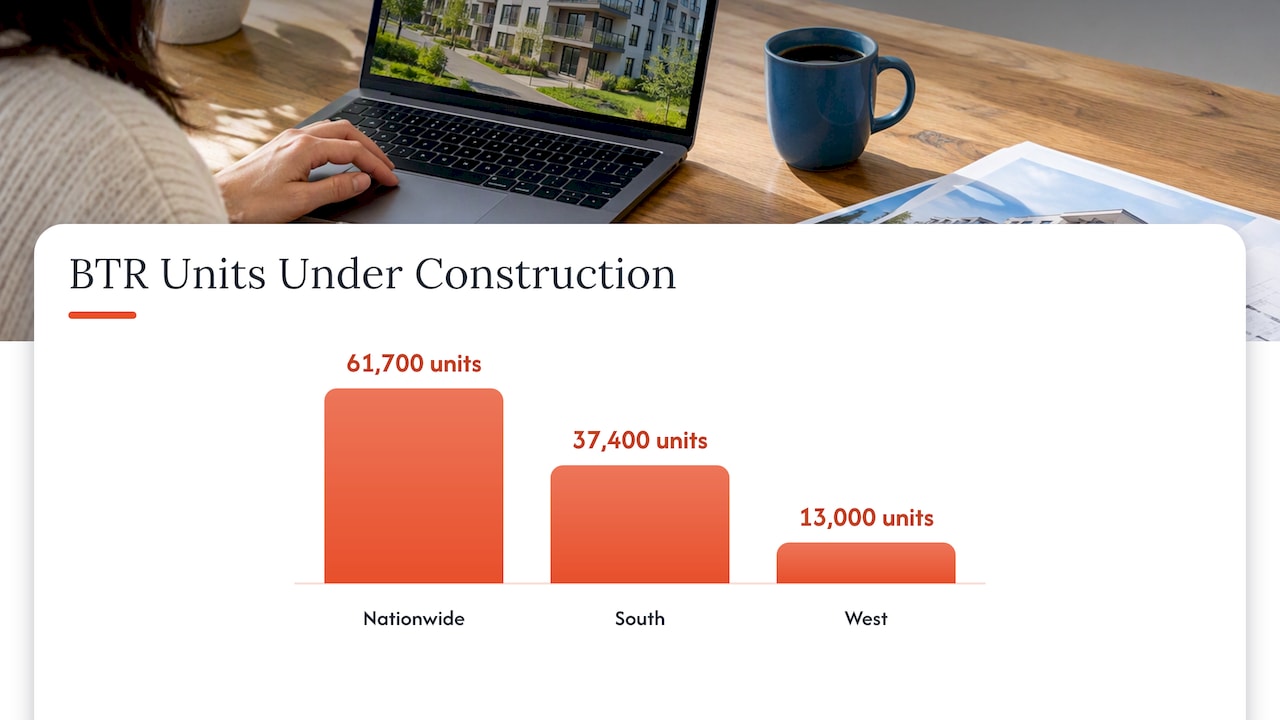
The development pipeline has cooled from its 2024 peak but remains substantial. As of early May 2026, roughly 61,700 BTR units were under construction nationwide, with the South accounting for more than 60% of that total, about 37,400 units, while the West held roughly 13,000 units under construction.
Supply peaked in early 2024 and has since declined by roughly 50% through the first quarter of 2026, according to quarterly data tracked by the National Apartment Association, signaling a market that is recalibrating rather than retreating. Demand has stayed resilient even as developers pull back on new starts, which is the clearest evidence that BTR is maturing into an income-oriented asset class rather than a pure growth play.
A few patterns matter most for underwriting decisions:
- Sun Belt concentration means regional job growth, migration trends, and local permitting speed carry outsized weight in deal selection.
- Deliveries are expected to moderate further into 2027 through 2029, based on RealPage’s later-quarter regional forecasts, which should ease near-term competitive pressure on lease-up.
- National rent growth remains muted, with Freddie Mac’s multifamily outlook flagging growth near 2.2% alongside a vacancy uptick toward 6.2% in the broader rental market, a backdrop that rewards operators who can hold occupancy rather than chase rent spikes.
Why Are Investors Allocating to Build-to-Rent Now?
The core appeal of BTR is a cash-flow profile that behaves more like stabilized multifamily income than speculative single-family appreciation. Renter households in BTR communities tend to stay longer than in scattered-site rentals, partly because the product offers home-like space without the financial commitment of ownership, which reduces turnover costs and vacancy drag.
Scale is the other half of the thesis. A single operator managing 150 units across one or two communities can centralize maintenance dispatch, standardize vendor contracts, and deploy a single technology stack for leasing and rent collection, all of which protect net operating income in ways that scattered single-family portfolios struggle to replicate.
Rental premiums in BTR typically come from a few sources:
- Space and privacy that a comparable apartment unit cannot offer, including private yards and attached garages in many communities.
- Amenity access bundled into rent rather than charged separately, which supports retention.
- Location flexibility, since BTR developers can build in suburban and exurban submarkets where land costs are lower but renter demand (often driven by affordability pressure relative to homeownership) remains strong.
Pro Tip: Underwrite turnover assumptions conservatively even with favorable retention data; a single bad lease-up quarter can erase a year of projected savings from lower churn.
What Underwriting Risks and Mechanics Should You Model?
BTR underwriting carries risks that differ meaningfully from stabilized multifamily acquisitions, because much of the capital is deployed before the asset produces any income.
- Entitlement risk: zoning approvals, HOA formation, and permitting timelines can slip, delaying the start of construction and the clock on interest carry.
- Construction-cost overruns: material and labor cost inflation can erode development spread even when the underlying rent thesis holds.
- Slow lease-up: unit-by-unit absorption that lags the pro forma directly extends the period the asset burns cash before covering debt service.
- Operating expense inflation: landscaping, road maintenance, and dispersed-footprint costs tend to push BTR expense ratios higher than comparable multifamily assets.
- Exit cap-rate risk: a widening of cap rates at sale, even without any operational shortfall, can compress or eliminate projected equity returns.
On the numbers side, practitioner underwriting guidance points to BTR operating expense ratios commonly landing in the 35% to 45% range of effective gross income, higher than typical garden-style multifamily, reflecting the cost of maintaining a low-density, geographically spread community. The same guidance recommends sizing leasing and operating deficit reserves to the sponsor’s specific absorption case rather than applying a generic reserve percentage, since lease-up velocity assumptions drive interest carry and stabilization timing more than almost any other input.
Forward-purchase and phased acquisition structures, where an investor commits capital before construction completes and closes on units as they deliver, have become common in BTR deals. These structures shift some development risk away from the eventual owner but can also leave investors with limited control over HOA formation and construction decisions until the final closing, so contractual protections around document access and warranty schedules matter as much as the pricing itself.
How Do You Evaluate a Build-to-Rent Deal Before Committing Capital?
A disciplined diligence process turns a sponsor’s pro forma into a defensible investment decision. Start with the core metrics, then stress-test them, then interrogate the paperwork.
- Calculate the development spread between projected stabilized value and total cost, including land, hard costs, soft costs, and carry.
- Project stabilized net operating income using a realistic expense ratio rather than the sponsor’s base case alone.
- Run IRR sensitivity against cap-rate movement, since even a 50-basis-point widening at exit can materially change equity returns.
- Check debt service coverage at stabilization, not just at the sponsor’s optimistic leasing pace.
- Model lease-up on a unit-per-month basis, tied to certificate-of-occupancy milestones, rather than accepting a building-level absorption assumption.
This kind of grid, as outlined in BTR development-risk analysis, quickly reveals which deals have real cushion and which are underwritten to perfection.
Your due-diligence packet should also cover entitlement status, the draft HOA covenants, builder warranty terms, the specific protections in any forward-purchase contract, and any completion guarantees the sponsor is offering. For the capital stack side, lenders increasingly expect detailed rent-roll underwriting support before committing construction or bridge financing, so having that documentation ready speeds up the process.
Pro Tip: Ask every sponsor for their actual trailing lease-up pace on a comparable community, not just their projected pace on the deal you’re underwriting.
How Does Professional Management Change Build-to-Rent Outcomes?
Operational execution is where BTR returns are won or lost after the lease-up phase ends. Drawing on extensive experience managing many properties across multiple regional markets, our team has seen firsthand how centralized operations control cost growth in low-density, dispersed communities.
A few levers make the biggest difference:
- Pod-based team structures that keep a dedicated group accountable for leasing, maintenance, and resident relations within a single community.
- In-house maintenance capacity, which shortens response times and reduces the margin vendors typically add to repair costs.
- Proactive resident retention programs that reduce turnover before it shows up as vacancy loss.
- Transparent vendor selection and technology-enabled workflows that keep reporting accurate for investors tracking reserves and absorption against the original underwriting.
Investors who partner with an operator experienced in this asset class can set tighter reserve assumptions and more realistic absorption timelines from day one. For more detail on how density and layout affect ongoing maintenance costs, see our analysis of build-for-rent density tradeoffs.
Who Should Actually Pursue a Build-to-Rent Strategy?
BTR rewards investors who either have operational capability in-house or a committed partner who does. Passive capital chasing a quick flip should look elsewhere: the development-forward, shorter-hold version of this strategy only works for sponsors comfortable managing construction risk and lease-up uncertainty directly.
Investors seeking long-term income, by contrast, are better served holding through stabilization and into a multi-year operating phase, where retention and expense discipline compound. The practical takeaway: match your capital’s patience to the deal’s actual timeline, not the other way around.
— MediaBeast
How Auben Realty Supports Build-to-Rent Investors
We bring the operational side of build-to-rent together with the transaction side, so you’re not stitching together separate vendors for acquisition, construction oversight, and day-to-day management. Our Property Management and Project Management services cover lease-up through stabilization, our Asset Management service handles institutional-style reporting against your underwriting assumptions, and our Brokerage Services team supports acquisition and disposition.

If you’re evaluating a build-to-rent opportunity or an existing portfolio, our Multifamily & Build-to-Rent Services page is the place to start a conversation about what a portfolio review would look like for your deal. You can also review a closer look at how our management approach has performed across 2,700 properties.
This article is general information, not a substitute for advice from a qualified financial advisor. Consult a qualified financial professional about your own circumstances before acting on anything here.
FAQ
Is a rental property a profitable investment?
Profitability depends on the market, the purchase basis, and operating expenses relative to rent, but well-underwritten rental properties, including build-to-rent assets, can produce stable cash flow when occupancy and expense ratios stay within the ranges practitioner underwriting guidance outlines. Returns vary significantly by deal, so a property-specific pro forma matters more than a general market assumption.
What does “BTR construction” mean?
BTR construction refers to homes or communities built specifically to be rented rather than sold, often as detached single-family homes, townhomes, or cottage-style units grouped into a single managed community. These projects are designed from the start with centralized leasing, shared amenities, and rental-specific layouts in mind.
Is rent-to-own a good way to build credit?
Rent-to-own arrangements are a separate structure from build-to-rent investing and are not a core feature of most BTR communities; whether one builds credit depends entirely on the specific contract terms and whether payments are reported to credit bureaus. Anyone considering a rent-to-own agreement should review the contract with a qualified professional before relying on it for credit-building purposes.
What does Dave Ramsey say about renting?
Dave Ramsey’s general guidance favors renting over buying when a household is not financially ready for homeownership, framing renting as a reasonable short-term choice rather than a failure. For investors, that same affordability gap between renting and owning is part of what sustains renter demand across the single-family and build-to-rent markets, as explored in our breakdown of homeownership versus renting costs.
Sources
- Build to Rent Update 1Q 2026
- Build-to-Rent Through Q1 2026: Three years of data reveal stable demand, shifting supply and capital recalibration
- How Investors & Underwriters Should Evaluate Opportunities: Build-to-Rent (BTR) 2026 | Cactus