Build-to-Rent vs Multifamily: Which Fits Your Portfolio?
October 22, 2026
Build-to-rent (BTR) and multifamily are both purpose-built rental housing, but they behave differently. Multifamily stacks many units on one site and wins on scale, operating leverage and liquidity. BTR spreads single-family homes, townhomes or duplexes across a horizontal community and tends to win on resident stay length, floor plan size and control over maintenance. Which one is better depends on your capital, your appetite for development risk and how you plan to exit.
Below, we compare them on the criteria that move returns, with the current market context and the policy risk investors are modeling in 2026.
TL;DR
- Multifamily generally offers more units per acre, lower cost per door to operate and a deeper buyer pool at exit. It is also where the heaviest new supply in decades has pressured rents and vacancy.
- Build-to-rent appeals to households that want a house but are not ready to buy. It is a small but real niche, around 7% of single-family starts.
- Both are sensitive to interest rates. In this market, operations and underwriting discipline matter more than aggressive acquisition.
- BTR carries extra policy and exit risk tied to proposed limits on large institutional single-family owners.
- A hybrid or mixed-density approach, with strong third-party management, is often the most practical answer for a mid-size investor.
Table of Contents
- What counts as build-to-rent and what counts as multifamily
- How big each market is
- Build-to-rent vs multifamily: side by side
- Where multifamily is strongest
- Where build-to-rent is strongest
- The risks that decide the choice
- A simple decision framework
- Our perspective
- Getting help with either strategy
- FAQ
- Sources
What counts as build-to-rent and what counts as multifamily
Definitions matter because they change which data you read. The U.S. Census Bureau defines multifamily as structures with five or more units. Single-family, in the same definitions, includes detached homes, semidetached homes, row houses and townhouses separated by a ground-to-roof wall without shared heating systems or utilities. So a townhome community built for renters is a single-family product in federal statistics, even though it feels like an apartment community to residents.
The Urban Institute describes BTR as homes constructed specifically for renting rather than for sale. Many BTR communities add shared amenities such as trails, parks and pools. That is the key difference from scattered-site single-family rentals, where individual houses sit in different neighborhoods with no common features.
A useful mental model:
- Multifamily: vertical or garden-style buildings, shared walls and corridors, centralized systems, many units on a small footprint.
- Build-to-rent: horizontal layout, private entrances and often private yards or garages, a community managed as one asset.
- Scattered-site single-family rental: not BTR, and a different operating problem altogether.
How big each market is
Multifamily is the larger and older institutional asset class. In Q4 2025, multifamily made up 29% of housing starts, against 70% for single-family structures. Within single-family, BTR is a slice. The Urban Institute reported that BTR was about 7.3% of single-family starts between Q2 2022 and Q1 2023, up from an average of 29,000 starts a year from 1990 to 2020 to 68,000 starts in that period.
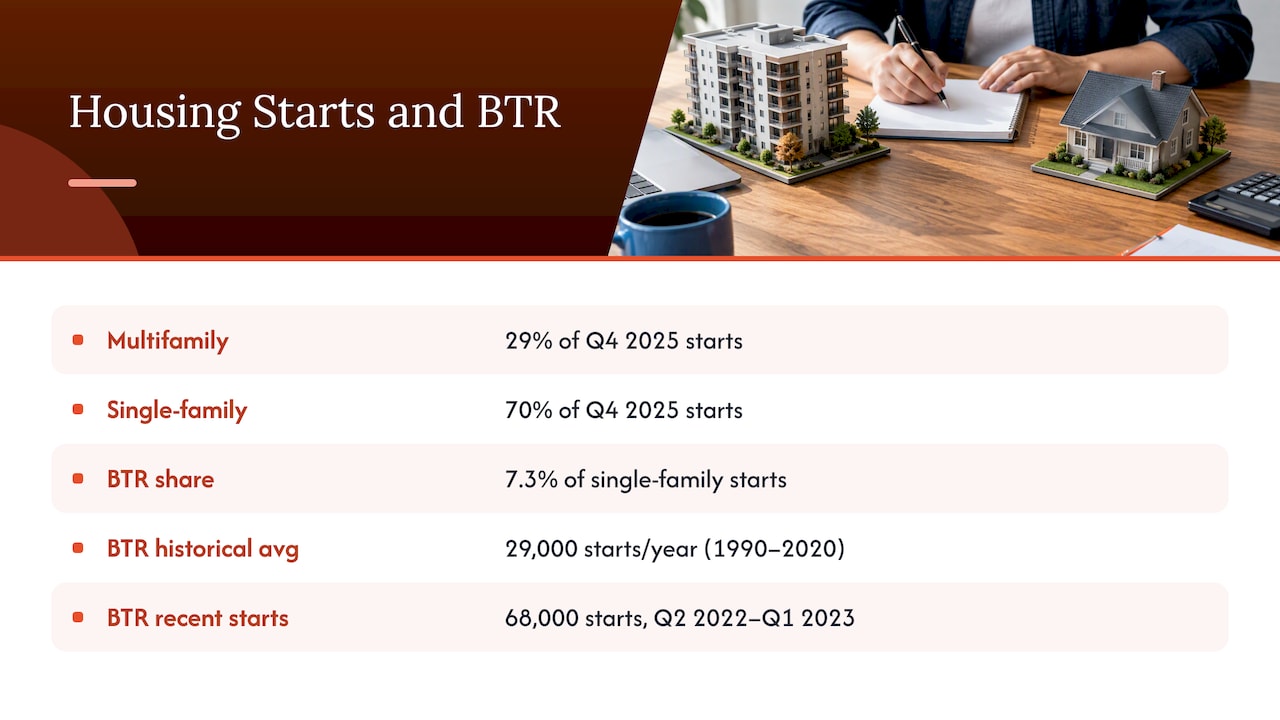
That growth has since cooled. NAHB reported that built-for-rent construction fell back in the first quarter of 2026, citing financing costs, more multifamily supply and policy concerns, while the four-quarter share stayed just under 7%.
Build-to-rent vs multifamily: side by side
| Criterion | Build-to-rent | Multifamily |
|---|---|---|
| Typical resident | Households wanting house-like space without buying | Wide range, from singles to families |
| Density | Lower, more land per unit | Higher, more units per acre |
| Operating efficiency | Less shared infrastructure, more roofs and yards | Centralized systems, on-site staff spread over more doors |
| Turnover | Often lower, reported stays are longer | Higher in many markets |
| Development cost | Higher land and site cost per unit | Lower land cost per unit, higher vertical construction cost |
| Exit options | Bulk sale or individual home sales, subject to policy risk | Deep institutional buyer pool |
| Entry capital | Often large for a full community | Wide range, from small buildings to large complexes |
| Main risks | Policy, density, exit complexity | New supply, rent growth, interest rates |
Treat the table as directional. Local rents, land prices and zoning decide the real numbers.
Where multifamily is strongest
Scale and operating leverage. One roof, one boiler plant or one set of common systems, one leasing office. More units share the same fixed costs, which is why a well-run apartment property can often produce a lower cost per door than dispersed homes.
Liquidity. There is a mature market of lenders and buyers. Freddie Mac says it provided $77.6 billion in multifamily liquidity in 2025, supporting 617,000 rental units. That kind of financing depth makes underwriting and exit easier to benchmark.
Durable demand. Freddie Mac’s outlook says that despite higher-for-longer rates, multifamily will likely remain a favored asset class, partly because the rising monthly cost of for-sale housing makes renting comparatively more affordable.
The catch right now is supply. Freddie Mac’s outlook flagged the highest new supply since the 1980s, with rent growth below the long-term average and vacancy creeping up. Its podcast transcript put the expected vacancy rate at 6.2%, worse than the historic average, and noted that operators may trade rent growth for occupancy. Note that this is a 2025 forecast, so check local submarket data before you underwrite.
Where build-to-rent is strongest
A clear resident niche. The Urban Institute says BTR serves households that want single-family living but lack the desire or current ability to buy. In suburban markets like those around Dallas-Fort Worth, Houston, Charleston and Jacksonville, that is a large pool of families who want a garage and a yard.
Control over maintenance. New homes built to one plan use standard finishes, standard parts and standard vendors. The Urban Institute notes that investors moved into BTR because it offers greater control over maintenance and costs than buying scattered older homes.
Retention. Longer stays mean fewer turns, less downtime and lower make-ready cost. Marketing materials in this space often cite average BTR stays of several years, but those are industry claims, not audited benchmarks. Ask any operator for its own renewal and turnover data by community, not a national average.
Amenities without the tower. Shared trails and pools give a community feel while each household keeps a private front door.
The risks that decide the choice
Interest rates hit both
Rates are the common enemy. Freddie Mac’s outlook says elevated, volatile rates exert negative pressure on asset values. For BTR and multifamily alike, that pushes investors toward operations: tighter expense control, better retention, disciplined capital spending. For a view on where borrowing costs may head, see this 2026 mortgage rate forecast before you lock in a debt assumption.
Policy risk is sharper for BTR
Proposed federal legislation targeting large institutional owners of single-family homes could change the BTR exit. The Urban Institute analysis of the Senate proposal argued it would steer capital away from the costlier build-to-rent model. NAHB said the Senate version would have required institutionally financed new single-family rentals to be sold to individual buyers within seven years, and noted that later House changes addressed that proposal. The rules were still moving as of this writing, so model your hold period with and without a forced-sale scenario.
Hold or sell
The Urban Institute also notes that with high rates and moderating rent growth, selling homes can look more attractive than holding them as long-term rentals. A BTR plan that depends on one exit path is fragile. A plan that works on cash flow alone is sturdier.
A simple decision framework
- Define your capital and timeline. A long hold with patient capital suits either. A short hold needs a clear exit buyer.
- Pick the submarket first. Compare local new supply, rent trends and school and job patterns before you pick a product.
- Underwrite conservatively. Use vacancy at or above current market levels, not last year’s peak occupancy.
- Stress the debt. Run a scenario with higher rates and a delayed sale.
- Check the operator. Management quality changes net income as much as the asset type does. Ask about in-house maintenance, vendor selection and renewal tracking.
- Consider a blend. Mixed communities with townhomes and apartments diversify resident type and share amenities. Our guide to why build-for-rent communities prioritize density explains the tradeoffs.
If you are also weighing smaller single-family or small multifamily holdings, our 7-step single family or multifamily checklist walks through the same questions at a smaller scale.
Our perspective
We manage both kinds of rental housing, so we do not need one to win. After more than 15 years and 2,700 properties served across 10 regional markets, our view is that the asset label matters less than three things: the submarket, the debt and the operator.
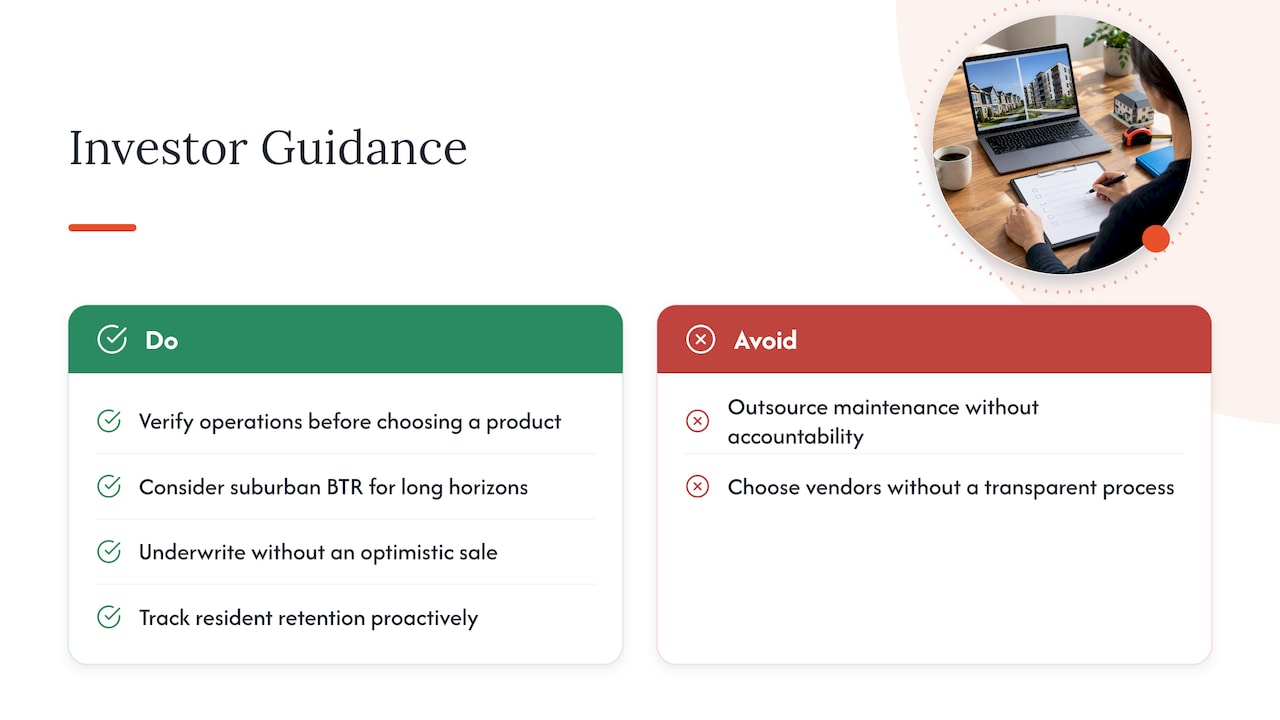
In multifamily, results hinge on controlling costs while supply is high. In BTR, results hinge on retention and on how many ways you can exit. In both, we have seen returns erode when maintenance is outsourced without accountability and when vendors are chosen without a transparent process. That is why we run in-house maintenance, use a pod-based team structure so each community has a focused team, and track resident retention proactively.
Our practical advice: if you are a first-time investor, start with the product whose operations you can verify. If you are an experienced investor with a long horizon, a BTR community in a suburban growth market can complement apartments, as long as the underwriting still works without an optimistic sale.
— MediaBeast
Getting help with either strategy
We work with owners and investors on multifamily and build-to-rent strategy, from acquisition through brokerage services and renovation oversight to day-to-day property management, across the markets we serve, including Charleston, Columbia, Dallas-Fort Worth, Houston, Kansas City and Jacksonville. If you want a second opinion on a deal, start with the multifamily and build-to-rent page and tell us your market and timeline. For more background on the product, read our overview of build-to-rent communities.
FAQ
Is build-to-rent the same as multifamily?
No, though they overlap. Federal statistics count multifamily as buildings with five or more units, while many BTR homes are detached or attached single-family units. Operationally, a BTR community is managed like an apartment community, with a single owner, shared amenities and standardized maintenance.
Which has lower turnover, BTR or multifamily?
BTR is generally reported to have longer stays, because renters choose it for space and stability. The figures vary by operator and market, so ask for actual renewal data from the community you are evaluating.
Is build-to-rent riskier than multifamily?
It carries different risks. BTR faces more policy and exit uncertainty, plus higher land cost per unit. Multifamily faces heavy new supply and thinner rent growth in many markets. Neither is safe without conservative underwriting.
How do I choose between them as a first-time investor?
Start with your capital, your hold period and the local market. Then pick the structure you can manage and verify. A professional property manager can help you model operating costs before you commit.
Sources
- What Is the Build-to-Rent Sector, and Who Does It Serve? (Urban Institute)
- BPS Definitions (U.S. Census Bureau)
- 2025 Multifamily Outlook (Freddie Mac)
- 2025 Multifamily Outlook report (Freddie Mac)
- 2025 Multifamily Outlook podcast transcript (Freddie Mac)
- 2025 Annual Housing Activities Report (Freddie Mac)
- The Evolving Role of Single-Family Rental Investors (Urban Institute)
- The Senate’s Surprising Move to Dissuade Investors from Building Rental Housing (Urban Institute)
- Single-Family Built-to-Rent Slowed at Start of 2026 (NAHB Eye on Housing)