Fort Worth Rental Market: 56.4% DFW Concessions Shift Leverage
October 13, 2026
Rents in Fort Worth are softening in 2026 as new apartment supply outpaces demand, giving renters more room to negotiate while owners compete harder for qualified tenants. The Texas Real Estate Research Center projects flat to slightly positive rent growth for stabilized units through 2026 and 2027, with recovery tied to how fast the current supply wave gets absorbed.
TL;DR:
- With 56.4% of DFW listings offering concessions in August 2026, ask each leasing office about free months, waived fees, or reduced deposits.
- Compare rents by bedroom count and neighborhood: downtown and employer adjacent areas tend to cost more, while supply heavy outer submarkets often sit at or below the median.
- Listings sitting three weeks or longer may invite lower offers; check whether quoted rent includes concessions, and budget utilities, parking, and pet fees separately.
- Owners should price against nearby comparable units, favor one targeted concession over a face rent cut, and prioritize renewals to avoid vacancy and turnover costs.
Table of Contents
- Fort Worth Rent Snapshot: Prices, Trends, and Concessions
- Rent Ranges by Unit Size and Neighborhood
- What’s Driving the Shift: Supply, Jobs, and Population
- Renter’s Playbook: Timing, Negotiating, and Budgeting
- Owner and Investor Strategy for a Softer Market
- A Local Lens on Fort Worth Leasing and Retention
- Who’s Renting in Fort Worth and What They Want
- How Local Rules Shape the Rental Market
- Fort Worth Versus Dallas and Other Nearby Metros
- Beyond 2027: What Could Reshape the Market
- What to Watch for the Next Market Signal
- How We Help Fort Worth Owners Navigate This Market
- FAQ
- Sources
Fort Worth Rent Snapshot: Prices, Trends, and Concessions
Fort Worth’s rental market is caught between two forces right now: a surge of new apartment deliveries pushing rents down, and steady job and population growth keeping long-term demand intact. The result is a market that favors renters in the short term without signaling a structural downturn, reflecting trends similar to those discussed in How to Invest in Austin Real Estate for Lasting Returns.
Concession activity has climbed sharply across the metro. The Dallas-Fort Worth area posted a concession rate near 56.4% in August 2026, according to Realtor, among the higher rates tracked across major Texas metros that month. That means more than half of listings in the metro offered some form of discount, free month, waived fee, or reduced deposit to get units leased.
For renters, that concession rate translates directly into negotiating leverage, especially on newer buildings still filling vacancies. For owners, it means advertised asking rent and actual collected rent are diverging, and tracking net effective rent (what you actually collect after concessions) matters more than headline pricing.
- Asking rents in Fort Worth are roughly flat to slightly softer than a year ago, per TRERC’s forecast.
- Concession use near 56.4% in DFW gives renters real room to negotiate.
- Owners should price competitively and consider targeted concessions rather than holding firm on asking rent in submarkets with elevated concessions.
Rent Ranges by Unit Size and Neighborhood
A single metro-wide average hides a lot. Fort Worth’s blended rent figure mixes studios, one-bedrooms, and larger family units, and the mix itself shifts the average: a submarket with more two-bedroom family rentals will show a higher blended number than one dominated by compact one-bedroom units, independent of whether either market is actually getting more expensive.
Typical patterns across Fort Worth submarkets include:
- Studios and smaller one-bedroom units generally sit below the citywide blended average, since they carry less square footage and fewer amenities.
- Two-bedroom and larger units pull the blended average up, particularly in newer build-to-rent and suburban communities built for families.
- Neighborhoods closer to downtown, the Cultural District, and areas near major employers tend to price above the metro median.
- Outlying submarkets with heavier recent apartment deliveries tend to price at or below the median, reflecting the extra supply competing for tenants.
If you’re comparing a quoted rent to “the Fort Worth average,” check what unit type and submarket that average represents before assuming you’re over or under market.
What’s Driving the Shift: Supply, Jobs, and Population
The short-term softness traces back to a construction boom that started in 2023 and 2024. Those projects are delivering now, in 2025 and 2026, flooding several submarkets with new units faster than renters can absorb them. NorthMarq’s Dallas-Fort Worth multifamily analysis attributes the current rent softness directly to this delivery wave, while projecting that absorption will catch up and push rent growth positive again as the pipeline thins into 2027.
Underneath the supply noise, the demand fundamentals remain solid. The Dallas Fed reports that Fort Worth’s economy kept expanding through May 2026, with continued payroll growth and rising population even as housing demand cooled slightly. Jobs and population growth are what keep a market like Fort Worth out of real trouble during a supply glut; they’re the reason analysts expect recovery rather than prolonged decline.
| Factor | Current signal | Near-term implication |
|---|---|---|
| New multifamily deliveries | Elevated, from 2023-2024 project starts | Continued rent softness through 2026 |
| Absorption | Catching up to supply | Expected to push rents positive by 2027 |
| Employment growth | Positive, per Dallas Fed | Supports long-term rental demand |
| Population growth | Positive, per Dallas Fed | Keeps occupancy fundamentals intact |
Expect concessions to stay common through the rest of 2026, then gradually taper as deliveries slow and absorption works through the backlog.
Renter’s Playbook: Timing, Negotiating, and Budgeting
With concessions this common, a passive search costs you money. A little strategy goes a long way in a market this favorable to tenants.
- Ask directly about concessions on every unit you tour: a free month, waived application fee, or reduced deposit are all common right now.
- Target newer buildings still in lease-up, where owners are more motivated to negotiate than on a fully occupied property.
- Watch for listings that have sat for three or more weeks; that’s usually a signal the owner is open to a lower offer or added incentive.
- Budget using the per-bedroom range for your unit type, not the citywide blended average, so you’re comparing against the right benchmark.
- Factor in utilities, parking, and pet fees separately: concessions rarely cover these recurring costs.
Pro Tip: Ask the leasing office directly whether the quoted rent reflects “net effective rent” after concessions, since that’s the number that actually hits your budget each month.
Owner and Investor Strategy for a Softer Market
Elevated supply doesn’t mean owners should panic-cut asking rent. It does mean pricing and lease terms need to reflect what’s actually happening in your specific submarket, not last year’s numbers.
- Price new listings against current comparable rents in your submarket, not citywide averages, since neighborhood-level supply varies widely.
- Offer a single targeted concession (one month free on a 13-month lease, for example) rather than cutting face rent, which protects your net effective rent while still competing for tenants.
- Lean into amenity and condition upgrades where you can, since renters have more choices right now and will pay a premium for move-in-ready units.
- Prioritize retention over acquisition: a renewal at a modest increase almost always beats the turnover cost, vacancy loss, and make-ready expense of a new tenant.
Pro Tip: A well-timed $500 to $1,000 renewal incentive is often cheaper than the turnover cost of an empty unit for 30 to 45 days.
As Realtor.com’s research notes, rising concessions reflect genuine renter leverage this cycle, so owners who adapt pricing strategy now tend to fill units faster than those holding out for last year’s rents.
A Local Lens on Fort Worth Leasing and Retention
Reading the regional data is one thing; applying it to a specific Fort Worth block or submarket is another. We have experience in property management, renovation oversight, and tenant placement in the Dallas-Fort Worth area, giving insight into how the current concession environment is playing out property by property, not just in metro-wide averages.
A few things we watch closely when advising owners in this market:
- Submarket-level absorption, since two neighborhoods a few miles apart can show very different vacancy pressure right now.
- Renovation returns, since a modest kitchen or flooring update often justifies a stronger asking rent even while competitors cut theirs.
- Tenant retention data, since a renewal at a fair increase typically outperforms chasing top-of-market rent on a new lease.
If you’re deciding whether to manage a Fort Worth rental yourself or bring in help, look for a manager who can show you submarket-specific pricing data, not just citywide trends, and who explains how they’d structure concessions to protect your net income.
Who’s Renting in Fort Worth and What They Want
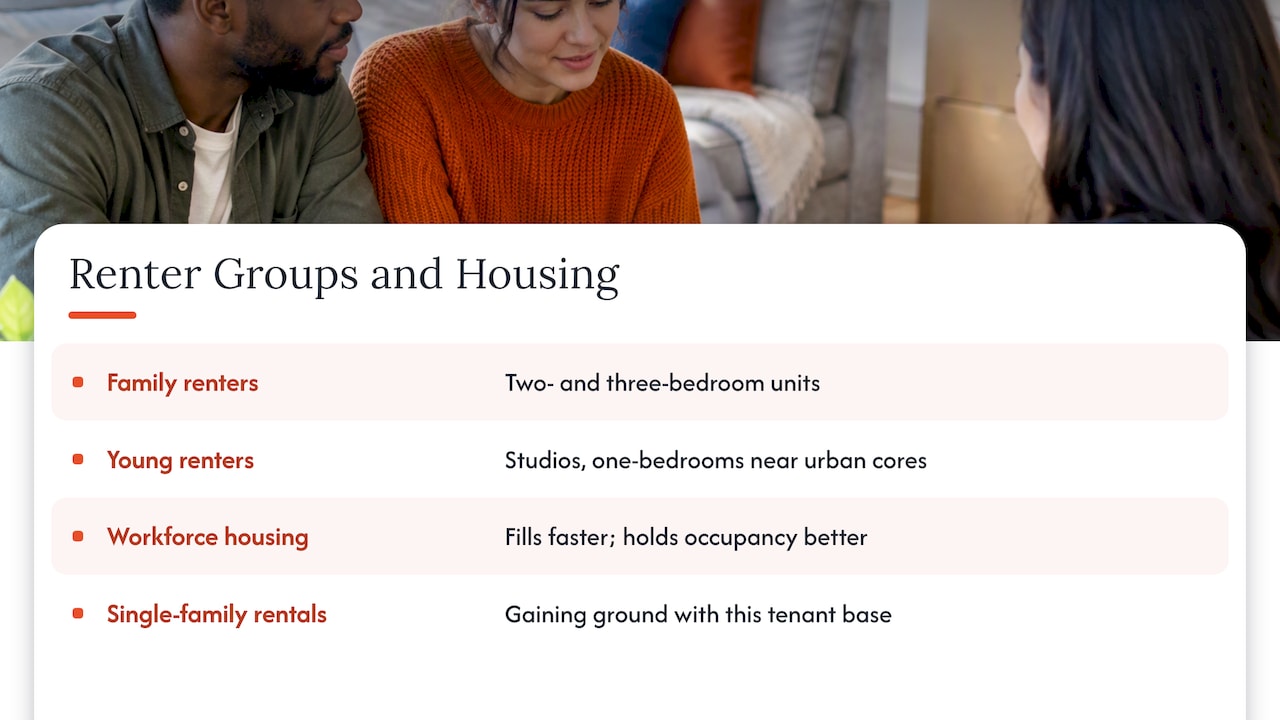
Fort Worth’s renter base skews toward working professionals in logistics, aerospace, manufacturing, and healthcare, reflecting the metro’s industrial and institutional employment base. That’s a meaningfully different tenant profile than Dallas’s more finance- and tech-heavy workforce, and it shapes what gets rented fastest.
Single-family rentals and build-to-rent communities have gained ground with this tenant base, particularly among renters who want more space, a yard, or proximity to suburban employers without committing to a home purchase. Workforce-oriented housing, meaning well-priced, well-located units rather than ultra-luxury towers, tends to fill faster and hold occupancy better through supply gluts than high-end product competing purely on amenities.
Family households and dual-income renters drive demand for two- and three-bedroom units, which helps explain why those unit types often command a premium over the citywide blended average. Younger professionals and students near the metro’s universities and medical districts still favor smaller one-bedroom and studio units, concentrated closer to urban cores and transit corridors.
For owners, matching your property type to the right tenant pool matters more in a competitive leasing environment. A single-family rental marketed toward a family relocating for an aerospace or logistics job tends to lease faster than the same unit marketed generically, because the pitch speaks directly to why that renter chose Fort Worth in the first place.
How Local Rules Shape the Rental Market
Texas law leans landlord-friendly compared to many states, which affects how both renters and owners should approach the Fort Worth market. There’s no statewide rent control in Texas, and Fort Worth has not adopted local rent stabilization ordinances, so asking rents move with supply and demand rather than regulatory caps.
Texas’s property tax structure also plays a quieter but real role in rental pricing. Because the state has no income tax, property taxes fund much of local government, and Tarrant County rates factor into the operating costs owners pass through in rent-setting decisions. Owners budgeting for 2026 and 2027 should factor in that property tax assessments, not just market rent trends, affect what rent level actually produces a sustainable return.
Fort Worth’s zoning and permitting processes also influence how quickly new supply comes online, which ties directly back to the current oversupply dynamic. Build-to-rent and multifamily projects approved during the 2023 to 2024 development cycle are the ones delivering now, and permitting pace in the next cycle will help determine whether today’s softness extends into 2027 or resolves faster.
For both renters and owners, the practical takeaway is that Fort Worth’s rental market responds quickly to supply changes precisely because there’s little regulatory friction slowing construction or rent adjustments in either direction.
Fort Worth Versus Dallas and Other Nearby Metros
Fort Worth and Dallas get lumped together in regional data, but the two markets behave differently enough that treating them as one can mislead both renters and owners. Fort Worth’s economy carries more weight from logistics, aerospace, and manufacturing employment, as the Dallas Fed’s indicators note, while Dallas skews more toward finance, tech, and corporate headquarters activity. That difference shows up in rental demand: Fort Worth tends to see stronger pull toward workforce and single-family rental housing, while Dallas sees more demand concentrated in luxury and urban-core apartments.
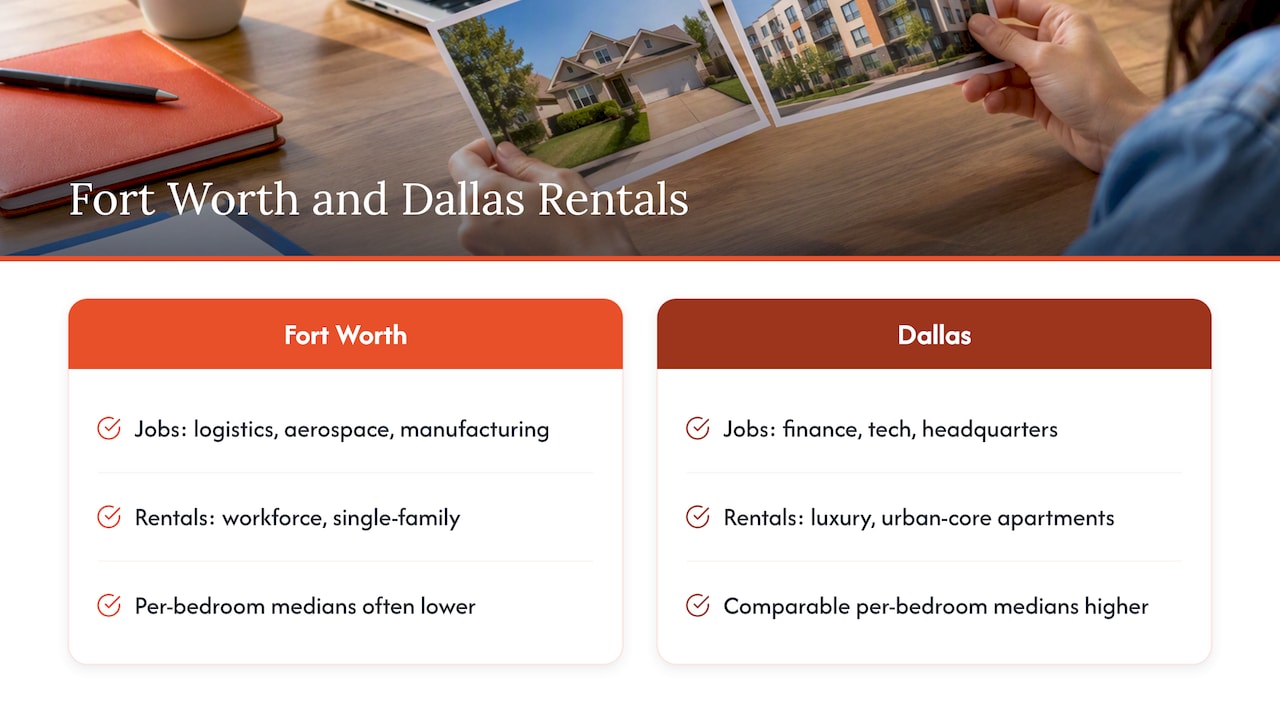
Pricing reflects that split too. Per-bedroom medians in Fort Worth often run below comparable Dallas figures, according to market median snapshots tracking the broader DFW area, partly because Fort Worth’s supply wave has hit certain submarkets harder and partly because its tenant base has different space and price expectations than Dallas renters.
Compared to smaller nearby communities, Fort Worth offers more rental inventory and a broader range of unit types, from downtown apartments to suburban build-to-rent communities, which gives both renters and owners more options but also more submarkets to track individually. For an owner managing properties across the broader DFW region, this means a single regional pricing strategy rarely works well: what clears in a Fort Worth submarket near an aerospace employer can differ meaningfully from what clears in a Dallas submarket a few miles away.
Beyond 2027: What Could Reshape the Market
Once the current supply wave gets absorbed, most regional analysts expect Fort Worth’s rental market to return to steadier, demand-driven rent growth. NorthMarq’s analysis points to recovery extending into 2027 as deliveries slow and absorption catches up, which would gradually shift leverage back toward owners.
The bigger long-term question is whether construction starts pick back up fast enough to trigger another oversupply cycle once this one clears, a pattern that has played out in fast-growing Sun Belt metros before. Interest rates, construction costs, and investor appetite for new multifamily projects will all shape whether Fort Worth sees a smooth landing or another boom-and-bust swing in the early 2030s.
Population and job growth remain the steadier variable. As long as Fort Worth keeps attracting logistics, aerospace, and manufacturing employers, as the Dallas Fed’s data suggests it has through 2026, underlying rental demand should stay resilient even through supply-driven rough patches. The risk worth watching isn’t demand collapsing, it’s supply overshooting again once the current glut clears and developers chase the next growth wave.
What to Watch for the Next Market Signal
Keep an eye on the months-of-supply figure for Fort Worth multifamily: a sustained drop toward 4.0 months typically signals the market is tightening back toward balance. Watch concession rates too; a steady decline from today’s elevated levels would confirm absorption is catching up. Most regional forecasts point to stabilization sometime in late 2026 into 2027.
— MediaBeast
How We Help Fort Worth Owners Navigate This Market

A market this sensitive to concessions and submarket-level supply rewards owners who have someone tracking the details daily, not quarterly. Our approach combines local Dallas-Fort Worth leasing knowledge with hands-on management, aiming to ensure pricing decisions reflect what’s actually happening on the block rather than a citywide average.
Depending on ownership needs, services offered may include:
- Property Management covering leasing, rent collection, and day-to-day operations.
- Project Management supporting value-add renovations to improve competitiveness in leasing.
- Asset Management aiding investors with portfolio-level decisions.
- Brokerage Services assisting with sales or acquisitions in the market.
An initial conversation walks through your property’s specifics and what a management plan would look like. Start with our Fort Worth property management page to see what’s involved.
FAQ
Are rents going down in Texas?
Rents are softening in several Texas metros, including Fort Worth, as heavy 2023-2024 construction delivers units faster than demand absorbs them. The Texas Real Estate Research Center projects flat to slightly positive rent growth for stabilized units through 2026 and 2027 rather than a sustained decline.
What is the current housing market situation in Fort Worth, Texas?
Fort Worth’s economy kept expanding through May 2026, with continued job and population growth even as housing demand cooled slightly, according to the Dallas Fed. The median home sales price sat around $355,000 in May 2026, while the rental side shows elevated concessions tied to new apartment supply.
Will rent prices go down in 2026?
Rent growth is expected to stay flat to slightly soft through 2026 as the market absorbs recent multifamily deliveries, per TRERC’s forecast. Analysts generally expect rent growth to turn positive again as absorption catches up, with recovery more likely in 2027.
Is Fort Worth a buyer’s or seller’s market?
Fort Worth’s housing market has leaned toward more balanced conditions recently, with softer housing demand noted alongside continued job and population growth in the Dallas Fed’s indicators. On the rental side specifically, elevated concessions currently favor renters over owners in lease negotiations.
How do I choose a property manager in Fort Worth?
Look for a manager who can show submarket-specific pricing data rather than citywide averages, since Fort Worth’s rent trends vary meaningfully by neighborhood. Ask how they structure concessions to protect net effective rent and whether they offer renovation or asset-management support alongside day-to-day leasing.
Sources
- Dallasfed
- Texas Real Estate Research Center forecast
- Realtor
- NorthMarq Dallas–Fort Worth multifamily insights