For Investors: Single Family or Multifamily? A 7 Step Decision Checklist
October 7, 2026
If you need cash flow and scale, multifamily usually wins; if you need liquidity and appreciation optionality, single-family often wins. Multifamily brings denser income and faster portfolio growth but comes with commercial financing rules once you cross five units. Single-family stays simpler to finance and sell but puts your income at the mercy of one tenant per property. Read on for the financing math, management trade-offs, and a checklist to apply to your next deal.
TL;DR:
- Multifamily properties offer higher cash flow stability and portfolio scaling benefits but require commercial financing for five or more units.
- Single-family homes are simpler to finance, sell, and often appreciate faster, making them ideal for investors prioritizing liquidity and appreciation.
- The new 2025 HUD financing rules favor smaller deals, but five-plus-unit properties face stricter commercial underwriting with potential refinancing risks.
- Managing multifamily units benefits from economies of scale and on-site staffing, while single-family portfolios spread risks across different neighborhoods.
- Investors should evaluate their primary goals and run detailed financial analyses before choosing between single-family and multifamily investments.
Table of Contents
- Single Family vs Multifamily at a Glance
- How Returns Are Built: Cap Rates, Appreciation, and Loan Terms
- Managing Single-Family vs Multifamily Day to Day
- Weighing the Risks, Reserves, and Exit Timing
- A Practical Checklist for Choosing Your Asset Type
- Where Auben Realty Fits Into the Decision
- An Editorial Take on Picking Your Lane
- Get a Clear Read on Your Next Property Move
- FAQ
- Sources
Single Family vs Multifamily at a Glance
The two asset types reward different goals, and the gap shows up clearest when you line up cash flow, appreciation, and financing side by side.
- Cash flow: Multifamily typically produces steadier monthly income because rent loss from one vacant unit is diluted across several others.
- Appreciation: Single-family properties have historically tracked local home price trends more directly, while multifamily value is driven more by net operating income than by comparable sales.
- Financing: A one-to-four-unit property qualifies for residential financing, while a five-plus-unit deal moves into commercial underwriting with different debt service coverage ratio (DSCR) and loan-to-value (LTV) requirements.
- Entry cost: Single-family deals generally require less capital upfront than a multifamily acquisition of comparable total unit count.
- Management: Multifamily concentrates repairs and tenant issues in one location, which can lower the time cost per unit once you have scale.
- Liquidity: Single-family homes sell to a broader buyer pool, including owner-occupants, which tends to shorten exit timelines.
Starter investors and those who want a simple exit often gravitate toward single-family. Passive investors chasing stable monthly income, and operators ready to scale a portfolio, tend to lean multifamily.
How Returns Are Built: Cap Rates, Appreciation, and Loan Terms
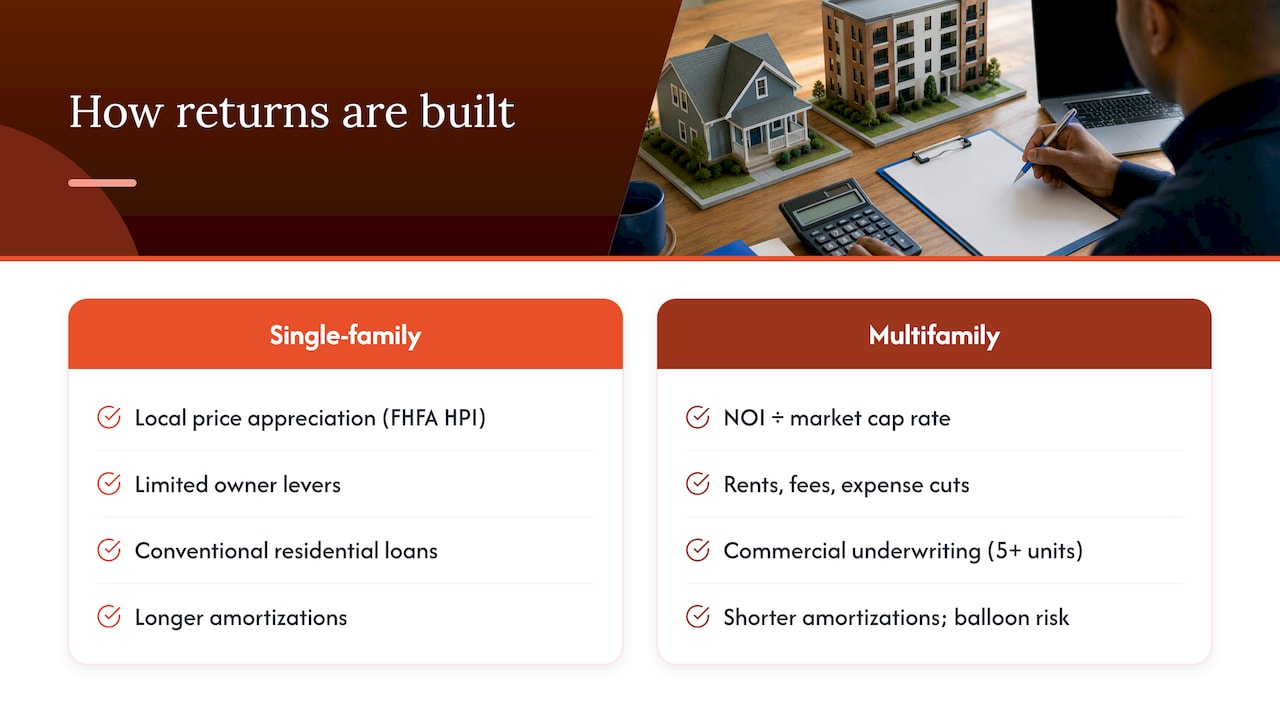
Multifamily value is a function of net operating income (NOI) divided by the market cap rate. Raise rents, add a laundry or parking fee, or cut operating expenses, and the resulting NOI increase flows straight into the property’s valuation. That’s why industry analysis points to multifamily as the asset class where owners can actively engineer value rather than wait on the market.
Single-family returns lean more heavily on local price appreciation. The FHFA House Price Index tracks single-family price changes using a repeat-sales method across all 50 states and more than 400 cities, and it remains the standard public benchmark for setting appreciation expectations in a given market.
Multifamily financing changed in 2025: the HUD Mortgagee Letter 2025-03 revised DSCR and LTV/LTC parameters for FHA-insured multifamily loans, adjustments aimed at improving financing access for qualified deals. One-to-four-unit properties still qualify for conventional residential loans with longer amortizations, while five-plus-unit deals face commercial underwriting, shorter amortization schedules, and sometimes balloon payments that create refinancing risk down the road. Both asset types allow depreciation deductions. Larger multifamily properties often present stronger opportunities for cost segregation studies that accelerate those deductions.
Managing Single-Family vs Multifamily Day to Day
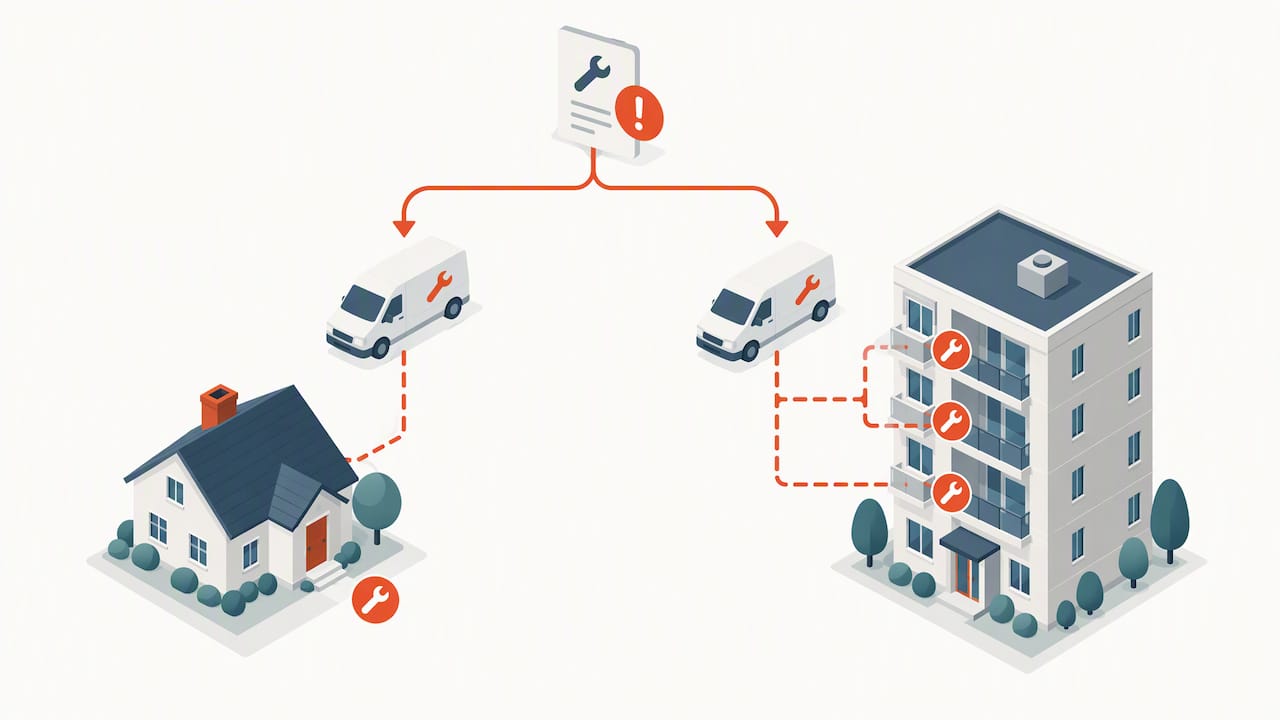
Multifamily properties benefit from economies of scale: one roof, one parking lot, and one on-site maintenance stop can serve dozens of units, which lowers the per-door cost of upkeep. Single-family portfolios spread that same workload across multiple addresses, often multiple neighborhoods, which adds drive time and vendor coordination even though each individual repair tends to be smaller.
- Multifamily concentrates tenant turnover, noise complaints, and maintenance requests in one place, which rewards an on-site or near-site manager.
- Single-family spreads risk across locations, so a bad block or a problem tenant affects only one income stream rather than a cluster of units.
- Capex lumpiness hits multifamily harder: a single failed roof or HVAC system can be a large one-time hit, while SFR repairs tend to stagger naturally across a portfolio.
- Reserves should scale differently: budget heavier short-term capex reserves per building for multifamily, and per-property reserves that grow with your unit count for single-family.
A home management plan that spells out vendor response times and reserve targets makes the decision to self-manage or hire a property manager much clearer.
Pro Tip: Ask any property manager you’re interviewing how they handle a simultaneous repair across multiple units versus a single-property emergency; the answer tells you how they’ll actually run your portfolio.
Weighing the Risks, Reserves, and Exit Timing
Vacancy risk looks different across the two asset types. A vacant single-family rental means zero income until it’s filled, while a vacant unit in a ten-unit building still leaves nine streams flowing. Market cycles cut the other way too: single-family appreciation can swing with local demand, while multifamily income tends to hold steadier because leases are staggered.
- Vacancy exposure: single-family is all-or-nothing; multifamily diversifies the loss across units.
- Exit liquidity: single-family homes draw a wider buyer pool, including owner-occupants, which generally shortens resale timelines.
- Buyer pool for multifamily skews toward investors, so pricing and timing depend more on cap rate trends and available commercial financing.
- Contingencies worth building in: a capex reserve sized to your roof, HVAC, and major system ages, plus thorough due diligence on rent rolls before you bid.
A Practical Checklist for Choosing Your Asset Type
Run these steps before you commit capital to either path:
- Name your primary goal: cash flow, appreciation, portfolio scale, or hands-off passive income each points toward a different asset type.
- Run the cap rate against your financing cost: if the spread is thin after a rate hike, the deal may not support commercial debt service.
- Set a cash-on-cash target and test whether projected rents and expenses clear it before you factor in appreciation.
- Apply the DSCR test for any five-plus-unit deal, since lenders will underwrite to it regardless of your own return model.
- Scrutinize the comps: a multifamily valuation built on optimistic NOI projections, or a single-family comp set that ignores recent price softening, is a red flag.
- Ask your lender directly how the current DSCR and LTV thresholds affect your loan sizing before you tour a single property.
- Ask a property manager or broker what per-door costs and typical turnover look like in the specific submarket you’re targeting; tracking the key metrics investors should follow keeps this comparison honest.
Where Auben Realty Fits Into the Decision
We manage both single-family and multifamily portfolios across our markets, so we see the financing and operational differences play out on real deals, not just spreadsheets.
- We offer asset management for investors scaling into multifamily and build-to-rent holdings.
- We provide full property management for single-family and small multifamily owners who want hands-off operations.
- Our multifamily and build-to-rent services support investors moving from single doors into larger holdings.
- Our team uses a pod-based structure and in-house maintenance to keep per-door costs predictable.
An Editorial Take on Picking Your Lane
Go single-family first if liquidity and simplicity matter more than scale. Go multifamily first if you can clear the DSCR test and want income that doesn’t hinge on one tenant. Most serious portfolios end up hybrid eventually. Run the numbers on your specific deal, and talk to a property manager before you assume either path is easier than it looks.
— MediaBeast
Get a Clear Read on Your Next Property Move
We help investors figure out which asset type actually fits their numbers, then handle the work that comes after you buy. Whether you’re weighing a single-family rental against a small apartment building or ready to scale into multifamily and build-to-rent, our brokerage, property management, and asset management teams work from the same playbook you just read.

- Request a free rental analysis to see what your property or target deal could realistically earn.
- Talk through acquisition, renovation, and ongoing management with one team instead of three separate vendors.
Start with a free rental analysis and compare your options with real numbers.
FAQ
Is it better to buy single-family or multifamily?
Neither is universally better: single-family tends to suit investors who want liquidity, simpler financing, and appreciation tied to local home values. Multifamily tends to suit investors chasing steadier income and scale, once they can meet commercial DSCR and LTV requirements.
What is the 1% rule for multifamily?
The 1% rule is a quick screening test where monthly rent should equal roughly 1% of the purchase price for a deal to be worth deeper underwriting. It’s a rough filter, not a substitute for a full cap rate and NOI analysis on an actual multifamily deal.
Is it worth investing in multifamily?
Multifamily can be worth it for investors who want income diversified across several units and are prepared for commercial underwriting on five-plus-unit deals. Industry analysis points to improving multifamily income performance as net operating income growth has supported stronger valuations in recent years.
What is the difference between a single-family and a multifamily property?
A single-family property houses one rental unit on one lot, financed and sold like a typical home. A multifamily property contains two or more units; properties with five or more units shift from residential to commercial financing rules, including different DSCR and LTV standards.
How does scaling a rental portfolio typically work?
Investors often start with one or two single-family or small multifamily properties, then reinvest cash flow and equity gains into larger deals. A systematic approach to scaling a portfolio usually involves setting clear acquisition criteria before adding each new property.
Sources
- U.S. Department of Housing and Urban Development — Mortgagee Letter 2025-03
- FHFA House Price Index (HPI)
- Realtor