Avoid $4,000 Turnover: 90–120 Day Lease Renewal Strategy for Landlords
October 3, 2026
Start renewals earlier and fix maintenance before offers go out. That single change raises retention more than any price cut, because tenants who feel heard and see a clean unit report tend to stop shopping around. Pair early outreach with a pre-renewal inspection and outcome-based incentives, and keep your timeline predictable. Managed programs build this sequence into every portfolio.
TL;DR:
- Conduct renewal outreach between 90 and 120 days before lease end to gauge tenant sentiment early and avoid rushed, emotional decisions.
- Use a structured timeline with dual deadlines at 120 days and 45 days to improve retention and ensure timely renewal or marketing.
- Focus on outcome-based incentives, such as rent credits or policy changes, instead of blanket rent discounts to protect long-term profitability.
- Prioritize maintenance responsiveness and document inspections thoroughly to influence renewal decisions and mitigate disputes.
- Start renewal processes early, leverage market comps accurately, and assess tenant payment history to make informed, risk-aware renewal offers.
Table of Contents
- A renewal timeline that keeps you ahead of move-out decisions
- Setting renewal rent without pricing out a good tenant
- Building renewal incentives that do not erode your returns
- Operations that keep tenants from starting to look elsewhere
- Documentation and legal steps that protect you at renewal
- Measuring whether your renewal strategy is actually working
- Handling tenants who go quiet or push back during renewal
- How market cycles should change your renewal approach
- Reading tenant financial stability before you commit to a renewal
- Auben Realty’s applied take on running renewal programs
- How Auben Realty can help with your renewal program
- FAQ
- Sources
A renewal timeline that keeps you ahead of move-out decisions
Two deadlines work better than one. An early soft check, placed 90 to 120 days before lease end, lets you gauge sentiment before a tenant starts browsing listings. Large operators who move renewal conversations to the 120-day mark report better retention because tenants make fewer rushed, emotional choices. A second, firmer deadline at 45 to 60 days then triggers your operational fallback: marketing the unit if the tenant has not responded.
A typical sequence looks like this:
- 120 to 90 days out: Pull market comps, schedule the pre-renewal inspection, and send a soft-touch message asking about renewal intent.
- 90 to 75 days out: Complete the inspection, open any repair work orders, and finalize the rent figure.
- 75 to 60 days out: Send the formal renewal offer with term options and any incentive language.
- 60 to 45 days out: Follow up by phone or text if there is no response; treat the 45-day mark as the hard deadline for a decision.
- 45 to 30 days out: Execute the signed renewal or begin listing the unit if the tenant has declined.
Assign roles so nothing stalls at a handoff: leasing staff own the outreach and offer language, maintenance owns inspection follow-through, and whoever runs your CRM owns the reminder cadence. A few checkpoints keep the process honest:
- Leasing confirms comps and drafts the offer before day 75.
- Maintenance closes every inspection-triggered work order before the offer goes out.
- Marketing or CRM staff log every tenant touchpoint so a stalled renewal is visible, not forgotten.
Setting renewal rent without pricing out a good tenant
Pull comps on units with matching size, floor level, and amenity access, then adjust for any concessions those comps are currently offering. A unit with a one-month free promotion two floors down is not a clean comparison until you normalize for that discount.
Push higher when your market has clearly inverted toward landlords, or when the unit needed no repairs and the tenant has a thin payment history. Undershoot it, or hold flat, when the tenant has a strong record, the unit needs work you have not finished, or your comps show flat to falling asking rents nearby.
Offering multiple term lengths, commonly 12, 18, and 24 months, gives tenants flexibility and gives you a lever besides price. A tenant anxious about a larger jump might take an 18-month term at a smaller annual increase, which locks in occupancy longer than a standard 12-month renewal would.
Average unit turnover costs run around $4,000 per unit, according to industry estimates cited by the National Apartment Association, which is the number that should anchor every pricing decision: a modest rent concession almost always costs less than a vacancy.
Building renewal incentives that do not erode your returns
Blanket free-rent offers feel generous but they set a precedent and cost cash flow immediately. Outcome-based incentives, tied to a longer lease term or an early signature, protect net operating income while still giving tenants a reason to commit. Operators have found that value-add incentives and policy changes often outperform temporary financial concessions for long-term retention.
Strong incentive options include:
- A rent credit applied only after the tenant signs a 24-month term, not before.
- A pet-policy change or reduced pet deposit, which can matter more to a tenant than a small rent reduction.
- A priority-repair guarantee, such as a 48-hour response window, written into the renewal offer.
- A referral credit if the tenant brings in a qualified applicant for another vacant unit.
Loosening pet restrictions in particular can be a higher-impact retention lever than a short-term rent concession, since pet-owning tenants often struggle to find comparable housing and will pay to avoid moving. When you do offer a temporary financial concession, attach a condition: a credit that applies only if the tenant completes the full new term protects you from subsidizing a tenant who leaves early anyway.
Pro Tip: Offer the incentive in the same message as the rent figure, never as a separate follow-up; tenants respond better when the full picture arrives at once.
Operations that keep tenants from starting to look elsewhere
Maintenance responsiveness is the operational lever most likely to decide a renewal before pricing ever enters the conversation. Centralized, timely maintenance response is widely cited as the top factor behind non-renewal when it is absent. Close out open tickets before the renewal offer goes out, and treat any inspection-triggered repair as a priority rather than routine backlog.
A simple communication cadence supports this: a text-first outreach for routine updates, portal confirmations for anything requiring a signature, and a phone follow-up if 10 days pass with no response. Automated CRM nudges can carry a meaningful share of this load. Portfolios using renewal automation have reported roughly a 6% lift in renewal rates compared with manual outreach alone. Recurring plumbing issues are a common trigger for complaints during this window, and preventive attention to common failure points before the renewal cycle starts can head off a bad inspection.
Track a short list of operational KPIs:
- Average repair turnaround time from ticket to close.
- Response rate to renewal offers within the first 10 days.
- Percentage of follow-ups completed on schedule.
Personalizing the renewal letter itself matters too: referencing a tenant’s specific maintenance history or service record increases renewal likelihood more than a generic notice does. For a deeper breakdown of maintenance categories and response planning, see this guide to the three kinds of maintenance your property will need.
Documentation and legal steps that protect you at renewal
Courts increasingly expect a documented trail, not a verbal agreement, when a renewal or rent increase is contested. Pre-renewal inspections, proof-of-service for rent increases, and signed tenant acknowledgments are the records most likely to matter if a dispute reaches a hearing.
- Schedule the pre-renewal inspection 30 to 60 days before the lease ends, using a short checklist covering five core areas: appliances, plumbing, HVAC, safety devices, and general wear.
- Photograph every item on the checklist, pass or fail, and attach the photos to the tenant’s file.
- If the inspection finds an issue, open a work order immediately and confirm completion before the renewal offer goes out.
- Serve any rent-increase notice as a separate document from the renewal offer itself, and keep proof of delivery, whether that is a signed receipt, a portal timestamp, or certified mail.
- Collect a tenant acknowledgment of the new terms, even informally, alongside the signed lease.
Keep the completed inspection record, the rent-increase notice with its proof of service, and the signed renewal in the tenant’s digital file for at least the length of the new lease term plus one year. A short, consistently completed checklist holds up better across a portfolio than a long form that staff skip under deadline pressure.
Measuring whether your renewal strategy is actually working
Four numbers tell you most of what you need: renewal rate, net effective rent change after incentives, turnover cost per unit, and average days to re-rent a vacated unit.
Run a simple comparison before approving any concession. Say a unit renting for $1,500 a month would cost $4,000 to turn, based on commonly cited industry turnover estimates, once you account for vacancy, marketing, and make-ready work. A $75-a-month concession over a 12-month renewal costs $900, far less than the turnover cost, which makes the concession the cheaper option whenever a tenant is genuinely on the fence.
- Review renewal dashboards weekly during peak leasing season.
- Run a cohort analysis quarterly to see how renewal rates move with pricing changes.
- Flag any unit with declining renewal interest for an early inspection, not just an early offer.
Renewal rates have been rising across several industry datasets even as rent growth has cooled, which suggests retention is becoming a more reliable lever than chasing new tenants at market rate.
Handling tenants who go quiet or push back during renewal
A non-responsive tenant is not automatically a lost renewal, but silence past your soft-check deadline should trigger a specific sequence rather than repeated identical emails. Switch channels: if the first outreach was a portal message, follow with a text, then a phone call, spacing each attempt by a few days rather than stacking them.
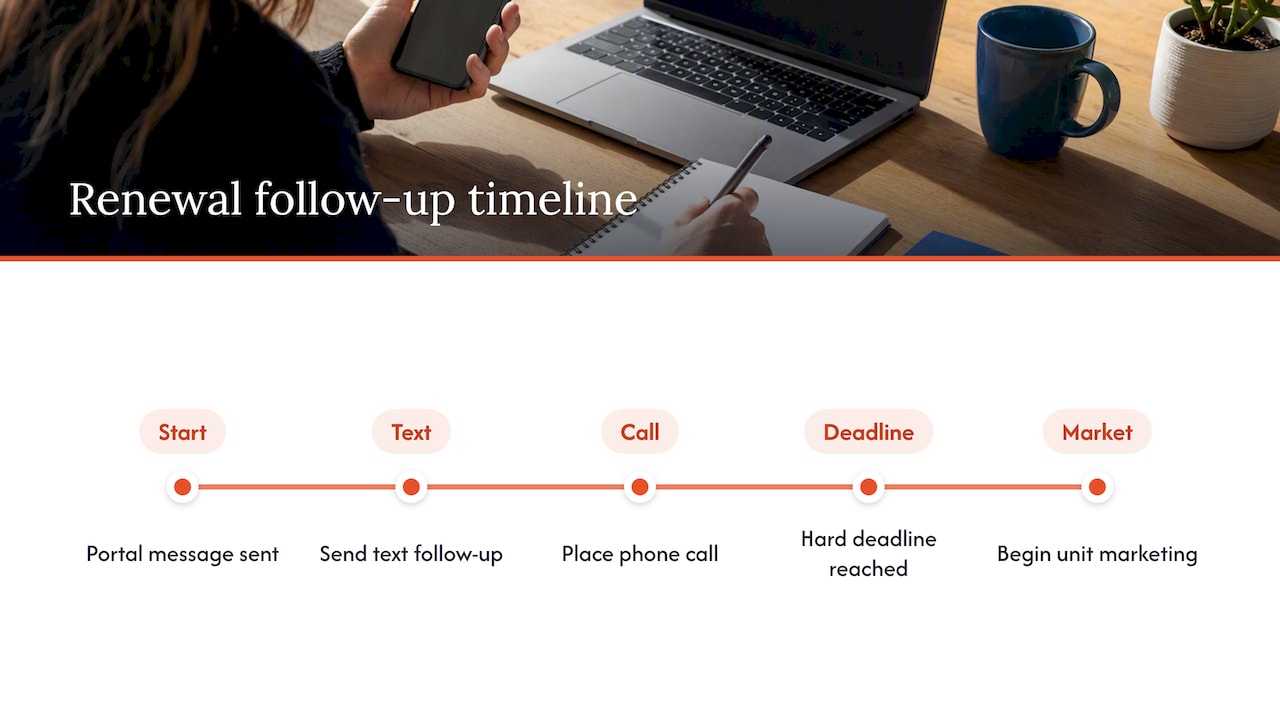
When a tenant does respond but pushes back hard on price or terms, resist matching their counter immediately. Ask what specifically is driving the objection: a competing offer, a budget change, or dissatisfaction with maintenance history. A tenant upset about slow repairs responds better to a service guarantee than to a rent discount, while a tenant citing a cheaper comp elsewhere needs a term-length or incentive conversation, not a bidding war.
Document every difficult interaction the same way you document a standard renewal: date, channel, and outcome. If a tenant remains unresponsive past your hard deadline, treat that date as final and begin marketing the unit immediately rather than holding it open indefinitely on the chance of a late reply. Holding a unit past the hard deadline without action is one of the most common ways renewal timelines quietly collapse into longer vacancies.
For tenants who are difficult but ultimately valuable, a short phone call from a manager, rather than a leasing agent, can resolve friction that email cannot. The goal is not to win every negotiation but to close the loop fast enough that you still have time to re-lease if the renewal falls through.
How market cycles should change your renewal approach
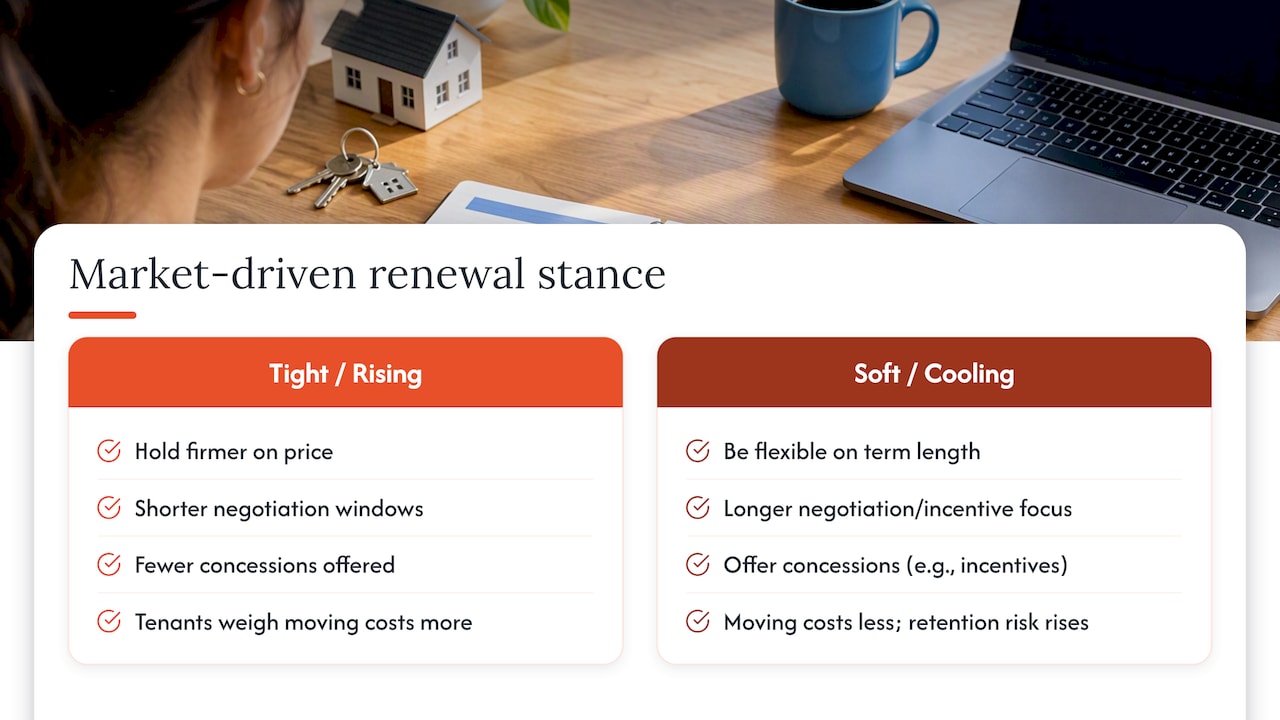
A tight rental market with falling vacancy supports firmer pricing and shorter negotiation windows, since tenants have fewer comparable options to shop against. A softer market, where comparable units are offering concessions, calls for more flexibility on term length and incentive structure before you touch the base rent.
Renewal rates have stayed resilient even as rent growth has slowed in recent data, which points to a broader shift: landlords increasingly treat renewals as the more dependable path to stable occupancy, rather than a fallback when new leasing is slow. That shift matters most in a cooling market, where the cost of chasing a new tenant at a marginally higher rent can easily exceed the cost of renewing an existing one at a smaller increase.
Watch your local comps closely during any rate or employment shift, since renewal pricing that made sense six months ago can become a retention risk quickly if nearby concessions change. In a rising-rate environment, tenants also weigh moving costs more heavily, which gives landlords slightly more room to hold firm on price, but that room shrinks fast once multiple nearby properties start offering free months or reduced deposits. The practical response is the same in either direction: price from current comps, not last quarter’s, and revisit your incentive mix every leasing season rather than setting it once a year.
Reading tenant financial stability before you commit to a renewal
A renewal decision is also a credit decision, even though it rarely gets treated that way. Payment history over the current lease term is the strongest signal you have: a tenant who paid on time for 11 of 12 months carries far less risk than one with several late payments clustered near the end of the term, even if both ultimately paid in full.
Look beyond the ledger when you can. A tenant who has mentioned a job change, a reduced work schedule, or a new dependent in maintenance requests or communications is worth a direct, low-pressure conversation before you finalize an offer. This is not about re-running a full credit check at every renewal, which is rarely necessary or practical, but about weighing the information you already have.
Where risk looks elevated, a shorter renewal term, a smaller rent increase, or a request for updated income verification can protect you without forcing a non-renewal. Where a tenant’s record is strong, that same information supports offering better terms, since retaining a reliable payer at a modest increase is almost always better than testing the market with an unknown applicant.
Auben Realty’s applied take on running renewal programs
Across managed portfolios, renewal timelines are built around early outreach, inspection-first risk review, and outcome-based incentives rather than flat concessions. A pod-based team structure keeps leasing, maintenance, and resident communication tied to the same renewal calendar, and in-house maintenance means repair work from an inspection does not wait on a third-party vendor’s schedule. Owners working with a managed renewal program should expect fewer surprise vacancies and a documented trail for every rent increase and inspection.
— MediaBeast
How Auben Realty can help with your renewal program
Running a 90-day timeline, an inspection checklist, and incentive tracking across dozens of units takes staff time most owners do not have. Auben Realty’s property management services build that calendar into day-to-day operations, while project management support handles any unit upgrades a renewal negotiation calls for, and asset management reporting shows portfolio-level renewal performance. Owners who want a managed renewal process can start with a consultation through our property management page.

FAQ
How do you negotiate a lower rent renewal?
Point to specific, verifiable comps for comparable units nearby and ask the landlord to match or adjust based on that data rather than making a general affordability argument. Offering a longer lease term in exchange for a smaller increase is also a common and effective trade for both sides.
What should you avoid saying during a renewal negotiation?
Avoid vague threats to move without a real plan, since landlords can usually tell when a tenant is bluffing and it weakens your position in future conversations. Also avoid oversharing financial hardship details that are not directly relevant to the lease terms being discussed.
What are the pros and cons of renewing a lease?
Renewing avoids the cost and disruption of moving and keeps a known, stable arrangement in place for both parties, while a new lease elsewhere might offer a lower rent or better amenities. The main downside of renewing is the risk of accepting a rent increase without fully checking whether better terms exist nearby.
What tactics work best when negotiating a lease?
Come with current market comps rather than a general request for a discount, and ask for flexibility on term length if the rent figure itself will not move. Landlords are also more likely to negotiate on non-financial terms, such as a maintenance guarantee or a pet-policy exception, than on the base rent alone.
How early should a landlord start the lease renewal process?
Most guidance points to starting 90 to 120 days before lease end, which gives tenants time to decide without feeling rushed. Large operators have found that moving renewal conversations to the 120-day mark improves retention compared with the standard 60 to 90 day window.
Sources
- ’Tis the Season… to Evaluate Lease-Up and Ensure Ongoing Stability | National Apartment Association
- What Property Managers Must Document at Every Lease Renewal | Revoscape
- Staying power: rent renewals boost multihousing stability | Yield PRO