60.3% Concessions Give Renters the Edge in Houston Rental Market 2026
September 30, 2026
Renters hold the leverage in Houston right now. Landlords are offering concessions at some of the highest rates in the country, median asking rent has fallen for more than three years straight, and inventory keeps climbing. The number to watch is the metro concession rate, which recently topped 60%, a clear sign owners are competing hard to keep units filled.
TL;DR:
- Concession rates in Houston have surged past 60%, indicating landlords are heavily incentivizing tenants amid rising supply and declining asking rents.
- Asking rents have declined for 37 consecutive months, with median rent near $1,373, while rental inventory and concessions continue to grow.
- Variations between neighborhoods significantly impact rents, with inner areas commanding premiums and newer suburbs offering more concessions due to increased competition.
- Effective rent and vacancy rates are more telling than posted asking prices, guiding owners on whether to offer concessions or adjust rents.
Table of Contents
- Latest metrics: rents, concessions, CPI, and inventory
- Why the metrics look this way: jobs, supply, and affordability
- What the next 6 to 12 months could look like
- What renters and owners should do next
- How a local manager reads these signals
- Average rental prices by neighborhood
- Types of rental properties available in Houston
- Vacancy rates and what they mean for renters and owners
- Demographic trends shaping rental demand
- How local regulations shape the rental market
- What renters and owners should watch beyond the metro numbers
- How Auben Realty helps owners respond to these conditions
- Sources
- FAQ
Latest metrics: rents, concessions, CPI, and inventory
Houston’s rental numbers tell a consistent story: more supply, more competition among landlords, and softer pricing power. Median asking rent in the metro sat around $1,373 in August 2026, down 2.7% year over year, marking the 37th straight month of annual rent declines. At the same time, the share of listings offering concessions climbed to 60.3%, a jump of 19.4 percentage points from a year earlier, according to the same Realtor.com report.
That concession spike is not unique to Houston. Realtor.com’s national analysis found concessions rising in 39 of the 50 largest metros, with Houston among the markets posting the sharpest year-over-year increases, a sign that new supply is outpacing lease-up speed across much of the country.
Meanwhile, the CPI rent index for the Houston metro, tracked by the Bureau of Labor Statistics through FRED, offers a useful contrast: it measures rent inflation across existing leases, which typically moves more slowly than asking rents on vacant units. When CPI rent inflation still shows gains while asking rents fall, it usually means the softening is concentrated in new and turnover leases rather than the broader base of renewals.
On the supply side, HAR’s mid-2026 update found single-family leased listings rising while average lease prices held roughly steady, reinforcing that renters have more options without an across-the-board price collapse.
| Metric | Reading | Source |
|---|---|---|
| Median asking rent (Aug 2026) | $1,373, down 2.7% YoY | Realtor.com |
| Metro concession rate (Aug 2026) | 60.3%, up 19.4 points YoY | Realtor.com |
| National concession trend | Up in 39 of 50 metros | Realtor.com |
| Single-family listings (mid-2026) | Rising, average lease price steady | HAR |
- Rents have declined for 37 consecutive months on an annual basis.
- Concessions are near record levels, giving renters room to negotiate.
- Single-family rental supply is expanding even as average asking prices hold flat.
Why the metrics look this way: jobs, supply, and affordability
The concession surge and flat pricing trace back to a straightforward supply-demand mismatch. Houston keeps adding jobs, which supports demand, but new rental units have arrived faster than the market can absorb them.
- The Greater Houston Partnership reports 50,300 jobs added in the 12 months ending July 2026, with construction, administrative support, and health care among the leading contributors.
- Multifamily completions and new single-family rental listings have pushed inventory higher across most submarkets.
- Houston’s relative affordability compared with coastal metros continues to draw new residents, which cushions demand even as supply grows.
Pro Tip: Track effective rent, not just posted rent. A unit advertised at full price with two free months and waived fees can cost less monthly than a slightly cheaper unit with no concessions.
What the next 6 to 12 months could look like
Two scenarios are plausible, and the difference will show up in the same indicators driving today’s numbers.
- Renter-friendly conditions persist if new supply keeps arriving faster than job growth can absorb it, keeping concessions elevated and asking rents flat or lower.
- The market stabilizes if job growth outpaces new completions, gradually pulling concession rates down and firming up asking rents.
- Watch four indicators: the metro concession rate, the CPI rent index, months of supply in HAR’s data, and local job growth reported by the Greater Houston Partnership.
A meaningful drop in the concession rate, paired with steady job additions, would be the clearest early signal that leverage is shifting back toward landlords.
What renters and owners should do next
The current data points to specific moves on both sides of the lease.
- Renters should compare at least three listings in a target submarket and ask directly about concessions before negotiating on base rent.
- Owners should weigh a limited-time concession against a permanent rent cut, since concessions preserve the lease’s stated rent for future comps.
- A small capital improvement, like updated flooring or lighting, can shorten vacancy without requiring a deep price cut.
Pro Tip: A common rule of thumb is to cap concession value at around one month’s rent spread across a 12-month lease rather than offering a larger upfront discount that permanently resets tenant expectations.
If a unit sits more than 30 days without strong showing activity, that is typically the point to reassess pricing or add a concession rather than waiting longer. Auben Realty’s leasing season guidance covers timing tactics that apply directly to this kind of market.
How a local manager reads these signals
A property management firm with extensive experience across multiple markets, including Houston, can provide informed perspectives on how concessions and vacancy interact. In practice, that often means pairing a targeted concession with a modest renovation, such as fresh paint or updated fixtures, to shorten time on market while protecting net operating income rather than cutting the base rent outright. Readers weighing their own approach can review Auben’s property management and project management services for a closer look at how that balance gets managed.

Average rental prices by neighborhood
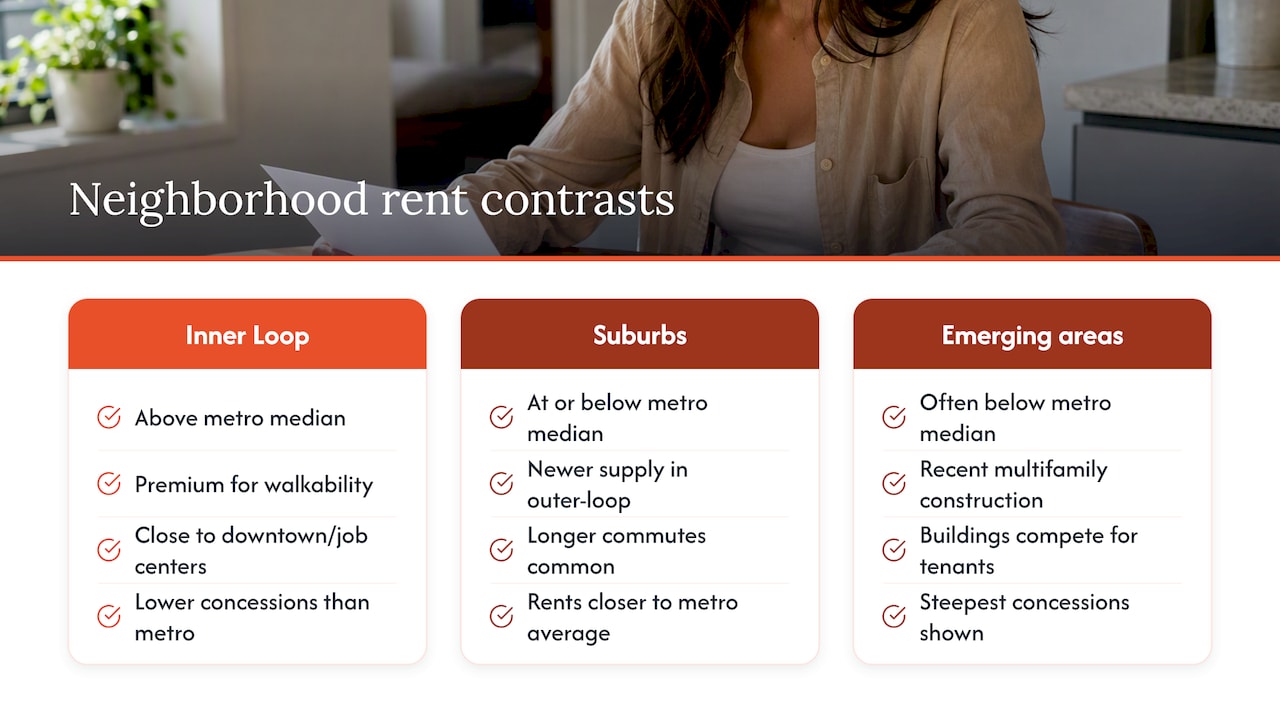
Metro-wide averages hide real differences between Houston submarkets. Inner Loop neighborhoods like Montrose, the Heights, and Midtown tend to command a premium over the metro median due to walkability and proximity to downtown and job centers. Suburban and outer-loop areas, including parts of Katy, Cypress, and Pearland, typically post rents closer to or below the metro average, reflecting newer supply and longer commutes. Energy Corridor and areas near major employers can swing with sector-specific hiring, while emerging areas with recent multifamily construction, such as parts of the East End, often show the steepest concessions because new buildings compete hardest for tenants. Because HAR and Realtor.com report metro-level figures rather than a full neighborhood breakdown, renters comparing specific submarkets should check current listings directly. Auben Realty’s rental listings page shows live examples of asking rents across the firm’s managed portfolio, which can serve as a useful reference point when comparing neighborhoods.
Types of rental properties available in Houston
Houston’s rental stock spans a wide mix of property types, which is part of why metro averages can be misleading. Traditional apartment complexes, from garden-style to high-rise, make up the largest share of listings and are where most of the concession activity documented by Realtor.com is concentrated. Single-family rental homes have grown as a category, especially in suburban submarkets, and HAR’s data shows leased single-family listings rising through mid-2026. Townhomes and condos round out the market, often appealing to renters who want more space than an apartment without the maintenance of a standalone house. Build-to-rent communities, purpose-built single-family developments designed for long-term renters rather than buyers, have also expanded in the metro and add another layer of competition to the suburban rental supply.
Vacancy rates and what they mean for renters and owners
Rising inventory and elevated concessions both point to higher vacancy pressure across much of Houston’s rental stock, particularly in newer apartment communities still working through initial lease-up. When vacancy runs higher, landlords compete more aggressively on price and incentives, which is exactly what shows up in the concession data. For renters, higher vacancy translates directly into negotiating room: more available units mean more leverage to ask for a lower rate, waived fees, or a free month. For owners, sustained vacancy erodes net operating income even when posted rent stays flat, since an empty unit generates no revenue at all. That is why tracking effective rent, the actual income after concessions, matters more in a higher-vacancy environment than simply watching the asking price. Owners managing multiple units often find that a faster lease-up at a modest concession beats holding out for full price against a slower-moving pool of prospects.
Demographic trends shaping rental demand
Houston’s population growth continues to be driven by job opportunities in sectors like health care, construction, and administrative support, all named among the metro’s top contributors to the 50,300 jobs added in the year ending July 2026. That job growth draws a mix of new residents, from early-career workers renting their first apartment to relocating families weighing the buy-versus-rent decision. Houston’s relative affordability compared with coastal job centers continues to make renting locally attractive even as national migration patterns shift. Households priced out of homeownership by mortgage rates or home prices also add to rental demand, a dynamic explored further in Auben Realty’s comparison of renting versus buying affordability. Together, these forces keep baseline demand steady even as supply-side pressure keeps pricing power tilted toward tenants for now.
How local regulations shape the rental market
Texas does not have rent control, and Houston, like the rest of the state, cannot impose rent caps under current state law, so pricing in the metro is set entirely by supply and demand rather than regulatory limits. That absence of rent control is part of what allows landlords to respond quickly to softening demand with concessions rather than being locked into fixed pricing structures. Local regulations that do apply tend to focus on habitability standards, lease disclosure requirements, and eviction procedures rather than price controls. For owners and investors, this means Houston’s rental economics are driven by market fundamentals, like job growth, supply additions, and concession trends, more directly than in metros with rent stabilization rules. Auben Realty’s broader look at why Houston remains a strong investment market covers how this regulatory environment factors into longer-term investment decisions.
What renters and owners should watch beyond the metro numbers
Metro averages mask real variation between submarkets, so check concessions and days on market in your specific neighborhood rather than relying on citywide figures alone. Lower-income renters should weigh whether newer, concession-heavy units offer better value than older stock with lower base rent but fewer incentives. Typical market renters have more room to negotiate right now than the headline median rent suggests, so ask directly about concessions before signing.
— MediaBeast
How Auben Realty helps owners respond to these conditions
Property management firms may offer management, leasing, renovation oversight, and asset management services to owners navigating Houston’s current conditions. Experienced property management firms help owners manage vacancy and pricing decisions directly. Start with property management to see how it fits your portfolio.

Sources
- Realtor
- Consumer Price Index for All Urban Consumers: Rent of Primary Residence in Houston-The Woodlands-Sugar Land, TX (CBSA) (CUURA318SEHA) | FRED | St. Louis Fed
- Harconnect
- Economy at a glance — September 2026 (Greater Houston Partnership)
FAQ
Is rent dropping in Houston?
Yes, median asking rent in Houston fell modestly year over year to roughly $1,373 in August 2026, marking 37 straight months of annual declines according to Realtor.com. Concessions have also risen sharply, adding further downward pressure on effective rent.
What is driving Houston’s high concession rates?
Rising rental supply, including new apartment completions and single-family listings, has outpaced lease-up speed, pushing landlords to offer concessions to fill units faster. Houston’s concession rate reached 60.3% in August 2026, one of the sharper increases among major U.S. metros tracked by Realtor.com’s national analysis.
Which cities have the highest rental demand?
Rental demand tends to run highest in metros with strong job growth and relative affordability, which is part of why Houston continues to attract renters despite softer pricing. Demand varies by local job market conditions, so checking metro-specific job growth and vacancy data gives a clearer picture than national rankings alone.
What is the best rental market in Texas for investors right now?
There is no single definitive answer, since the right market depends on an investor’s goals, but Houston’s combination of job growth and relative affordability makes it a market worth close consideration. Auben Realty’s analysis of Houston as an investment market covers the factors supporting that case in more detail.
How can owners tell if they should offer concessions or lower rent?
A short-term concession, like a free month or waived fees, preserves the lease’s stated rent for future comparisons, while a base rent cut resets tenant expectations permanently. Owners typically favor concessions when vacancy is temporary and tied to seasonal leasing patterns, reserving rent cuts for units that have sat unleased well beyond typical days-on-market in their submarket.