4 Days to Default: Houston Eviction Process and 2026 Rule 510 Changes
September 28, 2026
A Houston eviction must follow a fixed legal sequence: written notice to vacate, a lawsuit filed in the correct Justice Court precinct, a hearing set 10 to 21 days later, a judgment, a 5-day appeal window, and finally a writ of possession that requires 24 hours’ notice before execution. If you received a notice, your immediate move is to preserve every document and photo related to the tenancy; if you are the landlord, verify your notice and filing paperwork before you walk into court.
TL;DR:
- Eviction filings must include correct tenant names, proper notice proof, and be made in the proper precinct to avoid delays or voided judgments.
- The typical timeline for uncontested evictions is three to four weeks from notice to judgment, but contested cases or appeals can extend this to six weeks or more.
- Filing costs are generally modest but can increase with contested hearings, appeals, or jury fees, and all fees should be verified before filing.
- Self-help eviction methods, like changing locks or removing belongings without court approval, are illegal, and tenants can seek swift legal remedies like a writ of reentry.
- Proper documentation, adherence to procedural rules, and timely proof are critical for both landlords and tenants to minimize case delays and legal risks.
Table of Contents
- The step-by-step eviction process in Harris County
- How long does a Houston eviction actually take?
- What eviction filing costs in Harris County
- Tenant rights, defenses, and the ban on self-help eviction
- First moves after a notice or citation arrives
- What Auben Realty sees go wrong in eviction filings
- What the eviction process actually rewards
- How Auben Realty helps Houston owners avoid eviction headaches
- Official statutes, rules, and county forms to verify timelines and fees
- Sources
- FAQ
The step-by-step eviction process in Harris County
Texas law sets the floor for every Houston eviction, and Harris County Justice Courts add their own filing details on top of it.
-
Notice to vacate. Texas Property Code Chapter 24 requires a written notice before a landlord can file suit, and most leases default to 3 days unless the lease sets a different period.
-
Petition filing. The landlord files in the Justice of the Peace precinct where the property sits, and Harris County JP guidance requires the petition to include the property description, the grounds for eviction, how notice was delivered, the rent owed, and the names of every tenant on the lease.
-
Service of citation. The constable or an authorized process server delivers citation to the tenant, and the return of service becomes the landlord’s proof that notice reached the right person.
-
Hearing. Harris County courts set the hearing no sooner than 10 days and no later than 21 days after filing, and either side can request a jury.
-
Judgment. The judge rules for possession, rent, or both, and the losing party has a 5-day window to appeal before the judgment becomes final.
-
Writ of possession. A writ cannot issue before the sixth day after judgment, and once issued, the constable must post a 24-hour notice at the property before removing anyone, according to the Texas State Law Library’s eviction guide.
Rule 510 changes tied to SB 38 took effect for cases filed on or after January 1, 2026, and they touch petition content, joined rent-claim caps, and the summary-disposition track used for forcible entry cases. Anyone filing this year should confirm the current Harris County packet rather than reuse an older form.
How long does a Houston eviction actually take?
Timelines vary widely depending on whether the tenant contests the case or the landlord hits a procedural snag.
- Uncontested nonpayment case: notice period plus a hearing set near the 10-day minimum often means a judgment within roughly three to four weeks of filing.
- Contested case with an appeal: add the 5-day appeal window, then the time it takes the appellate docket to schedule a new hearing, which can push total resolution past six weeks.
- Summary disposition for forcible entry: this expedited track under Rule 510 gives the occupant only 4 days to respond, so a squatter case can reach judgment faster than an ordinary nonpayment suit.
Filing to hearing runs 10 to 21 days under Harris County JP rules, a window built into the court’s own docketing practice rather than left to a clerk’s discretion. Service problems, a missed constable attempt, or a crowded court calendar are the most common reasons a case runs longer than these baseline estimates.
What eviction filing costs in Harris County
Fees are modest compared to most civil suits, but they add up when a case is contested or appealed.
- Harris County charges consolidated filing fees that cover the petition and initial court costs, listed on the county’s civil filing fee schedule.
- Constable service fees apply separately for delivering citation to the tenant.
- A jury trial requires a jury fee, paid several days before trial, per the Harris County fee schedule.
- Attorney fees are recoverable only when the lease allows them or a specific statute permits it, and rent claims joined to an eviction suit are capped at $20,000 under Rule 510.
Fee amounts change periodically, so confirm current figures on the precinct’s own fee sheet before filing.
Tenant rights, defenses, and the ban on self-help eviction
Texas law does not let a landlord change the locks, remove doors, or set belongings on the curb without a court order. That kind of self-help eviction is illegal, and a tenant locked out this way can seek a writ of reentry, which restores possession quickly when a justice reasonably believes an unlawful lockout occurred, as described in the Texas Property Code’s reentry provisions.
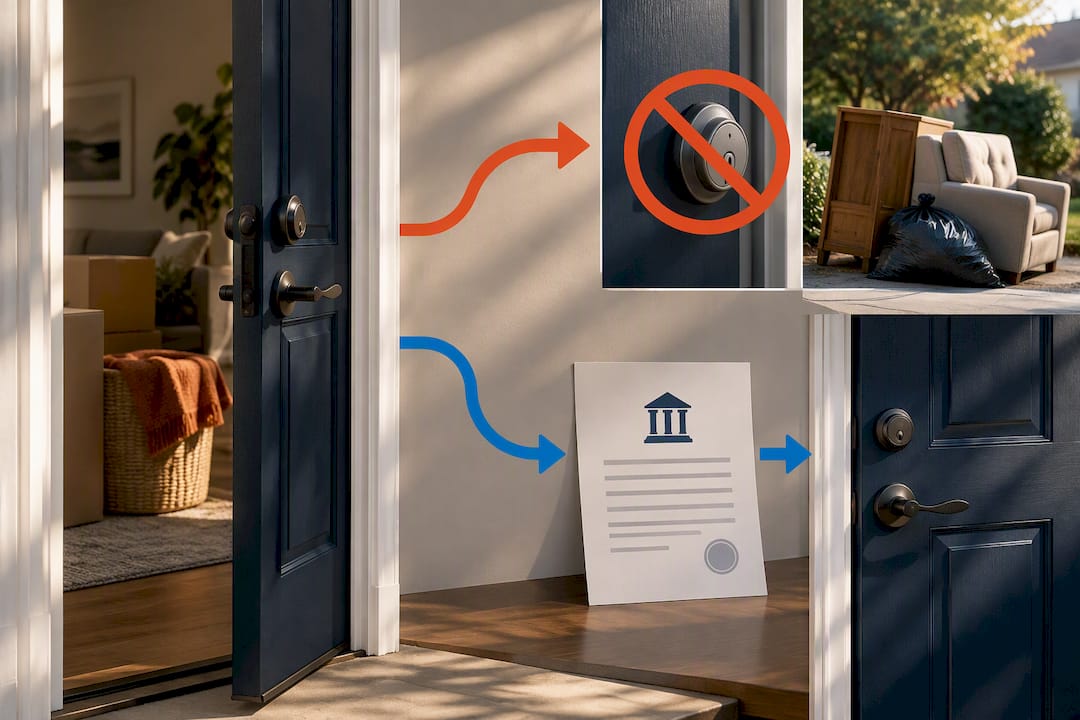
Common defenses raised at a hearing include improper notice delivery, rent that was tendered and refused, retaliation for a repair complaint, and active-duty military protections. The University of Houston People’s Lawyer points out that eviction hearings decide who has the right to possess the unit, not who owns it, so documentation matters more than argument.
Pro Tip: Keep a single folder, physical or digital, with your lease, every notice you received, payment receipts, repair requests, and photos of the unit’s condition; a tenant who can hand a judge organized proof often shortens the hearing.
- Preserve the lease, all written notices, and payment records.
- Save repair requests and any photos showing the unit’s condition.
- Note names and contact information for witnesses who saw notice delivery or a lockout.
If you are locked out, file a sworn complaint for reentry with the Justice Court immediately. The landlord then has a short window to request a hearing before you regain access.
First moves after a notice or citation arrives
The first 48 to 72 hours shape how the rest of the case goes, for both sides.
- Tenants: gather your lease, notices, and payment history, then decide whether you can pay what is owed or need a payment arrangement before the hearing.
- Tenants: attend the hearing in person; a default judgment against a tenant who never shows up is common and hard to reverse.
- Tenants: contact a legal aid clinic or tenant hotline if your notice looks incomplete or your notice period seems too short.
- Landlords: confirm exactly how and when notice was delivered, and keep proof (a photo, a certified mail receipt, or a signed acknowledgment).
- Landlords: name every adult tenant on the lease in the petition, since omitting one, a mistake practitioners in Houston see often, can void a writ against that person and force a refiling.
- Landlords: pull the current Rule 510 petition template from the Harris County JP eviction pages rather than reusing an older form, and file in the correct precinct.
What Auben Realty sees go wrong in eviction filings
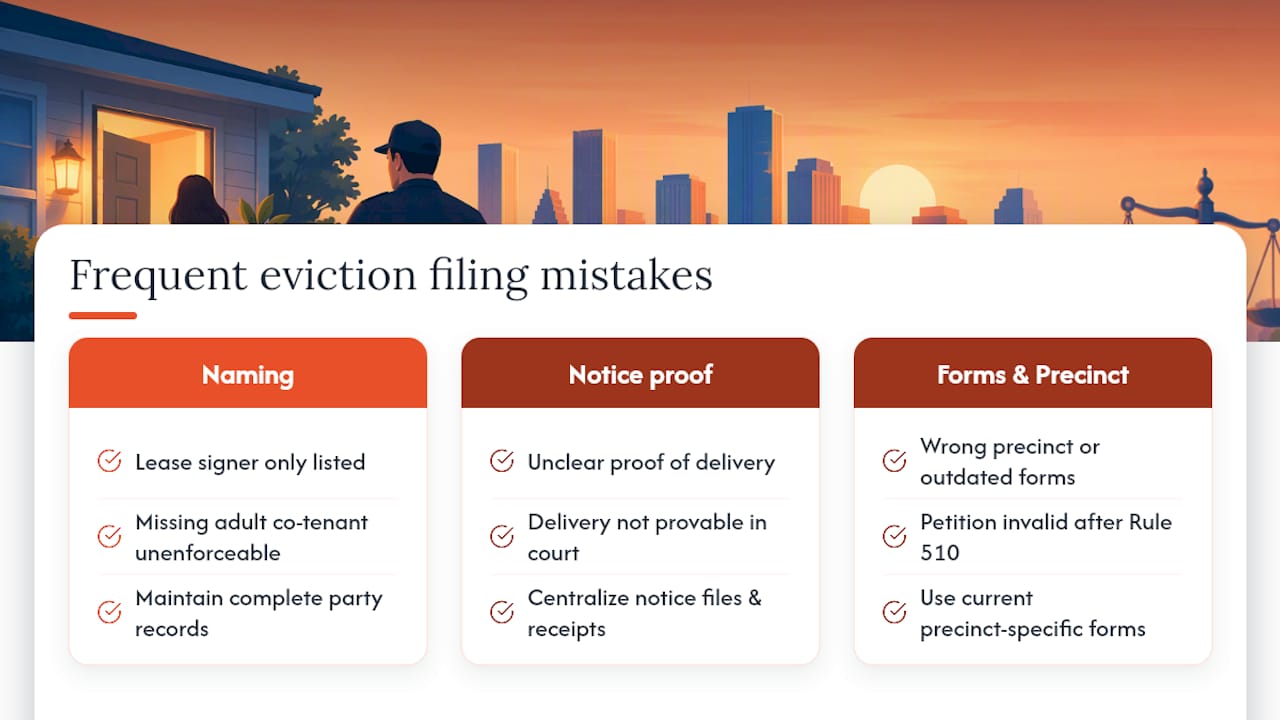
Auben Realty has managed rental properties for more than 15 years across 2,700 properties in 10 regional markets, and eviction filing mistakes tend to repeat themselves regardless of market. The most common one is incomplete party naming: a landlord lists the lease signer but skips an adult co-tenant, then discovers the writ cannot be enforced against that person.
Unclear proof of notice delivery is the second recurring problem, followed by petitions filed in the wrong precinct or built on outdated forms after the 2026 Rule 510 changes. The fix is usually operational rather than legal: lease clauses that spell out notice timelines clearly, a centralized file for every notice and delivery receipt, and property management that catches these gaps before a case ever reaches a courtroom. For more on avoiding disputes before they escalate, see our tips on handling difficult tenants.
What the eviction process actually rewards
The conventional advice to “know your rights” undersells how much of a Houston eviction case turns on paperwork accuracy rather than the merits of the dispute. A tenant with a legitimate reason for nonpayment can still lose because they skipped the hearing, and a landlord with clear grounds can still lose weeks of rent because one co-tenant’s name was missing from the petition.
The 2026 Rule 510 changes make this truer, not less true. Summary disposition moves fast enough that a party who does not respond within 4 days can lose by default before ever explaining their side. Priority one, for either side, is procedural precision: correct notice, correct forms, correct precinct, and a documented paper trail. Everything else, including the strength of a defense or the sympathy of the facts, matters only after those basics are handled correctly. Property owners who avoid self-help shortcuts and follow the court’s process consistently spend less time and money than those chasing a faster, informal fix.
— MediaBeast
How Auben Realty helps Houston owners avoid eviction headaches
Most eviction problems start months before a notice ever goes out, in a lease that was vague or a maintenance request that went unanswered. Auben Realty’s property management service handles tenant screening, lease drafting, and day-to-day communication so fewer disputes reach the point of filing, and in-house maintenance through our project management services resolves repair complaints before they become legal defenses.

When an eviction is unavoidable, having accurate records already on file, correct tenant names, documented notices, and a clean payment history, shortens the process instead of stalling it.
- Full-service property management, including tenant placement and lease terms built to avoid notice disputes.
- In-house maintenance and renovation oversight to close repair-related defenses before they surface.
- Asset management support for investors who want fewer vacancies and less legal exposure over time.
If you own rental property in the Houston area, visit our property management page to see how we handle eviction risk before it starts.
Official statutes, rules, and county forms to verify timelines and fees
- Texas Property Code Chapter 24: governing statute for eviction suits and notice requirements.
- Texas State Law Library eviction guide: plain-language walkthrough of the full timeline.
- Harris County JP filing guidance and current fee schedule: local forms, precinct rules, and costs.
- Rule 510 revisions effective 2026: updated procedural requirements.
This article is general information, not a substitute for advice from a qualified lawyer. Consult a qualified legal professional about your own circumstances before acting on anything here.
Sources
- Texas Property Code Chapter 24
- Texas State Law Library eviction process guide
- Harris County JP — Filing Eviction Cases
- Harris County Justice Courts — civil filing fees
- Redline of Rule 510 revisions (January 2026)
FAQ
How long is the eviction process in Houston?
A typical uncontested case runs from notice to judgment in about three to four weeks, since Harris County courts set hearings 10 to 21 days after filing. Contested cases or appeals add time, sometimes six weeks or more, while an appeal is pending.
What is the fastest a landlord can evict a tenant?
The fastest route is summary disposition for forcible entry cases under the 2026 Rule 510 changes, which gives the occupant only 4 days to respond. This track is meant for squatter situations, not ordinary nonpayment cases, which follow the standard 10 to 21 day hearing window.
Does a 3-day notice mean I have to leave in 3 days?
No. A 3-day notice to vacate is a pre-suit requirement under Texas Property Code Chapter 24, not an immediate removal order. The landlord still has to file suit, win a hearing, and obtain a writ of possession before anyone can legally be removed.
Can a landlord change my locks without a court order?
No, self-help eviction, including changing locks or removing belongings without a court order, is not legal in Texas. A tenant locked out this way can file for a writ of reentry, which can restore access quickly according to the Texas Property Code’s reentry rules.
What happens after a landlord wins an eviction judgment?
The tenant has a 5-day window to appeal before the judgment becomes final, and a writ of possession cannot issue before the sixth day after judgment. Once issued, the constable posts a 24-hour notice at the property before physically removing the tenant’s belongings, per the Texas State Law Library.