Avoid Dismissal: 15+ Year Eviction Playbook for U.S. Landlords
September 26, 2026
Start by serving the correct written notice, documenting every step, and never attempting to remove a tenant yourself. The eviction process for landlords follows a set legal sequence: notice, court filing, hearing, judgment, and writ of possession, though exact timelines shift by state and city. Federal law under the Fair Housing Act and VAWA limits how and when you can proceed. The next section breaks the process into a checklist you can follow today.
TL;DR:
- Serving the correct notice type, properly timed, and following the jurisdiction’s specific service methods is essential to avoid restarting the eviction process.
- The notice periods for nonpayment or lease violations can range from 3 to 30 days depending on local laws, which must be strictly honored before filing suit.
- Filing the eviction in the correct court and naming all adult tenants is critical, with proper proof of service required to prevent case dismissal.
- Federal laws like the Fair Housing Act and VAWA impose limits on discrimination, retaliation, and protecting victims of domestic violence, requiring careful documentation.
- Avoiding illegal shortcuts, such as lockouts or utility shut-offs, and properly handling tenant belongings post-eviction can prevent legal liabilities and support a smooth recovery process.
Table of Contents
- Step-by-step eviction process from notice to writ of possession
- Which notice to serve and how long each timeline runs
- Filing in court, the hearing, and enforcing the judgment
- Federal limits: Fair Housing, VAWA, and anti-retaliation rules
- Building the evidence file that wins your hearing
- Illegal shortcuts that can sink your case
- Handling tenant belongings after eviction
- Dealing with tenant stays or eviction delays
- Alternatives to eviction worth considering first
- Post-eviction: cleanup, repairs, and re-renting
- Service of process: methods and where they go wrong
- What experienced landlords know that most guides skip
- How Auben Realty helps landlords avoid and manage evictions
- Sources
- FAQ
Step-by-step eviction process from notice to writ of possession
Skipping a step or filing before a notice period ends is one of the most common ways landlords lose an otherwise valid case. Following this order protects you from a forced restart.
- Review the lease and confirm the default. Check the signed lease for the exact violation, whether it is unpaid rent, an unauthorized occupant, or a lease breach, before you write anything.
- Attempt documented outreach. A dated text, e-mail, or letter noting the issue and requesting a resolution creates a paper trail that helps later if the case goes to court.
- Choose the right notice type. Pay-or-quit notices apply to unpaid rent, cure-or-quit notices apply to fixable lease violations, and unconditional quit notices apply to serious or repeated violations with no chance to fix them.
- Serve the notice properly. Deliver it according to your state’s accepted methods (personal delivery, posting and mailing, or certified mail) and keep proof of service.
- Wait out the full notice period. Filing even one day early can force you to restart the entire process.
- File the eviction lawsuit in the court that has jurisdiction over the rental property, naming every adult tenant on the lease as a defendant.
- Prepare for the hearing. Gather your lease, notice copies, proof of service, and rent ledger, and organize them so a judge can review them quickly.
- Attend the hearing and obtain judgment. Present your evidence factually; if the tenant does not appear, many courts allow a default judgment.
- Request the writ of possession once the judgment is final and any appeal window has closed.
- Coordinate with the sheriff or constable to execute the writ, since only law enforcement can physically remove a tenant.
A few habits reduce risk at every stage:
- Keep a single, dated file (digital or paper) for every notice, communication, and receipt tied to the tenancy.
- Never rely on a verbal notice; courts want a written, served copy.
- Confirm your local court’s specific form requirements before filing, since a wrong form can delay the case by weeks.
Pro Tip: Call the court clerk’s office before filing and ask which eviction forms are current. Many county courts update templates yearly, and an outdated form is grounds for dismissal.
Which notice to serve and how long each timeline runs
The notice you serve depends entirely on the violation, and the number of days you must wait depends entirely on your state and sometimes your city.
A pay-or-quit notice applies when rent is late or unpaid and provides a tenant a period to pay or vacate, with the exact time depending on local law. A cure-or-quit notice applies to a fixable lease violation, such as an unauthorized pet or unregistered occupant, and gives the tenant a chance to correct the issue. An unconditional quit notice applies to serious or repeat violations, such as ongoing illegal activity, and typically does not offer a cure option.
Timelines vary widely. Some states allow a 3-day pay-or-quit notice for nonpayment, while cure-or-quit periods can range from about 7 to 30 days depending on the jurisdiction. Local court rules and even city ordinances can shorten or extend these windows, so check your specific county or state court’s published guidance before you calculate a deadline, as one representative example from New York courts shows nonpayment cases require the statutory notice before any filing can proceed.
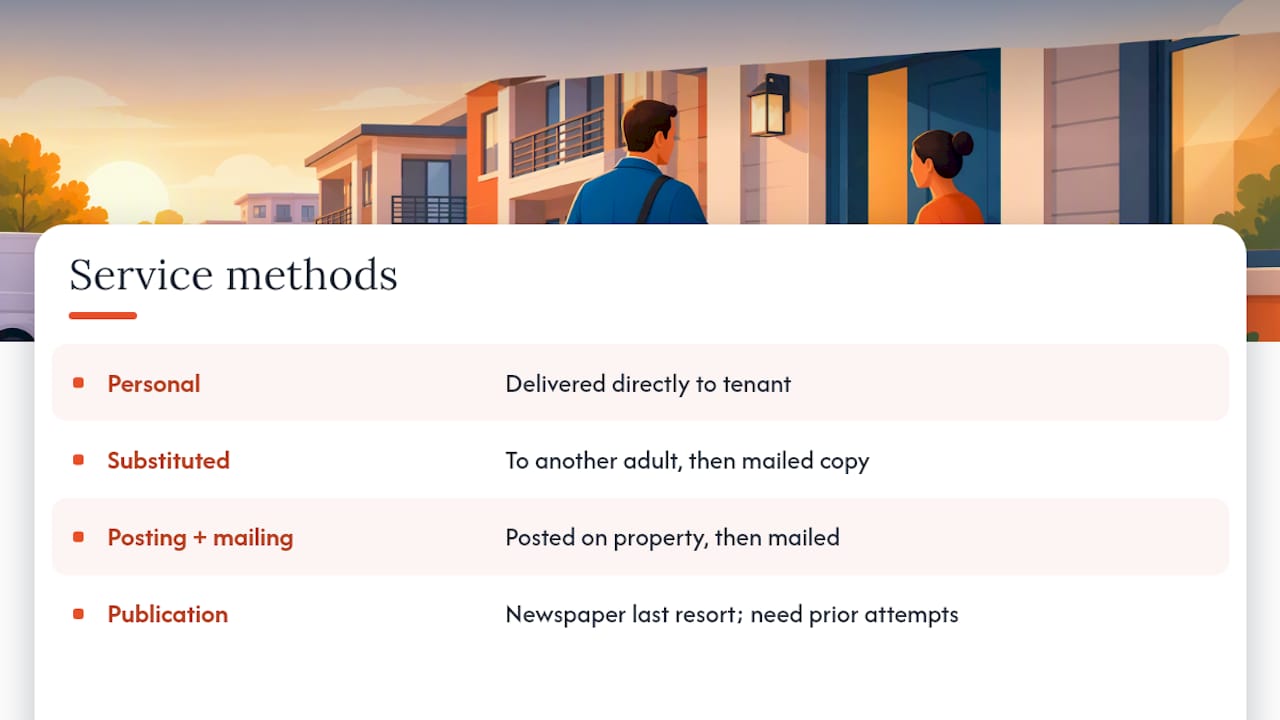
Accepted service methods generally include:
- Personal delivery directly to the tenant.
- Substituted service to another adult at the residence, followed by a mailed copy.
- Posting the notice on the door combined with mailing a copy, sometimes called “nail and mail.”
- Certified mail with return receipt, which some states accept as a standalone method.
Proof of service, whether a signed affidavit, a certified mail receipt, or a process server’s declaration, is what the court will ask for at the hearing. Without it, a judge can dismiss the case outright.
Filing in court, the hearing, and enforcing the judgment
Once the notice period has fully run and the tenant has not complied, you file the eviction lawsuit, often called an unlawful detainer or summary possession action, in the court with jurisdiction over the property’s location, typically a justice, municipal, or county court.
- Name every leaseholder as a defendant. Leaving off an adult on the lease, or relying only on a generic “and all occupants” label, can invalidate the filing and force you to restart, a risk legal guidance on eviction proceedings warns landlords about directly.
- Serve the tenant with the court summons. This is separate from the earlier notice and follows its own state-specific rules for delivery and proof.
- Attend the scheduled hearing. Many courts set hearings within one to two weeks of filing, though local caseloads affect that window.
- Present your evidence. A rent ledger, copies of the served notice, proof of service, and written communications are the core documents judges expect to see.
- Address common tenant defenses. Tenants often argue improper notice, unaddressed repair requests, or retaliation, so your documentation needs to answer those points before they are raised.
- Receive judgment. If you win, the court issues a judgment for possession and, in many cases, unpaid rent and costs.
- Track the appeal window. Tenants typically have a short, defined period to appeal, during which enforcement may pause depending on local rules.
- Request the writ of possession once the appeal window closes without action.
- Have the sheriff or constable execute the writ. Only law enforcement can lawfully remove the tenant and their belongings.
Pro Tip: Bring three copies of every document to the hearing, one for the judge, one for the tenant, and one for yourself, so nothing gets left behind in the shuffle of a busy docket.
Federal limits: Fair Housing, VAWA, and anti-retaliation rules
State timelines are only half the picture. Federal law overrides local procedure in specific situations, and getting this wrong exposes you to complaints, lawsuits, and delays far longer than any notice period.
The Fair Housing Act bars evicting a tenant, or treating one differently during the eviction process, because of race, color, religion, sex, national origin, familial status, or disability. Victims of discriminatory or retaliatory eviction attempts may file complaints with HUD or bring civil action within two years of the discriminatory act, so a single inconsistent decision, like enforcing a notice period more strictly for one tenant than another, can create real exposure.
VAWA adds a separate layer of protection in HUD-covered housing. It allows a landlord to bifurcate a lease, removing an abusive household member while keeping the victim housed, rather than evicting the whole household over an incident of domestic violence. Landlords covered by these programs must provide notice of VAWA rights using HUD’s required forms, and tenants may have up to 14 business days to submit supporting documentation for emergency protections.
Practical compliance steps:
- Apply the same written notice standards to every tenant, regardless of household composition.
- Train any staff who serve notices or communicate with tenants on Fair Housing basics.
- Treat a reported domestic violence incident as a request for lease bifurcation review, not an automatic ground for eviction.
- Document every step of a sensitive case in writing to show consistent, lawful handling.
Building the evidence file that wins your hearing
Judges rule on documents, not impressions. A missing notice copy or an undated photo can cost you a case that should have been simple.
Keep and organize:
- The signed lease and any amendments.
- A complete rent ledger showing every payment and missed payment.
- Copies of every written notice, along with proof of service.
- Photos or videos of property conditions, dated and labeled.
- Repair invoices and inspection reports tied to the unit.
- A log of all tenant communications, including texts and e-mails.
Store records digitally with clear file names and dates, and keep a backup paper packet for court, since some clerks still prefer physical copies at filing or hearing. Affidavits summarizing your timeline can help a judge move through the case faster.
Pro Tip: Build your tenant file at move-in, not at move-out. A documented leasing process gives you a complete record before a dispute ever starts.
Illegal shortcuts that can sink your case
Self-help evictions, changing the locks, shutting off utilities, or removing a tenant’s belongings without a court order, are illegal in every state and can expose you to civil damages and, in some jurisdictions, criminal charges.
Common mistakes that force a restart or worse:
- Locking out a tenant before a judge issues a writ of possession.
- Harassing a tenant into leaving through repeated threats or unannounced visits, conduct explored in this breakdown of landlord harassment rules.
- Serving a notice with the wrong dates, amount owed, or party names.
- Filing before the notice period fully expires.
- Applying different eviction standards to tenants in protected classes.
If you catch a mistake, stop the conduct immediately, correct the paperwork, and document the fix. When the case involves a discrimination claim, a domestic violence disclosure, or any ambiguity about proper notice, get an attorney involved before your next filing.
Handling tenant belongings after eviction
Most states require a specific process for property left behind after a lawful eviction, and skipping it can turn a clean case into a new liability. Once the writ of possession is executed, the sheriff or constable typically oversees the physical removal, and many jurisdictions require the landlord to store abandoned belongings for a set period rather than discard them immediately.
Photograph and inventory everything left in the unit before you move or store it. Keep the inventory alongside your other case documents, since a dispute over lost or damaged items can surface weeks after the eviction is technically closed.

Check your state and local rules for the required storage duration and any notice you must send the former tenant about retrieving their property. Some jurisdictions require a written notice with a deadline before you can dispose of unclaimed items, and some allow you to charge reasonable storage costs. Never sell or discard belongings before that window closes, since doing so can create a separate small claims exposure even after you have legally regained possession of the unit.
Dealing with tenant stays or eviction delays
An eviction judgment does not always mean immediate possession. Tenants can file an appeal, request a stay, or, in some cases, file for bankruptcy, and each of these can pause enforcement even after you have won in court.
An appeal typically must be filed within a short, defined window after judgment, and some courts require the tenant to post a bond covering back rent or ongoing rent during the appeal to keep enforcement paused. If no bond is posted, you may be able to proceed with the writ despite the appeal being pending, though the exact rule depends on your state.
Bankruptcy filings trigger an automatic stay under federal law that halts most eviction enforcement the moment the case is filed, even if you already have a judgment. Landlords in this situation generally need to file a motion for relief from the stay in the bankruptcy court before the writ can move forward, which can add real time to an already long process.
Because both appeals and bankruptcy filings involve federal or appellate procedure outside a typical eviction docket, this is a point where consulting an attorney is worth the cost. Trying to enforce a writ during an active stay, even by mistake, can create separate legal problems on top of the delay itself.
Alternatives to eviction worth considering first
Eviction is often the most expensive and slowest way to resolve a tenant problem, so many landlords screen for cheaper, faster fixes before filing.
A short payment plan, agreed to in writing, can resolve a nonpayment case without the cost of court fees, lost rent during the process, and turnover expenses afterward. Mediation, sometimes offered free through local housing courts or community programs, can settle lease-breach disputes, like a pet violation or noise complaint, without either side needing an attorney. A cash-for-keys arrangement, where the landlord offers a modest payment in exchange for a fast, voluntary move-out, can also be cheaper than a full court process when the goal is simply getting the unit back quickly.
These options work best for a tenant who wants to comply but is short on time or money, not for one who is unresponsive or engaged in serious lease violations. Difficult-tenant situations that stop short of eviction, such as chronic late payments or property care issues, often respond well to structured conversations before legal notices are ever served, an approach covered in these tactics for handling difficult tenants. Weigh the cost of a payment plan or mediation session against weeks of lost rent and legal fees before deciding to file.
Post-eviction: cleanup, repairs, and re-renting
Once you have legal possession back, the clock on lost income starts running in the other direction, and a fast, careful turnaround protects your bottom line.
Start with a full walkthrough and photo record of the unit’s condition, which supports any security deposit deductions and documents damage for your files. Serious cases, like significant property damage left behind by a tenant, may require more extensive repair work before the unit is rentable again, a situation detailed in this account of a severely damaged rental.
Schedule cleaning, repairs, and any needed renovation promptly, since a vacant unit generates no income while it sits unrented. Update your listing with current photos and pricing based on today’s market conditions rather than reusing the previous listing, and screen new applicants carefully, since a stronger tenant screening process at this stage lowers your odds of repeating the same situation.
Finally, review the sequence: what led to this eviction, whether it was a screening gap, a lease clause issue, or a communication breakdown, and adjust your process before the next tenant moves in.
Service of process: methods and where they go wrong
Service of process, delivering the court summons and complaint after you file, is a separate legal step from serving your original notice, and it has its own strict rules that vary by state.
Common accepted methods include personal service directly to the tenant, substituted service to another adult resident followed by a mailed copy, and posting on the property combined with mailing when the tenant cannot be found. Some states also allow service by publication in a local newspaper as a last resort when a tenant is actively evading service, though courts generally require documented attempts at other methods first.
The most frequent challenges landlords run into are tenants who avoid answering the door, units with multiple adult occupants where only one gets served, and process servers who fail to file a proper affidavit of service. Any of these can give a tenant grounds to challenge the case and delay judgment. Hiring a licensed process server or using the sheriff’s office for service, where available, reduces the risk of a botched attempt, since these methods come with built-in proof of service that courts recognize without dispute. Confirm your state’s exact accepted methods before you file, since using an unapproved method can undo weeks of otherwise correct casework.
What experienced landlords know that most guides skip
The eviction process for landlords is less about knowing the law and more about discipline: serving the right notice, on the right day, to the right person, every single time. Most cases that fall apart in court do not fail because the tenant was in the right. They fail because the landlord skipped a step, misnamed a party, or filed a day too early.
After years of managing rental properties, industry leaders have built eviction-prevention playbooks around consistent tenant screening, standardized notice templates, and documented outreach at the first sign of trouble, the same habits that keep most disputes from ever reaching a courtroom. A rigorous screening process, like the one described in this look at property manager screening practices, catches many problem tenancies before a lease is even signed.
The real cost trade-off isn’t DIY versus professional management. It’s the hours you’ll spend on paperwork and court dates versus the fee you’d pay someone else to handle it correctly the first time.
— MediaBeast
How Auben Realty helps landlords avoid and manage evictions

Auben Realty’s Property Management service is built to keep landlords out of the courtroom in the first place, and to handle the process correctly when eviction becomes unavoidable. That means rigorous tenant screening before a lease is signed, standardized lease enforcement and notice procedures that hold up in court, and in-house maintenance that resolves habitability complaints before they become legal disputes.
When professional management is in place, clients can receive consistent, documented communication with tenants from move-in through any dispute, properly drafted and served notices that meet state requirements, coordination with legal counsel when court action is necessary, and fast turnaround on cleanup and re-renting once a unit is vacant.
The result is fewer evictions overall, and less of your own time spent on the ones that do happen. If you are managing a rental yourself and want that handled correctly, check availability for Auben Realty’s property management services in your market.
This article is general information, not a substitute for advice from a qualified lawyer. Consult a qualified legal professional about your own circumstances before acting on anything here.
Sources
- HUD: Report housing discrimination
- Landlord’s Guide to Nonpayment Eviction Proceedings — NYCourts
- FindLaw: Eviction and Unlawful Detainer
FAQ
What’s the fastest a landlord can evict a tenant?
The fastest timelines apply to nonpayment cases with short notice periods, some as brief as three days, but the total process still requires the full notice period plus court filing, a hearing, and a writ of possession. Even in a straightforward case, expect the full process to take several weeks once every legal step is completed properly.
How long does a landlord have to wait to evict a tenant in Illinois?
Notice periods and filing timelines in Illinois vary by the type of violation and by city, since some municipalities have their own rules on top of state law. Check the Illinois court system or your county circuit court’s published eviction guidance for the exact notice period that applies to your situation.
How much notice is required to evict a tenant in Texas?
Texas generally requires a written notice to vacate, commonly three days, before a landlord can file an eviction suit, though the lease itself may specify a different period. Local county procedures, like the one Gregg County, Texas publishes, lay out the exact notice and filing steps for that jurisdiction.
Do landlords usually win eviction cases?
Outcomes depend heavily on whether the landlord served the correct notice, waited out the full notice period, and brought complete documentation to the hearing. Cases most often fail on procedural errors, like naming the wrong parties or filing early, rather than on the underlying facts of the dispute.
What happens if a tenant’s belongings are left behind after eviction?
Most states require landlords to inventory and store abandoned property for a set period rather than dispose of it immediately, with specific notice requirements for the former tenant to reclaim items. Check your state and local rules before discarding or selling anything left in the unit.