5 Year Rental Pro Forma That Catches DSCR Shortfalls for Investors
September 26, 2026
A rental pro forma is a forward-looking income and expense projection that shows expected net operating income, cash flow, and lender or investor metrics for a rental property. Build one before you buy, refinance, or renovate. The output includes NOI, cash-on-cash return, DSCR, and often IRR. A template and worked example follow below.
TL;DR:
- The accuracy of a rental pro forma heavily depends on precise input data, especially rent estimates, vacancy rates, and operating expenses, which vary by property and market.
- Key metrics like DSCR, cap rate, and IRR provide different insights; DSCR is critical for loan approval, often requiring a minimum of 1.2 to 1.3, and should be stress-tested against interest rate and occupancy changes.
- Property-specific unit-level rent rolls and explicit CapEx schedules improve model reliability, especially for larger or value-add properties, to accurately assess upside, risks, and financing feasibility.
- Underwriters typically apply their own assumptions, such as vacancy floors and management fees, which may differ from your pro forma; aligning assumptions with lender standards speeds approval.
- Building and maintaining a disciplined, realistic pro forma, with stress tests for downside scenarios, prevents overestimating returns and helps manage property operations effectively to stay within projected financial parameters.
Table of Contents
- What Goes Into a Rental Pro Forma?
- NOI, Cap Rate, Cash-on-Cash, IRR, and DSCR: The Formulas That Matter
- How to Build a 5-Year Rental Pro Forma Step by Step
- A Worked Example: Five Years of Numbers on a Single-Family Rental
- Choosing the Right Tool: Spreadsheets, Calculators, or Software
- What Underwriters Actually Check Before Approving a Loan
- Common Pro Forma Mistakes and How to Stress-Test Your Numbers
- How Auben Realty Puts Pro Formas to Work
- The Real Value of a Pro Forma Isn’t the Model
- Let Auben Realty Turn Your Pro Forma Into a Working Plan
- Sources
- FAQ
What Goes Into a Rental Pro Forma?
A pro forma is only as good as its inputs. Get the raw numbers wrong and every formula downstream, no matter how sophisticated, produces a fiction dressed up as a spreadsheet.
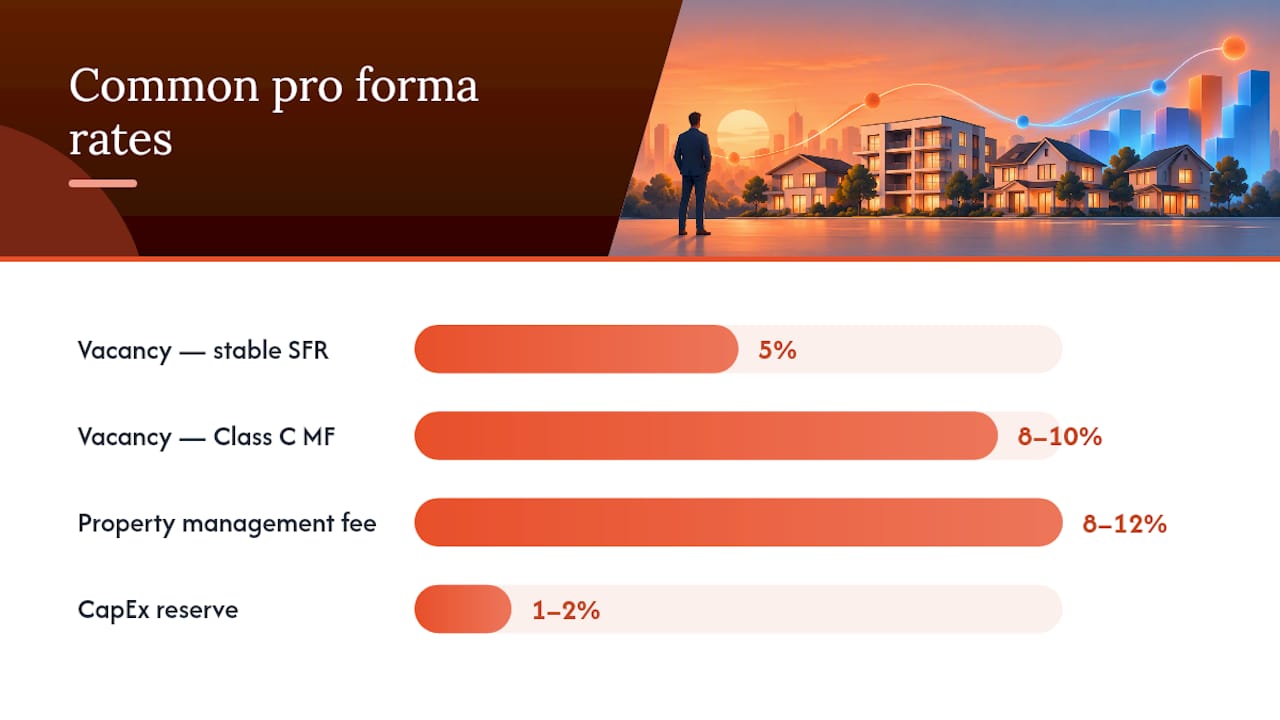
Start with gross potential rent: the total rent you would collect if every unit stayed occupied all year at full market rate. From there, subtract vacancy and credit loss, which covers both empty units and tenants who stop paying. A stabilized single-family rental in a stable market might run a 5% vacancy assumption, while a Class C multifamily property in a softer submarket could realistically need 8% to 10%. Add in other income, things like pet fees, parking, laundry, storage, or short-term rental cleaning fees, and you arrive at effective gross income (EGI). This is the real revenue line, not the wishful one.
Operating expenses come next, and this is where amateur pro formas fall apart fastest. A defensible expense section breaks out:
- Property taxes and insurance (get actual quotes, not last year’s bill)
- Property management fees, typically 8% to 12% of collected rent
- Repairs and maintenance, based on the property’s age and condition
- Utilities the owner covers (common areas, vacant units)
- Landscaping, pest control, and other recurring service contracts
- HOA dues, if applicable
Reserves and capital expenditures deserve their own line, not a buried percentage inside “maintenance.” Roofs, HVAC systems, water heaters, and flooring wear out on predictable schedules, and treating a 1% to 2% CapEx reserve as an explicit line item rather than a rounding error keeps a multi-year model honest instead of artificially rosy.
Financing inputs, loan amount, interest rate, amortization term, and any interest-only period, determine your annual debt service. Pair that with a projection horizon. Most practitioners cap projections at 5 to 10 years, since assumption error compounds quickly beyond that window. A rent growth estimate that is off by half a percentage point barely matters in year two. By year eight, it has warped the entire cash flow picture.
One more distinction matters for anyone analyzing more than a duplex: unit-level rent rolls versus aggregate projections. A four-unit building where three units rent at $1,400 and one sits at $1,050 because of a legacy tenant tells a different story than a flat “$1,300 average” assumption. Unit-level detail catches upside from below-market leases and flags risk from a tenant who might leave the moment you raise rent to market.
NOI, Cap Rate, Cash-on-Cash, IRR, and DSCR: The Formulas That Matter
Every rental pro forma metric answers a different question, and mixing them up leads to bad decisions.
Net Operating Income (NOI) = Effective Gross Income − Operating Expenses (excluding debt service and CapEx reserves in most conventions). NOI is the property’s income-producing power independent of how you financed it, which is exactly why lenders and appraisers anchor to it.
Cap Rate = NOI ÷ Purchase Price (or current market value). Cap rate works best for stabilized properties with steady, predictable cash flow. It breaks down for a property mid-renovation or mid-lease-up, because a single year’s NOI does not reflect where the asset is headed. Freddie Mac’s own appraisal guidance warns against applying a cap rate derived from trailing-12-month income to a forward-looking pro forma NOI, since that mismatch tends to produce an inflated valuation.
Cash-on-Cash Return = Annual Pre-Tax Cash Flow ÷ Total Cash Invested. This is the metric most individual investors actually care about, because it measures return on the actual dollars out of your pocket, down payment, closing costs, and initial renovation, not the total asset value.
IRR (Internal Rate of Return) accounts for the timing and size of cash flows across the entire hold period, including a sale or refinance at the end. IRR fits non-stabilized properties far better than a single-year cap rate, because lease-up periods and renovation timelines create lumpy, irregular cash flows that a snapshot metric can’t capture.
DSCR (Debt Service Coverage Ratio) = NOI ÷ Annual Debt Service.
DSCR benchmark: A ratio of 1.0 means income exactly covers the mortgage payment with nothing left over. Lenders commonly require a minimum DSCR of 1.2 to 1.3 to build in a margin of safety against vacancy spikes or unexpected repairs.
Use cap rate to sanity-check a purchase price against the local market. Use cash-on-cash to compare deals against your own capital constraints. Use IRR when a sale, refinance, or major renovation changes the cash flow shape over time. Check DSCR every time you’re borrowing money, because your lender certainly will.
How to Build a 5-Year Rental Pro Forma Step by Step
You don’t need commercial-grade software to build a rigorous pro forma. A spreadsheet, a calculator, and a disciplined sequence of steps will get you there.
-
Anchor your Year 1 assumptions. Pull actual comparable rents for the specific unit mix, not a citywide average. Confirm property tax based on the post-sale reassessed value where applicable, since many counties reassess on transfer. Get real insurance quotes rather than estimating.
-
Choose your projection length. Five years suit most buy-and-hold single-family and small multifamily analysis. Ten years makes sense for larger multifamily deals where a lender or partner wants to see a longer hold thesis, but longer horizons compound assumption error, so don’t stretch past what your assumptions can actually support.
-
Model rent growth. Apply an annual rent growth rate, commonly 2% to 4% depending on market, to gross potential rent each year. Don’t apply the same growth rate to every line item uniformly; rent, taxes, and insurance rarely move in lockstep.
-
Model vacancy and credit loss. Keep this consistent as a percentage of gross potential rent unless you have a specific reason to change it, like a planned renovation that will take units offline temporarily.
-
Add other income streams and apply a separate, usually more conservative, growth assumption since fee income doesn’t always track rent inflation.
-
Calculate Effective Gross Income (EGI) for each year: gross potential rent, minus vacancy/credit loss, plus other income.
-
Inflate operating expenses separately from rent growth. Property taxes often jump after a sale due to reassessment, then grow more slowly. Insurance has been climbing faster than general inflation in many markets. A flat 3% expense inflation assumption across the board is a common simplification, but stress-test it against your specific market.
-
Calculate NOI each year: EGI minus operating expenses (excluding debt service and CapEx).
-
Subtract annual debt service (fixed if you have a fixed-rate loan) to get pre-reserve cash flow.
-
Subtract your CapEx reserve to get final annual cash flow, the number that actually lands in your account.
-
Add an optional terminal value in Year 5 if you’re calculating IRR. Apply an exit cap rate to your projected Year 6 NOI to estimate a sale price, subtract estimated selling costs and remaining loan balance, and add that net proceeds figure to your final year’s cash flow before running the IRR function.
Pro Tip: Build your spreadsheet with assumptions in a separate input block at the top, rent growth, vacancy rate, expense inflation, exit cap rate, and reference those cells in every formula below. When a lender or partner asks “what if vacancy hits 12%,” you change one cell instead of rebuilding the model.
A Worked Example: Five Years of Numbers on a Single-Family Rental
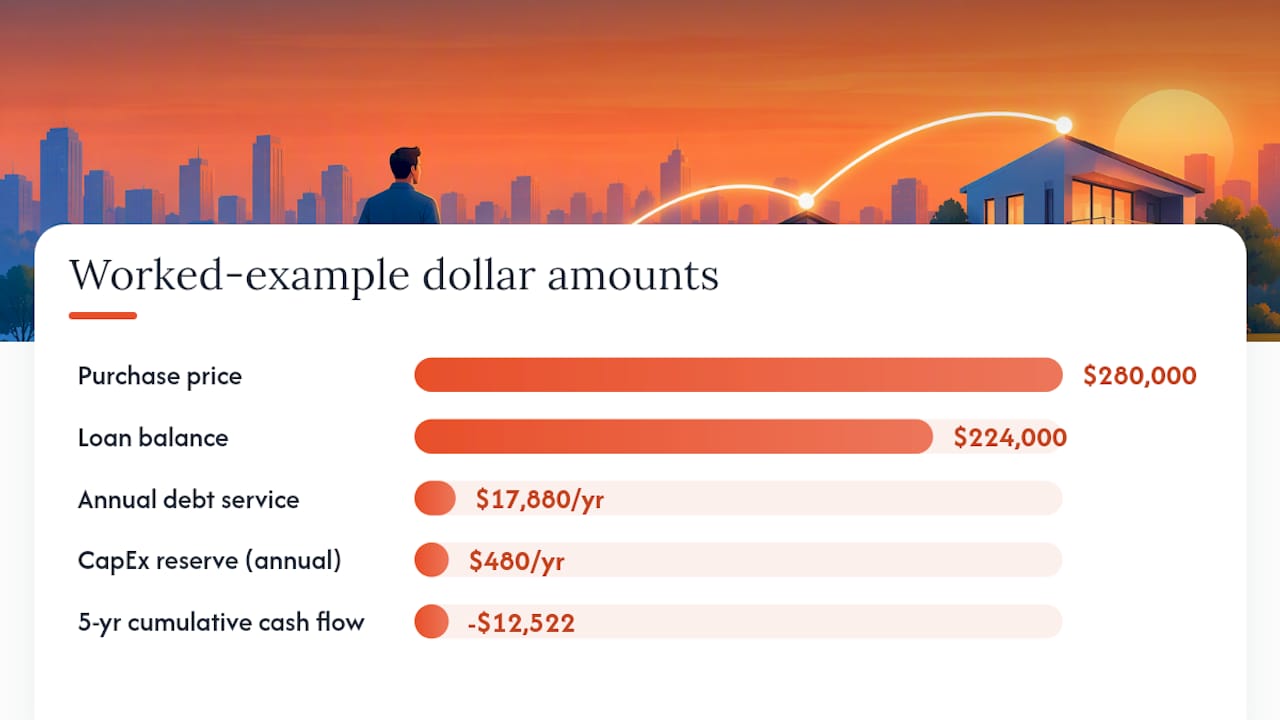
Numbers make this concrete. Take a single-family rental purchased for $280,000 with a $224,000 loan at 7% interest, 30-year amortization, meaning annual debt service runs about $17,880.
A 2% CapEx reserve on gross rent adds $480.
Cumulative five-year cash flow lands at roughly negative $12,522, a property fighting negative leverage from a high purchase price relative to rent. This isn’t a failure of the model. It’s exactly what a pro forma is supposed to reveal before you close, not after.
Year 1 DSCR here is $14,960 ÷ $17,880 = 0.84, well below the 1.2 to 1.3 threshold most lenders want to see. That single number should stop this deal at the underwriting stage, or force a renegotiation of price, or a larger down payment to shrink the loan.
Run the sensitivity checks before you trust any of this:
- Raise rent growth from 3% to 5% and cash flow improves modestly by Year 5, but doesn’t fix a Year 1 DSCR problem.
- Push vacancy from 6% to 10% and Year 1 cash flow drops further, into deeper negative territory.
- Bump expense inflation from 3% to 5% and the five-year cumulative loss widens by several hundred dollars.
Breakeven occupancy, the vacancy rate at which cash flow hits zero, sits well below what this deal’s Year 1 numbers assume, another signal that the purchase price needs to come down or the down payment needs to go up.
Choosing the Right Tool: Spreadsheets, Calculators, or Software
A basic spreadsheet handles the vast majority of single-family and small multifamily analysis just fine. If you’re evaluating one to three properties a year, templates built around property info, loan info, assumptions, and output metrics like NOI and cash-on-cash cover everything you need without a monthly subscription.
Web-based calculators speed up quick screening when you’re comparing a dozen listings and need a fast go/no-go signal, but most strip out the customization a spreadsheet allows, like unit-level rent rolls or a custom CapEx schedule tied to a property’s actual roof age.
Dedicated rental analysis software earns its cost when you’re managing a portfolio across multiple markets, need to share live models with partners or lenders, or want automated market rent comps pulled in rather than manually researched.
Before trusting any template, run this checklist:
- Does it separate CapEx reserves from operating expenses, or bury them together?
- Can you input unit-level rent rolls, not just an averaged monthly figure?
- Does it calculate DSCR automatically, or only NOI and cap rate?
- Can you adjust rent growth and expense inflation independently, year by year?
- Does it support a terminal value calculation for IRR, if you need multi-year return analysis?
Adapting a template across property types matters too. Short-term rentals need seasonal revenue curves instead of flat monthly rent, plus a separate line for cleaning and platform fees. Single-family models are the simplest version, one unit, one rent roll. Multifamily rental analysis requires unit-by-unit rent rolls, a loss-to-lease calculation comparing current rents to market rents, and often a separate renovation-unit turn schedule if you’re executing a value-add strategy.
What Underwriters Actually Check Before Approving a Loan
Lenders rarely take your pro forma at face value, and understanding their adjustments before you apply saves time and embarrassment.
Fannie Mae defines Underwritten Net Cash Flow as underwritten effective gross income minus underwritten total expenses, a calculation that often differs meaningfully from an investor’s own pro forma. Underwriters typically apply their own vacancy floor regardless of what the seller’s rent roll shows, add a minimum management fee even if you plan to self-manage, and require a specific replacement reserve per unit per year rather than accepting a blanket percentage.
Underwriting benchmark: Most lenders set a minimum DSCR of 1.2 to 1.3, and they stress-test that number against a higher interest rate scenario or a lower rent assumption before issuing final approval.
To reconcile your pro forma with what an underwriter will actually produce:
- Pull three to five comparable rents from the immediate submarket, not a metro-wide average.
- Use the lender’s typical vacancy floor for the property type and market, even if actual current occupancy is higher.
- Document management fees at market rate, even if you or a family member plans to manage the property informally.
- Present replacement reserves as an explicit per-unit annual figure, since HUD’s own review guidance emphasizes documented, reconciled operating assumptions during underwriting.
Common Pro Forma Mistakes and How to Stress-Test Your Numbers
Most flawed pro formas share the same handful of errors, and every one of them is avoidable.
- Using a blanket expense ratio. Applying “50% of rent goes to expenses” across every property ignores real differences in age, taxes, and insurance costs between markets. Pull actual bills and quotes instead.
- Skipping the comparable-property check. Broker-supplied pro formas run optimistic more often than not; rebuild the rent and expense assumptions from your own local data rather than trusting the seller’s numbers.
- Underestimating CapEx and turn costs. A vacant-unit turn, paint, cleaning, minor repairs, lost rent during the vacancy, commonly runs several hundred to a few thousand dollars per unit. Model it explicitly, not as a rounding error inside maintenance.
- Skipping downside scenarios entirely. Sensitivity tables that flex one to three variables at a time reveal model risk faster than any other single exercise, especially for a partner or lender deciding whether to say yes.
Pro Tip: Always calculate and report your breakeven occupancy rate and your DSCR at the lender’s maximum allowable payment, not just at your projected rate. If a small rate increase or occupancy dip breaks the deal, you want to know that before closing, not after.
How Auben Realty Puts Pro Formas to Work
A pro forma on a screen is a projection. Turning it into rent collected and expenses controlled is operational work, and that’s where the numbers meet reality.
Property management teams take a pro forma’s assumptions and layer in the details a spreadsheet can’t see on its own: the actual condition of a roof that changes the CapEx timeline, a submarket’s real leasing velocity that adjusts the vacancy assumption, and the renovation sequencing that determines whether a value-add unit comes back online in month two or month five.
In practice, that means:
- Reconciling projected management fees against actual local market rates before a client finalizes a purchase decision
- Scheduling renovation and turn work against the pro forma’s assumed downtime, so a projected two-week vacancy doesn’t quietly become six weeks
- Feeding real leasing and turnover data back into future projections, so year two’s assumptions get sharper instead of staying static
Across the markets where property management firms operate, this feedback loop between the model and the property is what keeps a pro forma from becoming a document nobody looks at again after closing.
The Real Value of a Pro Forma Isn’t the Model
Most guides on this topic treat the pro forma as the finish line: build the spreadsheet, hit calculate, done. That’s backwards. The spreadsheet is the easy part. The discipline is in refusing to accept optimistic inputs, especially rent and vacancy assumptions handed to you by a seller or listing agent with an obvious incentive to make the deal look good.
Where conventional advice falls short is the emphasis on precision over honesty. A pro forma with formulas accurate to the penny built on a fantasy rent roll is worse than a rough estimate built on real comps, because the false precision makes bad assumptions feel trustworthy. DSCR is the number that cuts through that fog fastest. It’s blunt, lenders check it regardless of how good your narrative sounds, and it doesn’t care how much you want the deal to work.
If you take one thing from this guide, prioritize the stress test over the base case. Run the downside scenario before you fall in love with the upside one.
— MediaBeast
Let Auben Realty Turn Your Pro Forma Into a Working Plan
Building the model is step one. Executing against it, keeping vacancy near your projection, controlling turn costs, timing renovations so they don’t blow past the schedule, is where most investors actually lose ground on their numbers. This gap can be closed by managing the property against the same assumptions modeled, not a generic playbook.

Our teams work from your pro forma’s actual line items: the management fee assumption becomes a real management agreement, the CapEx reserve becomes a scheduled renovation plan through project management, and the rent growth assumption gets tested against real local leasing data every renewal cycle. For investors building a portfolio rather than a single property, asset management turns those year-by-year projections into ongoing performance reporting you can actually act on.
If you want a second set of eyes on your numbers before you commit capital, request a free rental analysis and see how your assumptions hold up against real market data in your area.
Sources
- Making It Pencil: The Math Behind Housing Development (Terner Center)
- Rental Property Pro Forma (Spot Check Tools)
FAQ
What Is a Rental Pro Forma?
A rental pro forma is a forward-looking projection of a property’s income and expenses, used to estimate NOI, cash flow, and metrics like DSCR and cash-on-cash return before you buy, refinance, or renovate. It differs from a historical financial statement because it models future assumptions, not just past performance.
What Is the 2% Rule for Rentals?
It’s a quick filter, not a substitute for a full pro forma, since it ignores financing costs, taxes, and actual operating expenses entirely.
What Is an Example of a Pro Forma?
A basic example projects gross rent, subtracts vacancy loss and operating expenses to reach NOI, then subtracts debt service to arrive at annual cash flow, typically laid out year by year across a 5 to 10 year horizon. The worked walkthrough above shows this full calculation with real dollar figures across five years.
What Is the 7% Rule for Rental Property?
Treat any rule-of-thumb percentage as a rough screening heuristic only, and confirm actual returns with a full pro forma using real local rent, expense, and financing figures.