Owners: Use 1%–4% and a 5 Step Plan for Property Maintenance Budgeting
September 24, 2026
The single most useful step you can take today is opening a dedicated savings account and setting an automated monthly transfer into it, even a small one. Everything else in property maintenance budgeting builds from that foundation.
TL;DR:
- Budget at least 1% to 2% of your home’s value annually, adjusting for age, climate exposure, and whether the property is rental or owner-occupied.
- Separate your maintenance funds into routine upkeep, large-system replacements, and emergency reserves to prevent confusion and ensure timely repairs.
- Create a replacement schedule for major systems by tracking installation dates and estimating remaining useful life, setting aside annual reserves accordingly.
- Automate monthly transfers into a dedicated savings account just after your mortgage or rent payment clears to avoid diverting funds from other bills.
- Invest in preventive tasks like regular HVAC inspections, gutter cleaning, and roof checks to reduce overall repair costs and prevent costly emergency failures.
Table of Contents
- What Is Property Maintenance Budgeting and Which Rule of Thumb Fits Your Home?
- How Do You Split a Maintenance Budget Into Buckets?
- How Do You Build a Replacement Timeline for Major Systems?
- Steps to Calculate and Automate Your Maintenance Budget
- Which Preventative Maintenance Tasks Actually Save Money?
- How Should You Pay for a Major Repair?
- How Does a Property Manager Actually Run a Maintenance Budget?
- Why Preventive Budgeting Beats Reactive Spending
- Let Auben Realty Handle Your Maintenance Budget for You
- Sources
- FAQ
What Is Property Maintenance Budgeting and Which Rule of Thumb Fits Your Home?
Property maintenance budgeting means setting aside a predictable amount each year to cover both routine upkeep and eventual system replacements, rather than scrambling when a water heater fails. The most cited heuristic comes from Fannie Mae, which pegs routine maintenance spending at 1% to 4% of a home’s value per year, with 1% to 2% as a reasonable floor for a well-maintained property.
Where you land in that range depends on three factors: age, occupancy type, and climate exposure.
- A home under 10 years old with newer systems can often budget closer to 1%.
- A home over 25 years old, or one with an aging roof or original HVAC, should plan for 3% to 4%.
- Rental properties tend to need the higher end because tenant turnover adds wear that owner-occupants don’t generate.
- Homes in humid, coastal, or freeze-thaw climates need extra cushion for moisture and expansion damage.
Run the math on your own property. A $500,000 home at the same rate is $10,000 a year, or roughly $833 a month. Bump either figure up a point if the roof, HVAC, or water heater is past the halfway mark of its expected life.
How Do You Split a Maintenance Budget Into Buckets?
A single lump sum invites confusion about what the money is actually for. Splitting your annual target into three buckets solves that: routine upkeep, capital replacements, and true emergencies.
- Routine covers predictable, recurring costs: filter changes, gutter cleaning, pest control, landscaping.
- Capital/replacement funds big-ticket items you know are coming: roofs, water heaters, HVAC systems, appliances.
- Emergency is a smaller cushion for the genuinely unpredictable, a burst pipe, storm damage, a sudden electrical fault.
Keeping these buckets separate matters more than it sounds. Freddie Mac’s guidance on financial preparedness warns that conflating a maintenance reserve with a personal emergency fund is a common mistake. Once you raid the roof fund to cover a medical bill, you’re back to reactive spending, and the roof still needs replacing on schedule.
How Do You Build a Replacement Timeline for Major Systems?
Every major system in your home is a ticking clock with a known lifespan. Home Depot’s guide to maintenance scheduling recommends treating each one as a tracked asset, not an afterthought you deal with when it breaks.
- List every major system: roof, HVAC, water heater, major appliances, plumbing, electrical panel.
- Record install dates, model numbers, and warranty expiration for each item, pulled from receipts, inspection reports, or the units themselves.
- Estimate remaining useful life using manufacturer specs or standard ranges (asphalt roofs run 20 to 25 years, water heaters 10 to 15, HVAC 15 to 20).
- Divide replacement cost by remaining years to get an annual reserve figure.
Here’s the math in action: a roof replacement costs $12,000 and has 15 years of life left. That’s $800 a year you need to be setting aside just for that one item. Do this for every major system and add the totals. This inventory approach, similar in spirit to the reserve studies condo associations run to fund shared capital projects, turns vague dread about “something breaking eventually” into a specific number you’re already covering.
Steps to Calculate and Automate Your Maintenance Budget
Building the budget is a five-part process, not a guess you write down once and forget.
- Gather your inputs. Pull your property’s assessed value, your last two to three years of actual maintenance spending if you have it, and the annual reserve total from your system inventory.
- Set your annual target. Take the higher of your rule-of-thumb figure (1% to 3% of value) and your inventory-derived total. If the inventory math comes out higher, trust it. It’s built on your actual systems, not an average.
- Open a dedicated account. Keep this separate from checking and separate from your emergency fund. Set an automatic monthly transfer so the money moves before you’re tempted to spend it elsewhere.
- Track spending as you go. A simple spreadsheet works fine. A property management app works better if you own more than one unit. Log every repair, date, and cost against the category it hit.
- Review quarterly, reforecast annually. Check actual spending against your target every three months, and rebuild the full budget once a year as systems age and costs shift.
Freddie Mac’s homeowner maintenance guidance points to the same conclusion from a different angle: owners who plan for big projects early and start saving before they need the money avoid financing repairs at high interest rates.
Pro Tip: Set your automated transfer for the day after your mortgage or rent payment clears, not the first of the month. That way the maintenance fund never competes with a bill that has a hard deadline.
Which Preventative Maintenance Tasks Actually Save Money?
The fastest way to shrink next year’s repair budget is to spend a little now preventing the failures that would otherwise force an emergency fix. The Department of Energy’s guide to home heating and cooling recommends a specific cadence: HVAC inspections every spring for cooling and every fall for heating, monthly filter checks, duct sealing, and correct insulation levels.
- Schedule HVAC tune-ups twice a year, not just when the system stops working.
- Clean gutters in spring and fall to prevent water intrusion at the roofline.
- Inspect the roof after major storms and once a year at minimum.
- Air-seal gaps around windows, doors, and utility penetrations.
- Install programmable thermostats and ENERGY STAR lighting to cut wear on HVAC and reduce utility loads.
Scheduled maintenance can cut heating and cooling costs by roughly 5% to 10%, according to the same Department of Energy guidance, while also reducing the odds of an emergency system failure. That’s a meaningful dent in your routine bucket for the cost of a twice-yearly inspection.
How Should You Pay for a Major Repair?
The bucket the money comes from should match the type of expense. A known, scheduled replacement, like a roof at year 20, draws from your capital reserve. A sudden failure with no warning draws from the emergency fund. Neither should touch your personal savings if you’ve built the reserves correctly.
When reserves fall short, you have real options, each with tradeoffs:
- HELOC: lower interest rates, but ties the loan to your home equity and takes time to set up.
- Personal loan: faster to access, but higher rates than a HELOC.
- Contractor financing: convenient for the specific job, but often the most expensive option long term.
- Insurance claim: appropriate for sudden, covered damage, not for wear-and-tear replacements.
Whichever route you take, get at least three bids before hiring, and stagger large projects across different years when the timing allows it, so you’re never funding two major replacements in the same twelve months.
How Does a Property Manager Actually Run a Maintenance Budget?
Professional property managers don’t budget by guesswork, they run a system. Professional property managers maintain a live inventory of every major system across a property, run preventive schedules by season rather than waiting for a tenant complaint, and vet vendors ahead of time so a repair never starts with a scramble for a contractor.
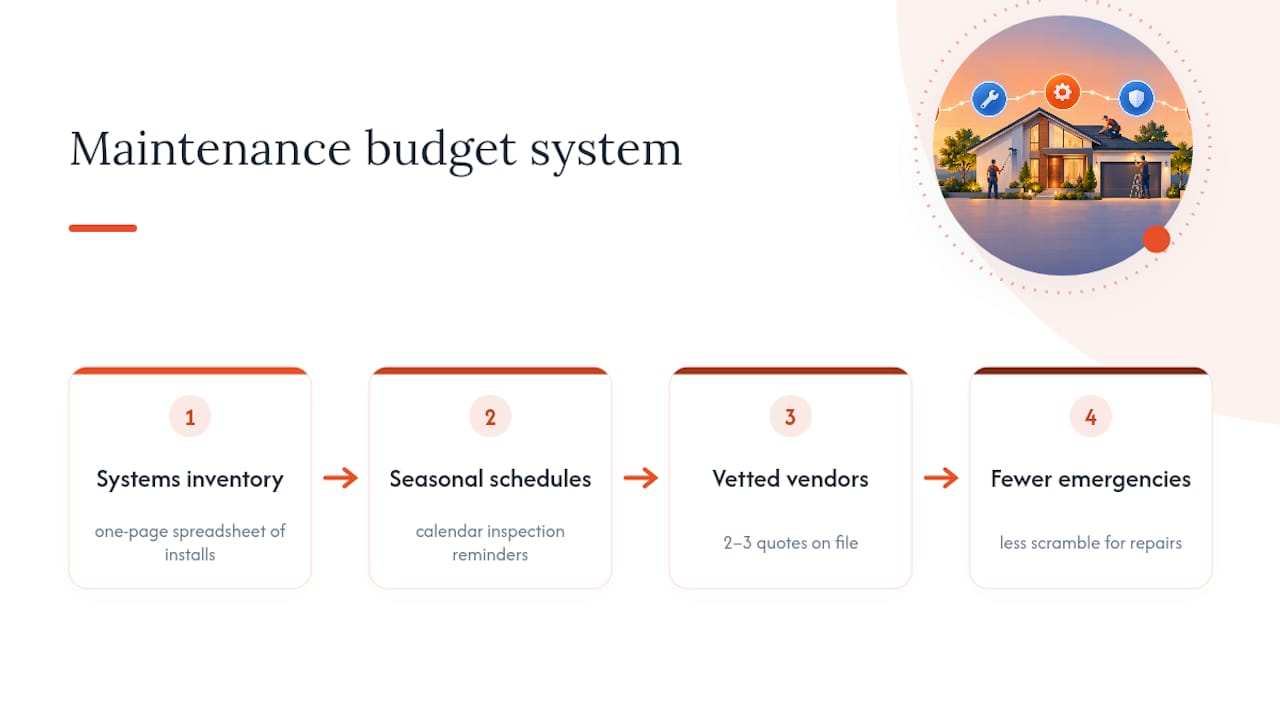
Homeowners can copy the core of this on a smaller scale: build a one-page spreadsheet listing your systems and install dates, set seasonal calendar reminders for inspections, and get two or three vendor quotes on file before you actually need one. A home management plan built around these habits turns maintenance from a source of anxiety into a routine line item.
Why Preventive Budgeting Beats Reactive Spending
Most homeowners learn this the expensive way: skip a $150 HVAC tune-up for three years running, then face a $6,000 system replacement two winters ahead of schedule. The math on prevention almost always wins, but the discipline to fund it before something breaks is where most budgets fail. Owners who track their systems and reserve for them on a planned maintenance schedule rarely face the kind of five-figure surprise that derails a household budget entirely.
— MediaBeast
Let Auben Realty Handle Your Maintenance Budget for You
If you’d rather not track inventories, chase contractor bids, or manage the quarterly review yourself, that’s exactly the gap Auben Realty’s property management service fills. Instead of building your own spreadsheet and calendar reminders, you get a team already running the inventory, vendor vetting, and preventive scheduling described above, on your property, year-round.

For owners planning a bigger renovation or system overhaul rather than routine upkeep, Auben’s project management service oversees the bids, scheduling, and staging so a capital project doesn’t blow through your reserve or drag on for months. If you own multiple properties and want the reserve math handled at a portfolio level, asset management extends the same discipline across every unit you hold.
Consider reaching out to a property management firm to talk through your property and get a maintenance program built around it instead of a spreadsheet you have to remember to update.
Sources
- How to Build Your Maintenance and Repair Budget – Fannie Mae
- Are you financially prepared? — Freddie Mac MyHome blog
- Guide to Home Heating and Cooling — U.S. Department of Energy
- How to create efficient maintenance schedules — The Home Depot
FAQ
What Percentage Should I Budget for Home Maintenance?
Most guidance points to 1% to 4% of your home’s value per year, with 1% to 2% as a reasonable starting point for a newer, well-maintained property. Older homes, rentals, and homes in harsh climates should budget closer to the top of that range.
Should My Maintenance Reserve and Emergency Fund Be the Same Account?
No. Freddie Mac’s guidance recommends keeping them separate because mixing the two leads to either drained repair savings or an underfunded emergency cushion. Each fund needs its own account and its own purpose.
How Do I Estimate the Useful Life of My HVAC System or Roof?
Manufacturer specs give a baseline: roofs typically last 20 to 25 years, HVAC systems 15 to 20, and water heaters 10 to 15. Documenting install dates and model numbers lets you track exactly where each system sits in that range.
Does Auben Realty Help With Maintenance Budgeting?
Yes. Auben Realty’s property management service includes inventory tracking, preventive scheduling, and vendor vetting that support a predictable maintenance budget. Current pricing details are available directly on the Auben Realty site.
How Much Can Preventative Maintenance Actually Save?
Scheduled HVAC maintenance alone can cut heating and cooling costs by roughly 5% to 10%, while also lowering the odds of a sudden, expensive system failure. Simple tasks like filter changes and duct sealing account for most of that savings.