Section 8 Property Management: Owner Playbook to Secure HAP
September 23, 2026
Yes, Section 8 can provide steady, government-backed rent payments for landlords who meet local Public Housing Authority requirements and keep units inspection-ready. Expect paperwork, a formal inspection before move-in, and a rent reasonableness review before your first payment lands. Landlords who treat the PHA as a working partner, rather than a bureaucratic hurdle, see fewer delays and fewer surprises once the lease is active.
TL;DR:
- Local PHAs require thorough paperwork, inspections, and rent reasonableness reviews, which can extend the process to six weeks or more.
- Landlords must continue screening voucher applicants equally and document policies clearly to defend against potential legal challenges.
- Failing to self-inspect units before inspections risks delays and increased repair costs, as unresolved issues can suspend or delay payments.
- Building a strong relationship with your PHA caseworker improves approval speed, reduces errors, and facilitates smoother renewals and payments.
- Regular organization of records, including lease agreements, inspection reports, and communication logs, shortens dispute resolution and contract renewal timelines.
Table of Contents
- What Section 8 Property Management Actually Involves
- Why Landlords Accept Vouchers, and What They Get Wrong
- Passing Inspection: From HQS to NSPIRE
- Working With Your Local PHA: RFTA and Timeline
- Screening, Leases, and Evictions Under Section 8
- The Money Side: HAP Timing, Rent Setting, and Taxes
- Should You Accept Vouchers? A Quick Decision Framework
- How Auben Realty Handles Section 8 Portfolios
- Typical Timelines and What Repairs Actually Cost
- Handling Tenant Disputes and Complaints
- Regulatory Changes and What They Mean for Your Property
- Record-Keeping That Protects You
- Common Challenges and Practical Fixes
- Marketing Your Property to Voucher Holders
- An Owner’s Take on What Actually Works
- Let Auben Realty Handle the PHA Side of Things
- Where to Verify These Rules Yourself
- Sources
- FAQ
What Section 8 Property Management Actually Involves
Section 8, formally the Housing Choice Voucher program, is federally funded through HUD but run locally by roughly 2,200 Public Housing Authorities across the country. You never sign a contract with HUD directly. You sign a Housing Assistance Payments contract with your local PHA, and that agency becomes your point of contact for everything from rent approval to inspections.
Payment splits into two pieces: the PHA covers the Housing Assistance Payment (HAP) portion, and the tenant covers the remainder, usually a portion of their adjusted household income. Once the lease starts, the PHA pays its share directly to you, which is what makes the program attractive to owners tired of chasing rent.
Your obligations under the HAP contract include:
- Maintaining the unit to Housing Quality Standards or NSPIRE inspection criteria for the full lease term
- Submitting required paperwork accurately, including the lease and any addenda the PHA requests
- Notifying the PHA of any change in tenancy, rent, or unit condition
- Never charging the tenant more than the PHA-approved rent amount
Why Landlords Accept Vouchers, and What They Get Wrong
The biggest draw is payment certainty. A guaranteed HAP portion each month reduces the risk of a tenant paying nothing at all, since the subsidized share is not tied to whether the tenant’s job situation changes. Voucher holders also tend to stay put longer than market-rate renters, since moving means reapplying and possibly waiting months for a new inspection. Lower turnover means fewer vacancy gaps and fewer re-leasing costs.
The misconception that trips up new landlords is treating a voucher as a substitute for screening. It is not. A voucher confirms income assistance, nothing about a person’s rental history or reliability as a tenant. Smart practice looks like this:
- Run the same credit, background, and rental history checks you would for any applicant
- Apply identical income and screening thresholds across voucher and non-voucher applicants
- Check state and local source-of-income protection laws before rejecting an applicant based on voucher status
- Verify the voucher amount and bedroom size match your unit before scheduling a walkthrough
Pro Tip: Keep your screening criteria in writing and apply them the same way every time. If a rejected voucher applicant challenges the decision, a documented, consistent policy is your best defense.
Passing Inspection: From HQS to NSPIRE
HUD is in the process of replacing the old Housing Quality Standards inspection with a new system called NSPIRE, which stands for National Standards for the Physical Inspection of Real Estate. Instead of a simple pass or fail, NSPIRE scores deficiencies by severity, meaning a cracked outlet cover and an exposed wiring hazard no longer get treated the same way.
The items that trip up landlords most often:
- Missing or non-functioning smoke and carbon monoxide detectors
- Cracked or missing outlet and switch covers
- Active plumbing leaks under sinks or around water heaters
- Missing GFCI protection near water sources in kitchens and bathrooms
- Peeling paint in units built before 1978, which triggers lead-based paint scrutiny
Self-inspecting against the HUD landlord checklist before the official visit catches most of these issues in an afternoon. A failed inspection does not just delay your first payment. Repeated failures can suspend HAP disbursement entirely until the unit is corrected and reinspected, so a $15 outlet cover and a working smoke detector can be the difference between a payment landing on time and a payment landing weeks late.
Working With Your Local PHA: RFTA and Timeline
Your local PHA is not a passive approval office. It is the entity you will call when something goes wrong, so building a working relationship early pays off. Most PHAs have a landlord portal or listing service where you can advertise available units directly to voucher holders.
Once you have a prospective tenant, you submit a Request for Tenancy Approval (RFTA), which includes the proposed lease terms, rent amount, and unit details. The PHA then evaluates whether your rent is reasonable compared to similar unassisted units in the area, so pulling two or three comparable listings and recent lease data before you submit strengthens your case.
Expect a typical timeline of two to six weeks from RFTA submission to your first HAP payment. Common causes of delay include:
- A failed initial inspection that requires repairs and a second visit
- An incomplete RFTA missing signatures or lease details
- Contract renewal backlogs at PHAs processing high volumes of existing vouchers
- Rent reasonableness disputes when the proposed rent sits well above comparable units
Landlords who attend PHA landlord briefings and keep templates ready for RFTA submissions and inspection responses tend to move through this process faster than those handling it for the first time.
Screening, Leases, and Evictions Under Section 8
Consistency is the rule that protects you legally and operationally. Screen every applicant, voucher or not, against the same credit, criminal history, and prior landlord reference standards. The Philadelphia Housing Authority’s landlord guidance makes clear that participation is voluntary, but once you sign a lease, you cannot collect payments from the tenant above the PHA-approved amount.
Your lease must include the HUD tenancy addendum, which spells out the tenant’s and PHA’s rights and obligations alongside your standard lease terms. Document the unit’s move-in condition thoroughly with photos and a signed checklist. This record becomes critical if a dispute over damages or deposit deductions comes up later.
Eviction works under your state’s normal landlord-tenant law. A voucher does not create special protection against eviction for cause, whether that is nonpayment of the tenant’s portion, lease violations, or property damage. What is different is the paperwork trail:
- Notify the PHA in writing when you begin an eviction action
- Keep timestamped copies of every notice, filing, and court document
- Continue following your state’s required notice periods exactly
- Expect the PHA to stop HAP payments once the tenancy officially ends
The Money Side: HAP Timing, Rent Setting, and Taxes
Direct deposit is the fastest way to receive your HAP payment, and most PHAs offer it. The tenant pays their share separately, usually through the same channels as any other rent payment. When the math does not add up on time, the GAO’s review of HAP payment delays points to contract renewal backlogs and manual processing as the leading causes, not tenant nonpayment.
Mitigating those delays comes down to communication: call your PHA caseworker before a renewal date approaches, confirm your HAP is enrolled for direct deposit, and follow up in writing if a payment is more than a week late.
Setting rent starts with HUD’s Fair Market Rent data, published annually by metro area and bedroom count. Your PHA will compare your proposed rent against that figure and against unassisted comparables nearby.
A few money basics worth locking in:
- HAP counts as rental income on your tax return, same as any other rent collected
- Rent reasonableness reviews go faster when you bring your own comparable listings
- Payment standards vary by PHA, so a rent that clears in one county may not clear in the next
Should You Accept Vouchers? A Quick Decision Framework
Run through this before listing a specific property to voucher holders:
- Check your mortgage exposure. If your loan terms or insurance require a certain rent floor, confirm the PHA’s payment standard covers it comfortably.
- Compare local FMR to your market rent. In some high-demand metros, market rent for a unit can outpace what the PHA will approve, cutting into your margin. In others, the FMR sits close to or above market rent.
- Weigh administrative capacity honestly. Inspections, RFTA submissions, and PHA communication take real time. If you self-manage a handful of units, decide whether you have the bandwidth or need help.
- Balance the tradeoffs. Stable subsidized income and lower vacancy risk come with inspection obligations and paperwork that market-rate leasing does not require.
None of these questions has a universally right answer. A duplex in a tight rental market with a mortgage well below the FMR is a very different calculation than a luxury unit in a market where voucher payment standards lag behind rent.
How Auben Realty Handles Section 8 Portfolios
Auben Realty structures its property management around dedicated pods, small teams responsible for a set of properties rather than a single manager juggling hundreds of units. For Section 8 owners, that means one point of contact who knows your unit’s inspection history, your PHA’s quirks, and your tenant’s lease terms without starting from scratch every call.
In practice, that looks like pre-inspection walkthroughs before the official PHA visit, in-house maintenance crews who can fix common fail items fast, and digital recordkeeping that keeps HAP payment histories and repair invoices organized for disputes or audits. Owners working with a manager should expect proactive rent reasonableness support, meaning someone pulls comparable listings before the PHA asks for them, not after.
Typical Timelines and What Repairs Actually Cost
The two to six week window from RFTA to first payment assumes your unit passes inspection on the first try. When it does not, add another one to three weeks for repairs and a second inspection visit, plus whatever time your PHA takes to reschedule.
Cost depends entirely on what fails. The cheapest fixes, a missing outlet cover, a dead smoke detector battery, a loose handrail, run under $50 and take an afternoon. Mid-range fixes like GFCI outlet installation near sinks or replacing a water heater’s pressure relief valve typically run $150 to $400 per fix depending on your market and whether you hire an electrician or plumber. The expensive category is anything touching lead-based paint in pre-1978 units, where remediation can run into the thousands depending on the scope, or structural issues like a failing roof or foundation crack that NSPIRE inspectors flag as severe.
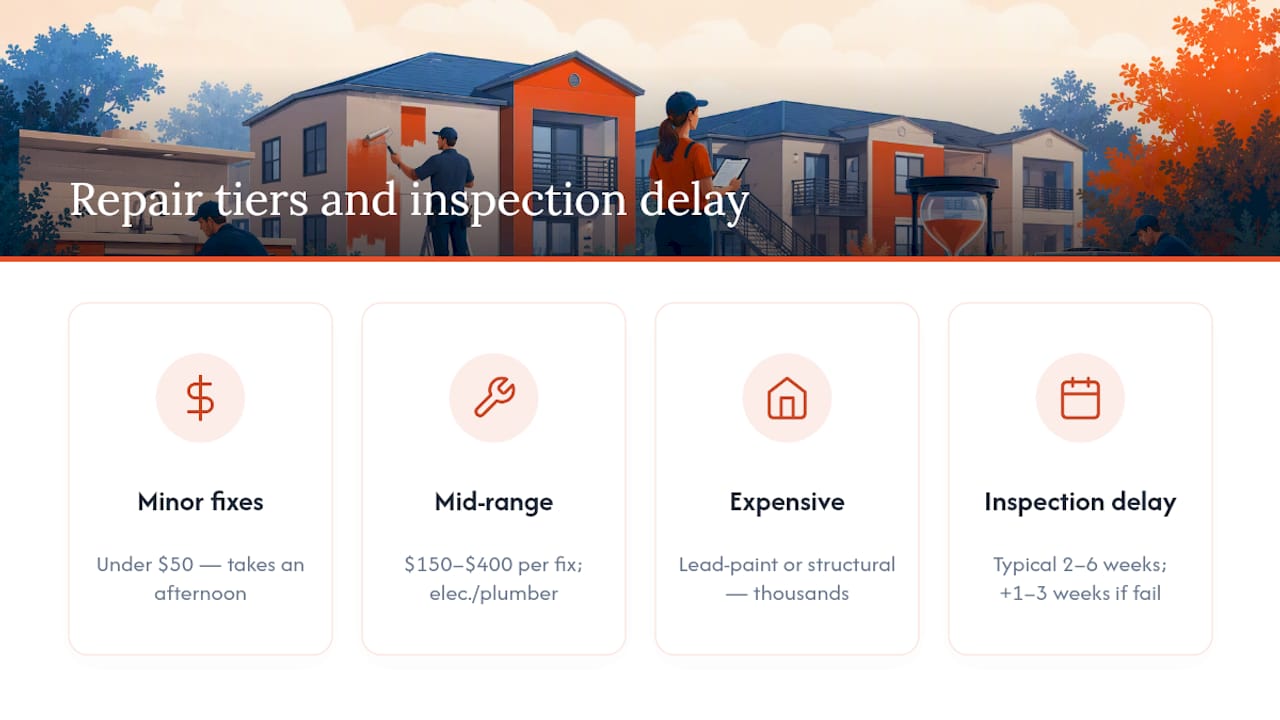
The pattern worth noting: units that pass on the first inspection almost always belong to landlords who self-inspected first. That single hour of prep against a checklist is consistently cheaper than the delay cost of a failed inspection, which can push your first HAP payment back by weeks.
Budget for ongoing maintenance too. NSPIRE inspections happen periodically throughout the lease term, not just at move-in, so a unit that passed last year still needs the same detectors working and the same GFCI outlets intact this year.
Handling Tenant Disputes and Complaints
Most Section 8 disputes fall into three categories: maintenance requests the tenant feels went unaddressed, disagreements over security deposit deductions at move-out, and confusion over who owes what portion of the rent when a HAP payment is late.
The fix for all three starts before the dispute happens. Document the unit’s condition at move-in with photos and a signed checklist, so move-out comparisons have a clear baseline. Respond to maintenance requests in writing, even a simple text confirming you received the request and when you will address it, so there is no ambiguity about response time later.
When a dispute does arise, resolve it in this order:
- Talk to the tenant directly first. Most complaints about maintenance timing or deposit deductions resolve with a clear explanation and a reference to the lease terms.
- Loop in the PHA if the dispute touches HAP payments or inspection compliance. The PHA has its own dispute process for HAP-related disagreements, and involving them early keeps you compliant with program rules.
- Keep every communication in writing. Texts, emails, and portal messages create a record that protects you if the disagreement escalates to a formal complaint or legal action.
- Know your state’s timeline requirements for responding to maintenance requests and returning security deposits, since these vary and Section 8 tenants have the same state-law protections as any other renter.
Complaints that go unresolved tend to end up either with the PHA, which can trigger a re-inspection outside your normal schedule, or with a local housing court. Both cost more time than a five-minute conversation would have.
Regulatory Changes and What They Mean for Your Property
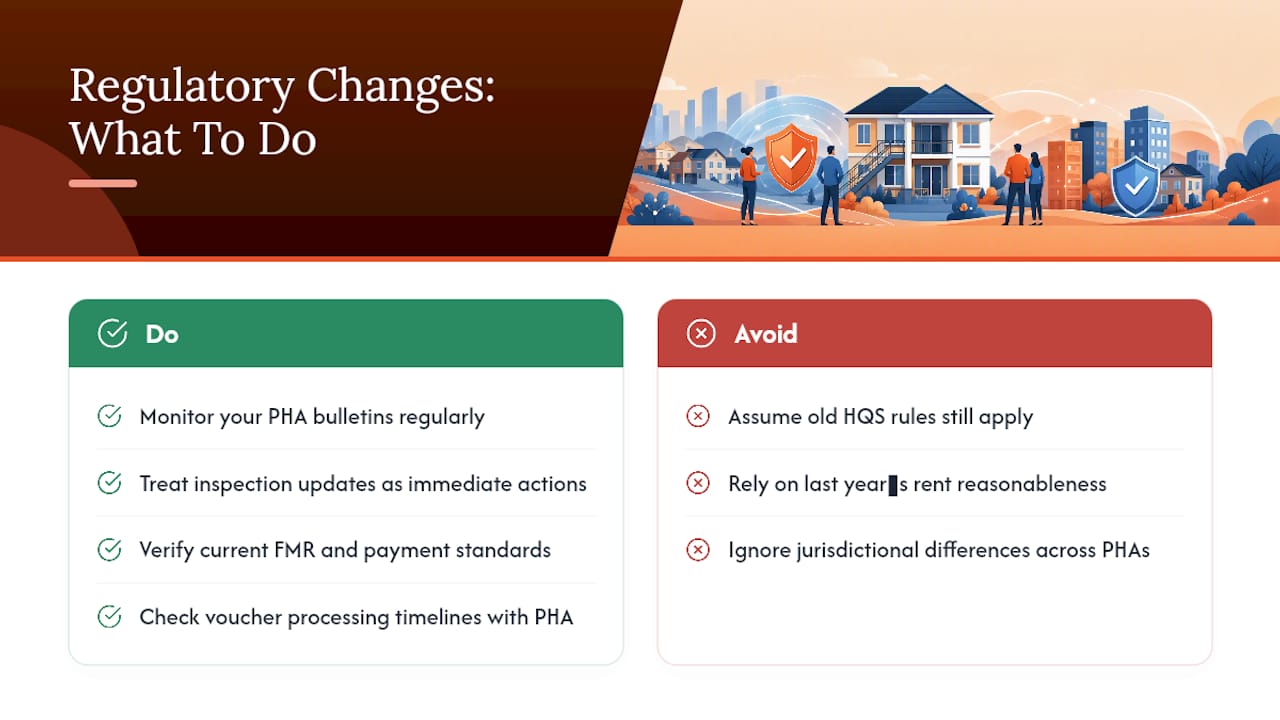
The Housing Choice Voucher program is not static. NSPIRE itself is a recent overhaul, replacing decades of HQS practice with a scored, severity-based inspection model that changed what inspectors look for and how strictly they grade it. Landlords who managed properties under the old HQS rules need to relearn the checklist, not assume the old standards still apply.
PHAs also periodically adjust their Fair Market Rent figures and payment standards, sometimes annually, which directly affects what rent the PHA will approve for your unit. A rent that cleared rent reasonableness last year is not guaranteed to clear this year if your local FMR moved or comparable market rents shifted.
Federal policy discussions about voucher funding levels and program administration surface regularly, and funding changes at the federal level can affect how quickly your PHA processes new vouchers, renews contracts, or issues payments. The GAO’s own reporting on processing delays points to administrative capacity, not just funding, as a recurring bottleneck.
The practical takeaway: do not assume the rules you learned when you first became a Section 8 landlord still apply years later. Check your PHA’s current landlord bulletin or newsletter periodically, and treat any inspection standard update as something to act on immediately rather than something to catch up on at your next scheduled inspection. A landlord managing multiple units across different PHAs faces this multiplied, since payment standards and even inspection scheduling can vary by jurisdiction even within the same state.
Record-Keeping That Protects You
Every HAP payment, every inspection report, every repair invoice, and every piece of correspondence with your PHA should live somewhere organized and searchable, not in a shoebox or a scattered email inbox. Time-stamped digital records resolve disputes faster and support contract renewal timelines, since a PHA processing a renewal wants to see a clean compliance history.
Keep these records at minimum:
- Signed lease and HUD tenancy addendum for every voucher tenant
- Move-in condition photos and signed checklists
- Every inspection report, pass or fail, with the date and inspector’s notes
- HAP payment history showing dates and amounts received
- Repair invoices tied to inspection fail items, showing the fix and the date completed
- Written correspondence with the PHA, including RFTA submissions and any dispute communications
This is not busywork. A landlord who can produce a full paper trail during a contract renewal or a payment dispute resolves the issue in days. A landlord without that trail is stuck reconstructing history from memory while payments sit on hold.
Common Challenges and Practical Fixes
The complaint heard most often from Section 8 landlords is the paperwork volume. Every unit needs an RFTA, every lease needs the tenancy addendum, every inspection needs documentation. The fix is not avoiding the paperwork. It is templating it. Build a standard packet for RFTA submissions once, and reuse it for every new voucher tenant with only the specific unit and tenant details changed.
The second recurring challenge is payment delays tied to contract renewals. Waiting until the last minute to confirm renewal status with your PHA guarantees you find out about a delay after it has already started. Calling thirty to sixty days ahead of a renewal date gives you room to fix any issue before it interrupts payment.
Inspection failures round out the top three challenges, usually from small items landlords assume are fine until an inspector flags them. The fix here is the same self-inspection habit covered earlier: walk the unit against the HUD checklist before every scheduled inspection, not just the first one.
A less discussed challenge is finding qualified applicants quickly enough to avoid vacancy stretching past what the subsidy offsets. Voucher holders often search PHA-run listing portals rather than general rental sites, so a unit only listed on a standard rental platform may sit vacant longer than necessary while eligible applicants never see it.
Marketing Your Property to Voucher Holders
List directly through your PHA’s landlord portal or listing service first. This is where most active voucher holders search, and it puts your unit in front of applicants who are already approved and ready to lease, cutting the usual back-and-forth over eligibility.
Beyond the PHA portal, standard rental listing sites still matter, since not every voucher holder limits their search to PHA channels. Write the listing the same way you would for any tenant: clear photos, accurate square footage, and an honest description of the unit’s condition. Note that the unit accepts vouchers explicitly in the listing text, since some applicants filter search results specifically for that phrase.
Pricing your listing at or near the local Fair Market Rent, rather than significantly above it, speeds up both applicant interest and PHA rent reasonableness approval. A unit priced well above comparable rents sits through a longer approval process even if you eventually find a tenant.
Landlords managing several units sometimes work with a real estate marketing service to keep listings visible across multiple channels at once, which matters more in markets with high voucher demand and fast-moving inventory. Whatever channel you use, respond to inquiries quickly. Voucher holders working against a time-limited voucher often need to secure a unit within a set window, and a slow response can lose you an otherwise qualified tenant.
An Owner’s Take on What Actually Works
The advice that circulates most about Section 8, treat every inspection like a pop quiz and hope for the best, is backwards. The landlords who do well under this program are the ones who front-load the work: self-inspect before the PHA shows up, build a relationship with a specific caseworker rather than calling a general line every time, and keep records organized before a dispute ever forces the issue.
What is overrated is the fear that voucher tenants are riskier than market-rate tenants. The data on payment reliability points the other direction. The subsidized portion of rent is not contingent on a tenant’s job status, and that alone removes a chunk of the risk that causes market-rate landlords sleepless nights. What is underrated is how much a failed first inspection costs in real time, not just repair dollars. A landlord who skips the self-inspection step and fails on the PHA’s first visit can lose three or four weeks waiting for a reinspection slot.
If you take one thing from this article, prioritize the relationship with your PHA caseworker over every other tactic. Everything else, faster payments, smoother renewals, quicker approvals, flows from that single working relationship.
— MediaBeast
Let Auben Realty Handle the PHA Side of Things
Auben Realty gives owners a full-service alternative to handling RFTA submissions, inspection prep, and PHA communication solo. Instead of learning your local PHA’s quirks through trial and error, you get a dedicated team that already knows the inspection checklist, coordinates directly with the housing authority, and reports back on payment status and repair costs without you chasing down answers.

When you request a quote, ask specifically about the manager’s experience with local PHAs, their track record on inspection pass rates, and how transparently they break down fees before work starts. Those three questions separate a manager who understands Section 8 operations from one who is guessing alongside you. Owners with units needing repair work before an inspection can also lean on Auben’s project management services to get fixes done fast and correctly the first time.
Ready to stop managing PHA paperwork on your own? Visit Auben Realty’s property management page to request a quote and see how a dedicated pod can take the inspection prep and HAP coordination off your plate.
Where to Verify These Rules Yourself
Check HUD’s PIH landlord resources and NSPIRE inspection guidance directly, review your local PHA’s landlord page (Philadelphia’s is a solid model), and read GAO’s reporting on HAP payment timeliness for the government’s own account of processing delays.
Sources
- Landlord responsibilities | Philadelphia Housing Authority
- Hud
- GAO-06-57: Housing Assistance Payments
FAQ
How much does Section 8 pay landlords?
The amount varies by unit size, local Fair Market Rent, and the tenant’s income, since the PHA pays a HAP portion directly to the landlord while the tenant covers the rest, typically a portion of their adjusted income. There is no fixed nationwide amount. Check your local PHA’s current payment standard before setting your asking rent.
Who manages Section 8 properties?
Local Public Housing Authorities administer the voucher program and approve rents, inspections, and contracts, while the property owner or a hired property manager handles day-to-day leasing, maintenance, and PHA communication. Many owners work with a full-service manager like Auben Realty to handle inspection prep and PHA coordination directly.
What is happening with Section 8 housing policy right now?
Federal voucher funding and program administration are subject to periodic budget and policy debates, and changes at that level can affect how quickly PHAs process vouchers and renew contracts. Landlords should follow their specific PHA’s bulletins for the most current local rules rather than relying on general news coverage.
Which state has the most Section 8 tenants?
Voucher distribution tracks population and housing costs, with larger states generally administering more vouchers overall through their many local PHAs. Exact rankings shift as HUD funding allocations and local waiting lists change, so check HUD’s own data resources for current figures in your state.
How long does it take to get approved as a Section 8 landlord?
Most landlords see two to six weeks from submitting a Request for Tenancy Approval to receiving the first HAP payment. Failed inspections, incomplete paperwork, or PHA renewal backlogs are the most common causes of delay beyond that window.